
Shopping Cart
There are no more items in your cart
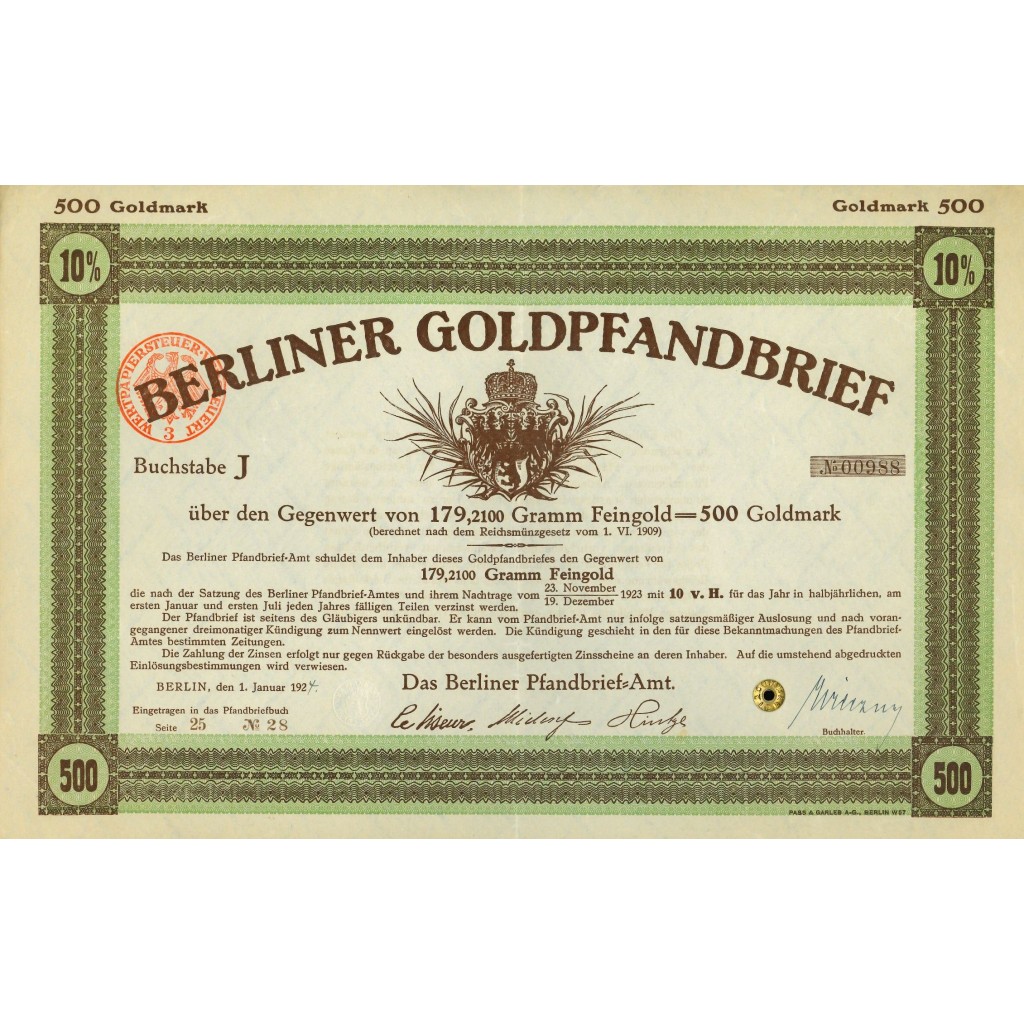


The Berliner Pfandbrief-Amt was a significant financial institution located in Berlin, active during the interwar period. This organization specialized in issuing mortgage-backed bonds known as "Pfandbriefe". These securities were highly valued for their safety and stability as they were backed by real estate assets.
The illustrated document, issued in 1924, represents a bond of 500 Goldmark, equivalent to 179.21 grams of fine gold. Issuances like this were typical of the era, offering an annual interest rate of 10%, payable in two semi-annual installments. Bonds like these were considered safe investments and were used to finance real estate and infrastructure development.
Historical Data of the Company
| Year | Revenue | Year of Establishment | Headquarters | Name at Delisting | Year of Stock Exchange Listing | Year of Stock Exchange Delisting | Year of Dissolution | Initial Capital | Final Capital |
|---|---|---|---|---|---|---|---|---|---|
| ND | ND | ND | Berlin | ND | ND | ND | ND | ND | ND |
Document Characteristics
| Issue | Series | Type of Bond | Interest Rate | Amount in Goldmark | Weight in Grams of Fine Gold | Issue Date | Administrator's Signature | Director's Signature |
|---|---|---|---|---|---|---|---|---|
| ND | Buchst. J | Goldpfandbrief | 10% | 500 | 179.21 | January 1, 1924 | - | - |
Importance of Scripophily
Scripophily, the collection of historical securities, is a captivating hobby that combines a passion for economic history with the aesthetics of historical design. Documents like the Berliner Pfandbrief-Amt bonds are not just pieces of paper; they represent an era and an economic culture. Each security tells a unique story, characterized by elaborate designs and authentic signatures of the executives of the time.
Owning a historical document such as a 1924 mortgage bond means possessing a fragment of history, a piece of art, and a symbol of economic trust. Scripophily collectors value these documents not only for their aesthetic appeal but also for their historical significance and their contribution to understanding global financial history.
All historical documents for sale are considered collectibles. The documents have no economic or financial value, and the second image is only representative of the referenced company's object.