
Shopping Cart
There are no more items in your cart
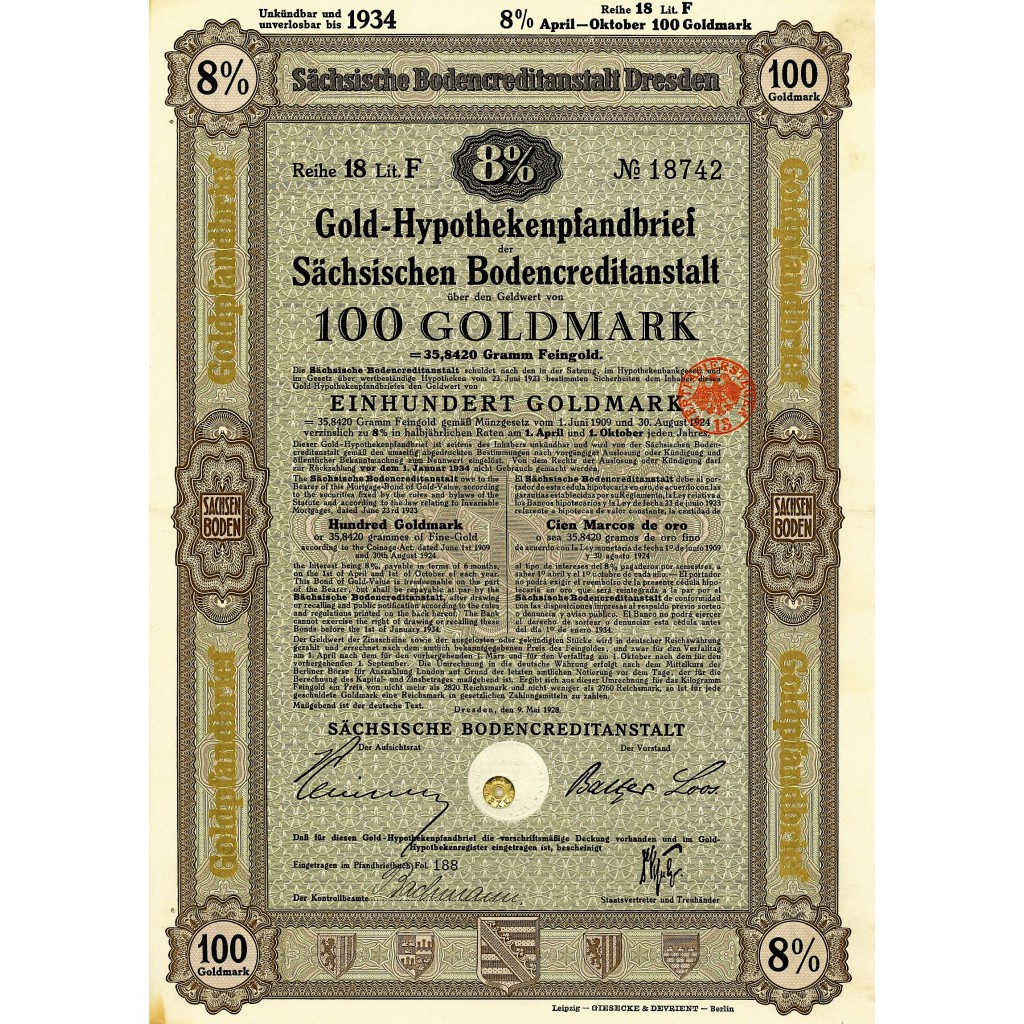


The Sächsische Bodenkreditanstalt, based in Dresden, was a significant financial institution in Germany during the 1920s and 1930s. Established on January 15, 1927, the bank specialized in issuing mortgage bonds, offering loans secured by mortgages on landed property. The document in question is a "Gold-Hypothekenpfandbrief" issued in 1928 with a nominal value of 100 Goldmark and an interest rate of 8%, representing a safe and solid investment for savers of the time.
Historical Data of Sächsische Bodenkreditanstalt
| Year | Revenue | Initial Share Capital | Final Share Capital | Year of Establishment | Headquarters | Name at Delisting | Year of Listing | Year of Delisting | Year of Dissolution |
|---|---|---|---|---|---|---|---|---|---|
| 1927 | ND | ND | ND | 1927 | Dresden | Sächsische Bodenkreditanstalt | ND | ND | ND |
Document Features
| Issue Date | Interest Rate | Nominal Value | Maturity | Zinssatz |
|---|---|---|---|---|
| May 9, 1928 | 8% | 100 Goldmark | 1934 | 8% |
Scripophily, the collection of historical financial documents such as stocks and bonds, represents a fascinating window into the economic and financial past. Each document tells a unique story, reflecting the historical context, business practices, and financial structures of its time. Owning a historical document like this not only adds value to one’s collection but also offers a tangible link to the past, a piece of economic and cultural history. Collectors appreciate these pieces not only for their rarity and aesthetic beauty but also for the historical significance and the evolution of financial practices they represent.
All historical documents for sale are intended for collection purposes. The documents have no economic or financial value (no economic or financial value), the second image is only representative of the company's object.