Shopping Cart
There are no more items in your cart
Establishment of the Association of Banks
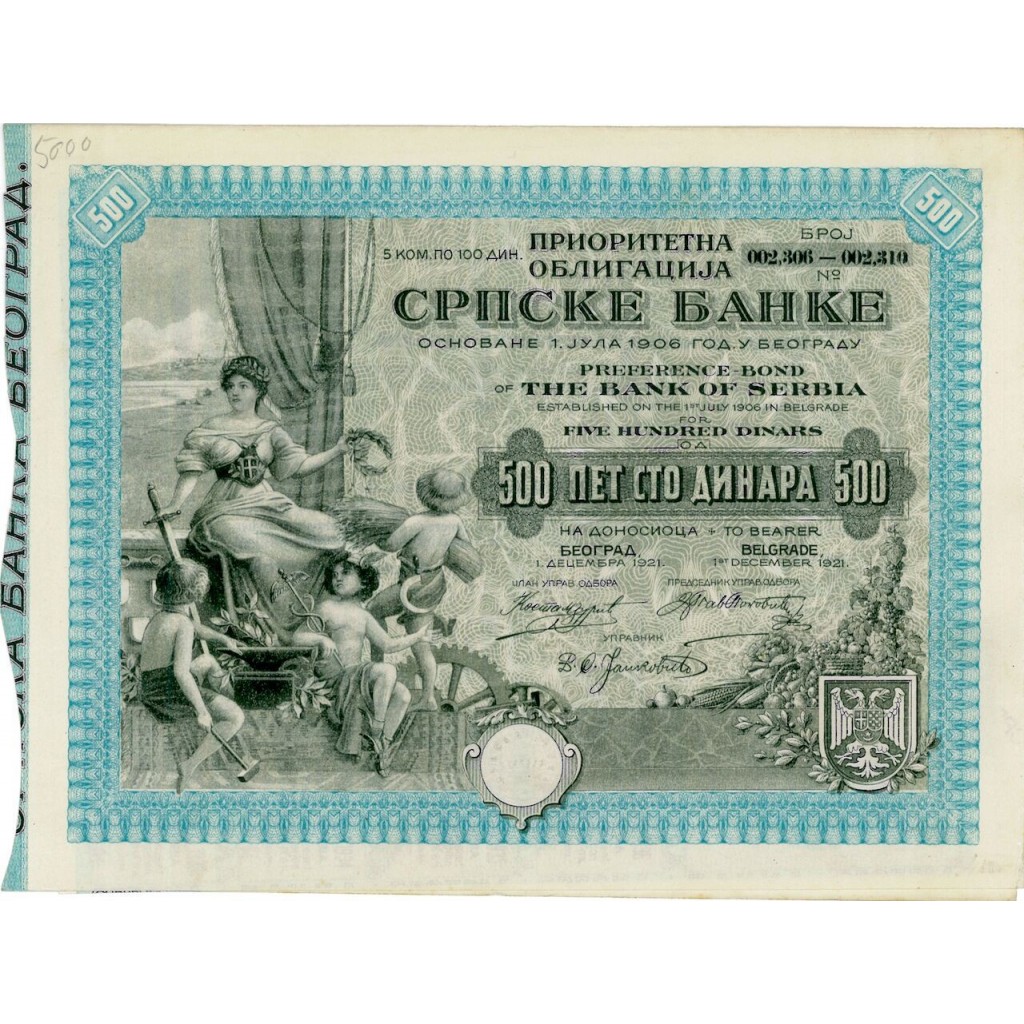
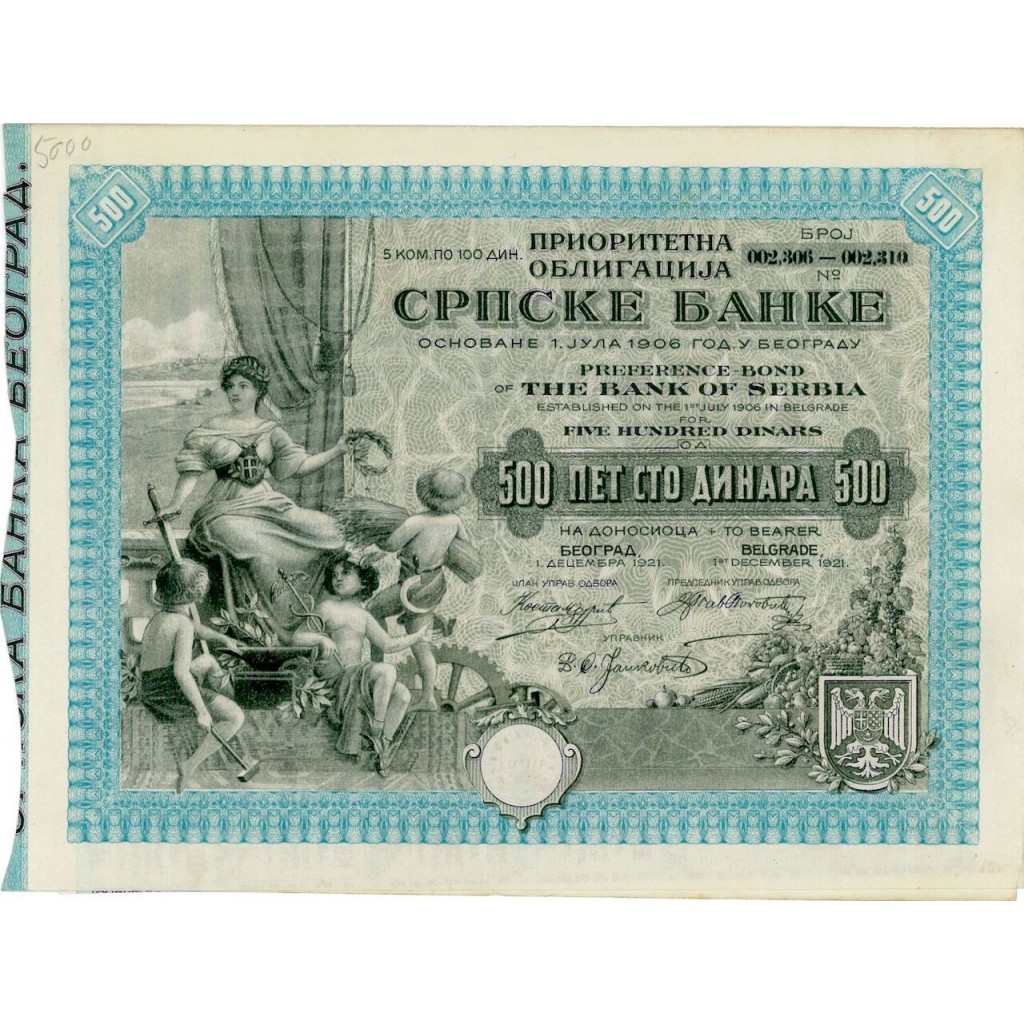
The founding session of the Association’s Assembly was held on December 4th 1921, in Prometna Banka in Belgrade. The Association of Banks was established by the following 39 monetary institutes: Opšta Privredna Banka, Francusko Srpska Banka, Prometna Banka, Jugoslovenska Banka A.D., Belgrade subsidiary, Izvozna Banka, Beogradska Trgovačka Banka, Prva Hrvatska Štedionica, major subsidiary in Serbia, Belgrade, Zemaljska Banka, Eskontna Banka, Srpska Banka, Kolonijalna Banka, Balkanska Kreditna Banka, Građanska Banka, Banka Slavija, Bankarsko i Trgovačko Deoničarsko Društvo, Jugoslovenska Trgovačka Banka, Vračarska Štedionica, Udeonička Zadruga A.D., Poslovna Banka A.D., Engleska Trgovinska Banka, Beogradska Založna Banka, Dunavski Kreditni Zavod, Slovenska Banka d.d. Zagreb, Belgrade subsidiary, Opšta Trgovinska Banka, Beogradska Trgovačka Štedionica, Dunavska banka, Beogradski Kreditni Zavod, Banka Nikola Bošković A.D., Podunavsko Trgovačko Akcionarsko Društvo, Centralna Banka, Beogradska Banka "Merkur", Građanska Štedionica, Zanatlijska Kreditna Banka, Srpsko Švajcarska Banka, Beogradska Banka, Mesarska Banka, Industrijska Banka A.D., Saobraćajna Banka, and Palilulska Banka.
At the Assembly session the Rules of the Association of Banks were adopted, 18 members of the Board of Directors were elected, along with 5 members of the Supervisory and 5 members of the Executive Board. The Rules defined the main mission of the Association: “The mission of the Association is to launch initiatives with the competent authorities in respect of the issues of general importance and common interest for the monetary institutes, to represent the Association of Banks as an entity before the authorities and in various commissions and delegations, to deal with all important issues in the field of economy and finance in its magazine, and to establish common institutions if the need arises, with a view to the best possible protection of its interests. A member of the Association can be every monetary institution…”
The idea about the establishment of the Association that will represent the interests of banks and other financial organizations was not a new one. The need for the existence of such a banking association that would legally represent all banks and take the necessary steps on their behalf in order to protect their mutual interests, such as the issues on regulating moratoriums, taxes, FX transactions, interest rates, loans, credit policy, etc. was present before. Due to their special interests and the particular position of banks in the economic life of the country at that time, the representatives of the monetary institutes launched the negotiations on the establishment of the Association of Banks. In May 1921 the representatives of 15 monetary institutes prepared the Draft of the Statue that was definitely adopted by 17 banks in October 1921. The Rules of the Association of Banks were then signed by 39 monetary institutes, and confirmed by the decision of the Minister of Trade and Industry, Mehmed Spaho, on November 17th 1921. Following this solution they started working on the organization of the founding Assembly session, held on December 4th 1921.
The First Ten Years of Operations
In the first ten years of its operations the Association of Banks achieved tangible results and enjoyed considerable respect of the monetary institutes. Already in the second years of its operation the Association had 131 members. In that year the Association was active in introducing more freedoms into the stock exchange operations, and laying a sound foundation for FX policy. In the same year, 1922, on several occasions, the Association performed its duty protecting its members, asking for more attention to be paid to their interests, which were jeopardized because of the restrictive FX policy. In relation to this, but also in relation to some other operations, the Association was in constant communication with the National Bank, sometimes harshly criticizing some of its decisions and behaviour. The Ministry of Finance and the Chamber of Commerce often approached the Association for cooperation, opinion, or the data on certain banks. The Association was also in communication with other similar professional institutions in the country and abroad, such as the League of Monetary and Insurance Institutions in Zagreb, the Association of Banking Organizations of Slovenia, the League of Czechoslovakian Banks from Prague, etc. During the 1920s on several occasions the Association of Banks from Belgrade attended meetings with similar associations, discussing numerous topics of mutual interest.
In 1923 the Association was actively engaged in preparing modifications and amendments to certain laws in the field of finance, such as the Law on Taxes and Law on Direct Taxes. The National Bank was asked to modify the Decision abolishing credit facilities to all monetary institutes whose paid-in capital is less than 3 million dinars. This, above all, affected monetary institutes in the former Kingdom of Serbia, which were, before the war, in possession of capital in golden dinars, but severely suffered from the wartime hardship. Their recovery was slow and difficult, because the Liquidation Bank was sluggish, especially in respect of the repayment of pre-war claims. This proposal to the National Bank, despite the numerous interventions and written requests, failed to yield any results.
In 1925 monetary institutes were a system full of uncertainties, as was emphasized in the annual report of the Association of Banks for that year. Dinar had the certain stability in relation to foreign currencies, yet its purchasing power did not increase. The monetary institutes operating with borrowed funds had to be rather cautious when extending loans, because each placement of funds entailed risks.
This concern of the monetary institutes becomes increasingly prominent, thus the idea dating back from 1924 about one institution that would provide data on debtors or credit applicants to monetary institutes finally gets implemented. In 1928 the Association prepared the Draft of the Decree on Establishment of Credit Intelligence Department, which was met with undivided approval and confidence. The final version of the Decree and the way of organization of this Credit Department, the forerunner of the present Credit Bureau, were defined in cooperation with the National Bank. The Credit Intelligence Department started operating within the National Bank on February 28th 1929.
Awards at the Tenth Anniversary of the Association
The tenth anniversary of the Association of Banks was celebrated on November 30th 1930 in the conference room of the Belgrade Stock Exchange. The session was attended by numerous representatives of banks and other financial organizations – members of the Association and various guests. The session was attended by: Mr Demetrovic, Minister of Trade and Industry, Mr Sverljuga, Minister of Finance, representatives of the Government, National Bank, Chamber of Commerce, Belgrade Stock Exchange, Association of Exporters, Chamber of Industry, etc. On this occasion, Minister Juraj Demetrovic pointed out that the Association took the initiative in many issues of general economic significance, and that he expected its assistance and cooperation in the future, too, in particular, in respect of the consolidation of economic relations and adoption of laws in the field of economic legislation. At the end of his address, Mr Demetrovic read out the Decree whereby HRH King Alexander honoured the numerous members of the Board of Directors, Supervisory and Executive Board, including Mr Lujo Mor, Secretary General of the Association of Banks.
In 1932 the number of the Association of Banks’ members hit the record high of 202. In the same year the Association was actively engaged in the preparation of the Law on the Protection of Farmers’ Rights, amendments to the Law on the National Bank of Yugoslavia, Law on the Conversion of Agricultural Debts, etc. At the Assembly session, the Secretary General Lujo Mor spoke about 1934 and the operations of the Association of Banks, pointing out, among other things, that it is wrong to believe that a decree on the protection of monetary institutes and their investors can be a remedy for a bank crisis. The recovery process needs to be two-facet: the first part should include the new necessary legal measures with a view to establishing a stricter organization in banking, and the second should include the measures for the revival of the monetary institutes’ operations in favour of the economy. In that year there were 620 monetary institutes overall, 105 of which asked for various kinds of protections, 170 for payment postponement, and 10 for rehabilitation.
In 1940 money market was liquid and influenced by inflation. The huge state debts with the National Bank caused an enormous increase of banknotes in circulation. At the Assembly session of the Association of Banks, held on April 26th 1941, this phenomenon was criticized, and the bankers pointed out that although they understand the time in which they live, and the fact that the state has its extraordinary needs, those needs should not have been financed in the worst possible way – by incurring state debts with the National Bank, thus creating inflation. What triggered most controversies and objections that year, both among the bankers and at the Association of Banks, was the Decree on Modifications and Amendments to the Law on the National Bank of the Kingdom of Yugoslavia, adopted in September 1940. This Decree was interpreted as the intention to conduct etatization of the National Bank. The Association of Banks called it ‘hermaphroditism in legal terms’. The criticism was directed at the provisions of the Decree denying shareholders’ rights and breaking the contract between the state and shareholders. Thus the Minister of Finance, on behalf of the state, became omnipotent in the National Bank, his omnipotence being the actual etatization.
The Report on the Association of Banks’ Operations for 1940 was the last to be considered and adopted at the Assembly session 20 days after the bombing of Belgrade, on April 6th, 1941. The activities of the Association of Banks were disrupted by war and years after the war ended, the Association was re-established.
Yugoslav Banking after the Second World War
Following the Second World War the banking sector went through several development stages. The first of those stages, from 1944 till 1946, is significant because the then government launched the formation of the so-called socialist banking, first gaining the control over and then liquidating the private banking system of the former Yugoslavia. The new federal bank was established – the Industrial Bank of Yugoslavia. Other state banks started to be opened, too. Towards the end of this first stage there were seven federal banks: National Bank of the FNRY, Industrial Bank of Yugoslavia, Postal Savings Bank, Trade Bank of the FNRY, State Investment Bank, Associated Agricultural Bank, and Yugoslav Export and Credit bank. There were also six republic banks and 59 local banks, 22 out of which were located in Serbia.
The second stage, which lasted from 1946 till 1948, was characterized by the banks’ mergers which considerably simplified our banking system. Towards the end of 1947 all banks were merged into the single National Bank and Investment Bank, but apart from those there were also 59 local banks, i.e. municipal savings banks.
It was in the third stage, from 1948 until 1952, that the two new types of banks were created: state banks for crediting agricultural cooperatives, and communal banks. The fourth stage lasted from 1952 until 1954. The Decree passed in 1952 prescribed the merger of the State Investment Bank of the FNRY and the state banks for the financing of agricultural cooperatives, whereas communal banks were abolished. The National Bank of the FNRY remained the only bank in the country with 463 branches. In the fifth stage (1954 – 1961) the crediting function of the banking system was decentralized and specialized. The new credit organizations were introduced, such as communal banks, city and cooperative savings institutions. The National Bank was again the central bank of the country.
Communal and savings banks, as independent banking organization, realized from the very beginning of their operations that they were only a part of the single credit-monetary system of the country. They understood the need for mutual symposia for the exchange of practical experiences and providing suggestions in respect of the adoption of new laws and regulations regulating the banking system of Yugoslavia. One of these symposia, held in Slovenia in the autumn 1954, marked the beginning of the future activities of the Association of Banks. The discussion at this symposium covered the promotion of savings and development of savings institutions.
League of Communal and Savings Banks – Forerunner of the Association of Banks
After several symposia in 1955 and 1956, the representatives of communal and savings banks finally reached a decision at the Assembly session in Sarajevo, on May 9th and 10th 1956, about the establishment of the League of Communal and Savings Banks of the FNRY, the forerunner of the Association of Banks or the continuation of the Association of Banks from the period between the two wars. On that occasion, they adopted the Statute precisely defining the activities of the League, rights and duties of its members, as well as the operating organs of the League. Already in the first years of its operation, this association of monetary institutes and savings organizations was recognized as a significant institution within the financial sector of the country. Numerous meetings were held with the Governor of the National Bank and other representatives of monetary authorities, banks and ministries, and within the first two years the following committees were formed within the League: Committee for Short-Term Operations, Committee for Long-Term Operations, Committee for Organization of Activities, Committee for Professional Personnel Training, and Committee for Savings Promotion.
At the Assembly session, held in March 1967, the League of Communal and Savings Banks changed its name into the Association of Yugoslav Banks. Starting from that year up until 1991 the Association experienced numerous re-establishments and transformations in the spirit of the existing laws and regulations. However, throughout all these years the Association preserved its major objective – to promote banking activity and solve the issues of common interest for its members.
In December 1991, at the session of the Association’s Executive Board, the implications of the political crisis for the banking and financial foreign operations were discussed, as a result of the deterioration of political situation in the country. The first effects of the crisis were reflected first and foremost in the sphere of banking and finance. The document of the European Economic Community coming from Rome on November 8th 1991, and the Decision from Brussels concerning the blockade of Serbia and Montenegro, officially marked the blockade of the banking and financial sector, although it actually started much earlier. In this and in the following year the reduction of the Association of Banks’ members continued due to the disintegration of the former Yugoslavia, and the secession of Slovenia, Croatia, Bosnia and Herzegovina, and Macedonia.
The economic situation was characterized by perennial stagnation and decrease in production, alongside extremely high inflation which, at the end of 1992, turned into hyperinflation that lasted until the end of January 1994. Inflation and introduction of economic sanctions to Yugoslavia, that effectively stopped international cooperation, influenced the Association’s operations in this period. After halting the enormous inflation surge and introducing the New Dinar, within the mandate of the NBY guvernor Dragoslav Avramovic, the Yugoslav banking was faced with unresolved matters concerning frozen savings, unregulated foreign debt and economy losses that were transferred to banks. In 1996 and 1997 the unperformed recovery of large enterprises, permanent increasing of economic liquidation severity, high percentage of uncollected claims and financial indiscipline led to extreme insolvency of the banking sector. Therefore, the National bank passed 15 decrees on revoking the licences of commercial banks.
Association of Serbian Banks since 2003
After the democratic elections in 2001 our country commenced its gradual return into the international financial institutions and the preparations for the beginning of structural reforms in the banking sector. With the implementation of the Banking sector restructuring strategy, bankruptcy and liquidation of numerous banks occured and then, in 2002, in the fourth stage, so did the privatisation of banks.
At the Board of Directors and Supervisory Board session, held on February 3rd, 2003, a decision was passed on changing the Association of Yugoslav Banks’ name to the Association of Serbian Banks. After that, on February 18th of the same year, the Commercial Court in Belgrade changed the name of this banking association in accordance with the concerned Decision.
The Association of Serbian Banks’ mission and vision, regardless of the substantial changes in financial and banking domains in two different time spans, did not change considerably. The Association of Banks had the reputation and the authority of the professional association of banking and financial organizations before and after the Second World War. Therefore, at the Assembly Session held in 2005, a decision was passed that the date of establishment - December 4th, 1921 - was to be proclaimed the Day of the Association of Serbian Banks. The institution with such tradition today is one of the oldest banking associations in Europe.