Shopping Cart
There are no more items in your cart
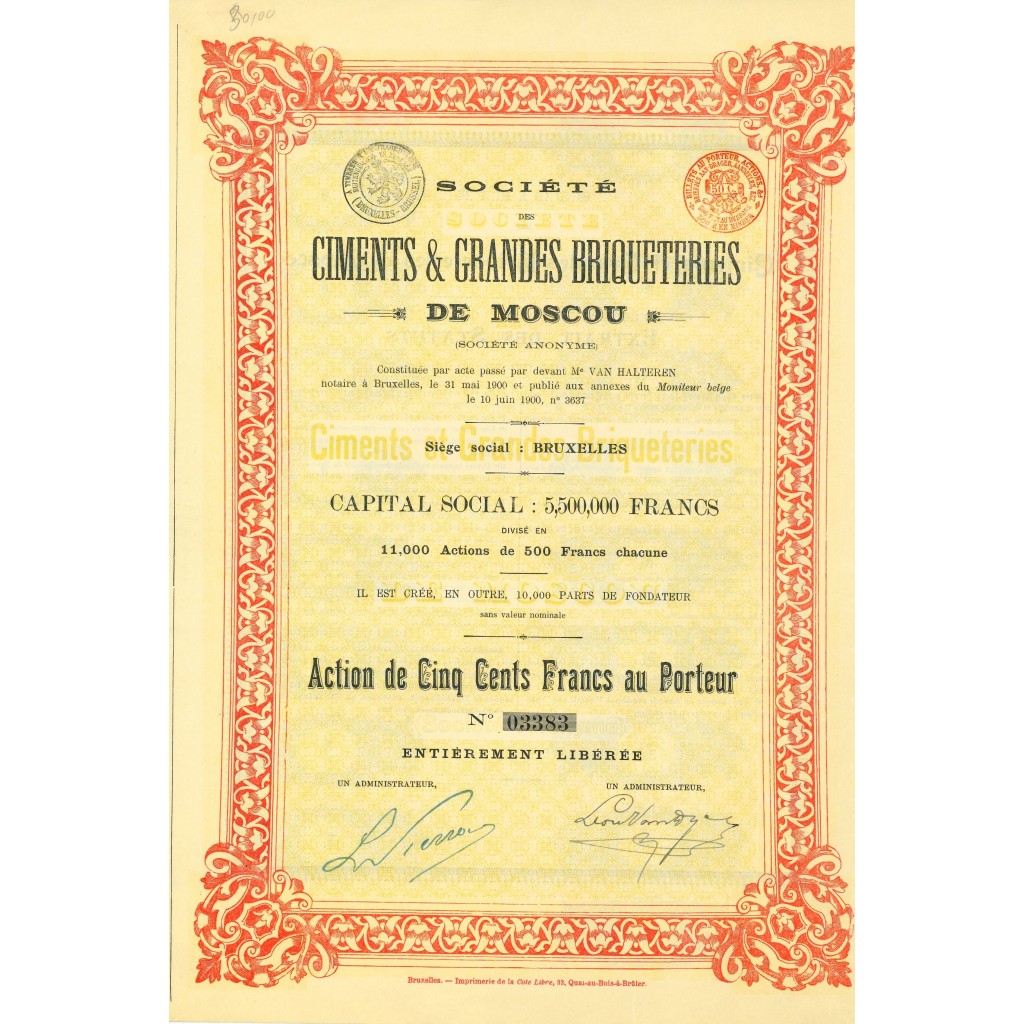


The "Société des Ciments & Grandes Briqueteries de Moscou" was established on May 31, 1900, in Brussels, Belgium, as evidenced by the notarial deed published in the Moniteur belge on June 10, 1900. The company was created to meet the growing demand for construction materials, particularly cement and bricks, during a period of rapid urban and industrial development in Russia.
The primary objective of the company was the production and trade of cement and bricks, essential products for infrastructure and construction at the time. With an initial share capital of 5,500,000 francs, the company issued 11,000 shares with a nominal value of 500 francs each, in addition to 10,000 founder shares with no nominal value.
Historical Data of the Company:
| Year of Establishment | Headquarters | Initial Share Capital | Year of Stock Exchange Listing | Year of Delisting | Year of Dissolution | Share Capital at Dissolution (or last available data) | Annual Revenue (1900) |
|---|---|---|---|---|---|---|---|
| 1900 | Brussels, Belgium | 5,500,000 francs | Not available | Not available | Not available | Not available | Not available |
Share Characteristics:
| Issue Date | Total Issue Amount | Nominal Value of Share | Serial Number | Language | Share Capital |
|---|---|---|---|---|---|
| 1900 | 5,500,000 francs | 500 francs | 12383 | French | 5,500,000 francs |
The presented share was issued in 1900 with a nominal value of 500 francs. Written in French, it reflects the importance of the company's operations in an international context.
Importance of Scripophily Collecting
Collecting scripophily offers an extraordinary window into the economic and financial past. Each document tells the story of governments and companies that contributed to the economic progress of their time. Collecting historical shares and bonds is not just a hobby, but a way to preserve and appreciate economic and cultural history.
This particular document from the "Société des Ciments & Grandes Briqueteries de Moscou" is an excellent example of scripophily. Issued during a crucial period for the development of infrastructure in Russia, it represents the importance of the economic and financial policies of the time. Its detailed craftsmanship and authentic signatures add a touch of authenticity and historical value, making it a desirable piece for any collector.
All historical documents for sale are intended for collection purposes. The documents have no economic or financial value (no economic or financial value), and the second image is only representative of the object of the reference company.