Shopping Cart
There are no more items in your cart
Historical Profile of Société d'Électricité d'Odessa
1. Historical Context and Company Foundation
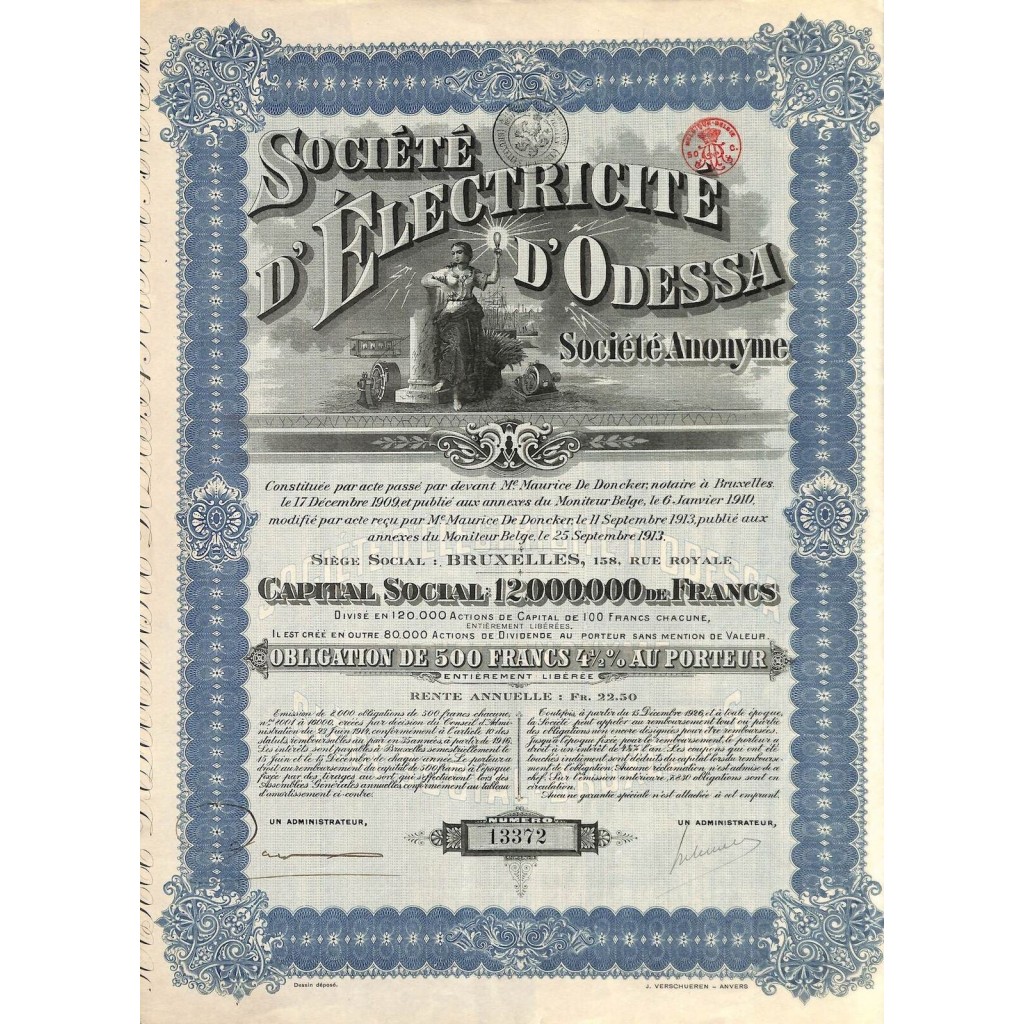
The Société d'Électricité d'Odessa was founded in Brussels on December 17, 1909, during a period of intense technological and industrial development in Europe and the Russian Empire. Odessa, one of the most important port cities on the Black Sea, was experiencing significant economic growth at the time due to its strategic position as a commercial hub between Europe and Asia. The city's industrialization required modernization of infrastructure, including electrification, to meet the growing energy demand of industries, transportation, and residential areas.
The document shows that the company was formally established by notary Maurice De Doncker in Brussels and officially published in the Moniteur belge on January 16, 1910. The company's statutes were later modified on September 11, 1913, reflecting likely expansion of the company’s activities to meet the increasing demand for electricity in Odessa.
2. Financial Structure and Company Objectives
The company had a share capital of 12,000,000 francs, divided into 120,000 shares with a nominal value of 100 francs each. Additionally, 80,000 dividend shares without nominal value were issued to incentivize investors. The document presented here is a bearer bond with a nominal value of 500 francs and an annual interest rate of 4.5%, which provided investors with an annual yield of 22.50 francs.
The primary goal of the Société d'Électricité d'Odessa was to supply electric power to the city and its emerging industries, thereby contributing to the modernization and economic development of the region. During the early 20th century, electrification was considered one of the key drivers of economic growth, and the presence of companies like this one represented a strategic investment for many European capitalists.
3. Artistic Design of the Certificate and Symbolism
The certificate is distinguished by its elegant artistic design, with a predominant blue color scheme that conveys a sense of authority and prestige. At the center of the certificate is an allegorical female figure holding a light bulb, symbolizing progress and technological innovation. In the background, elements related to the electrical industry, such as towers and transmission lines, can be seen, highlighting the crucial role of electricity in Odessa’s industrialization.
The border of the certificate is decorated with floral and geometric motifs in a neoclassical style, typical of bonds issued in the early 20th century. The presence of seals and the handwritten signatures of the administrators enhances the document’s authenticity and formality.
4. Signatures and Document Authenticity
The certificate bears the signatures of the company's administrators, attesting to its validity and reliability for investors of the time. Financial documents like this one were issued with great attention to detail to build trust among investors. The presence of original signatures and official seals increases the collectible value of these bonds, making them highly sought after by scripophilia collectors.
5. Collectible Importance and Current Valuation
Today, bonds issued by the Société d'Électricité d'Odessa represent a significant historical testimony to the industrialization of Eastern Europe and the Russian Empire. These documents not only offer insights into the economic ambitions of the time but are also appreciated for their artistic beauty and historical value.
The scripophilia market values these securities based on several factors, including rarity, condition, the presence of original signatures, and the serial number. A well-preserved document like the one shown here, with serial number 1371, can achieve high prices at international auctions due to its combination of historical value and aesthetic appeal.
6. Conclusion
The Société d'Électricité d'Odessa embodies the spirit of an era characterized by technological innovation and economic growth. Thanks to electrification, the city of Odessa was able to solidify its role as a commercial hub on the Black Sea. Today, owning a certificate from this company means not only holding a piece of economic history but also an artwork that tells the story of the industrial past of one of the most important cities in the Russian Empire.
These documents continue to captivate collectors and history enthusiasts for their intrinsic historical value and the craftsmanship with which they were created.