Shopping Cart
There are no more items in your cart
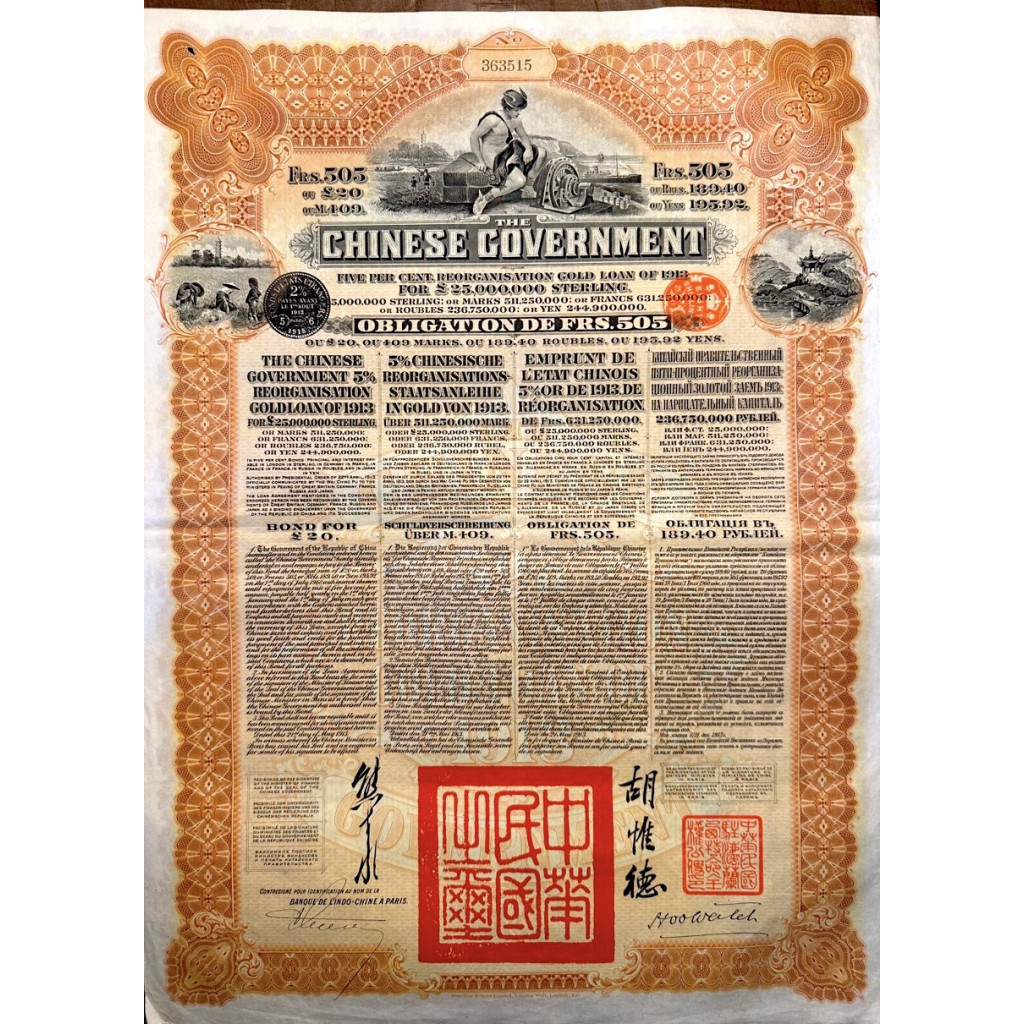
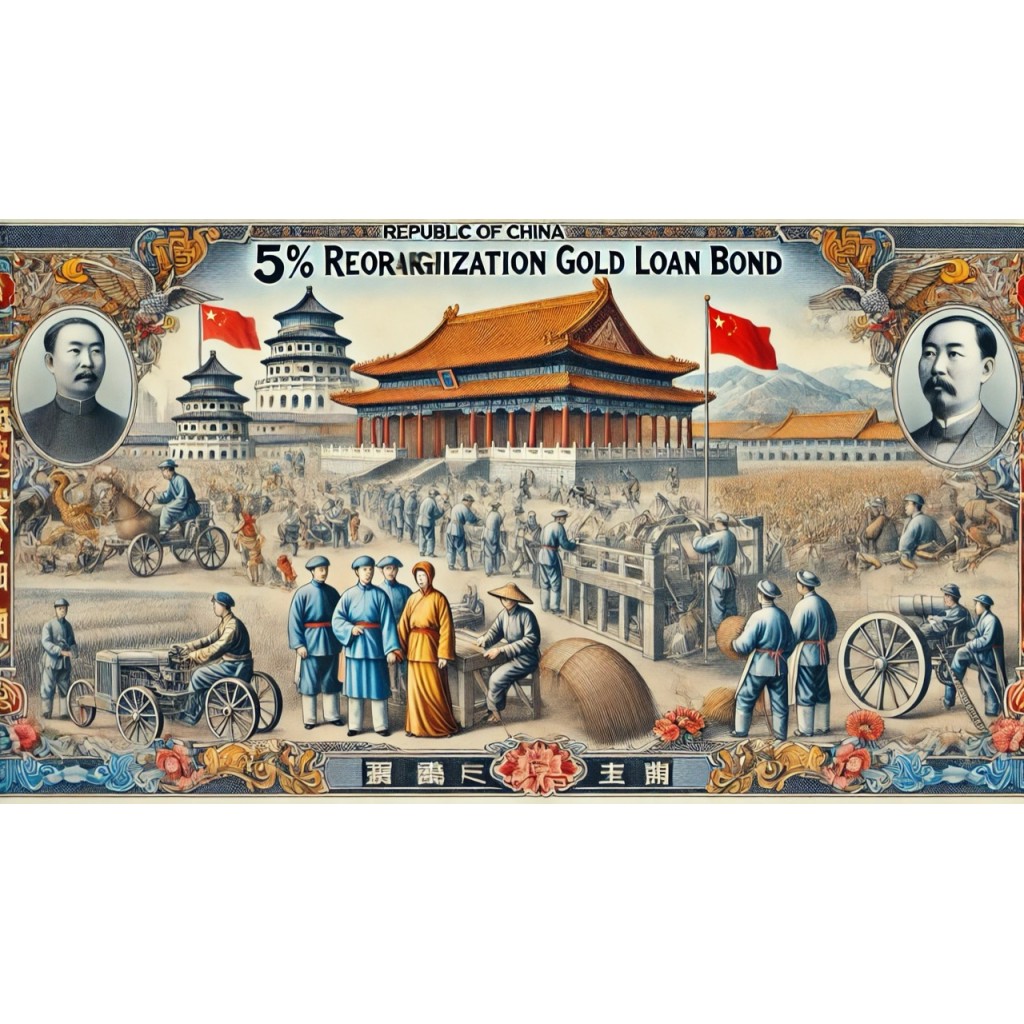
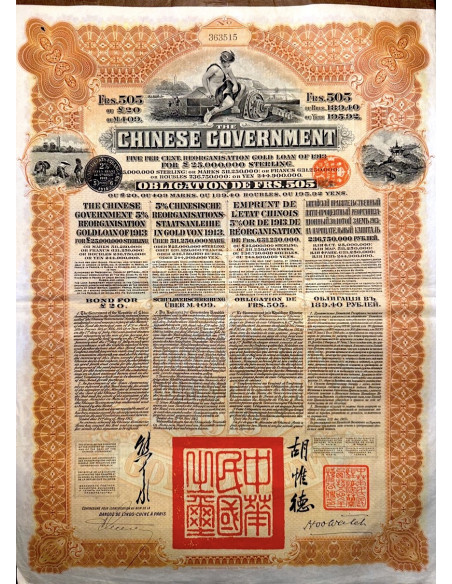
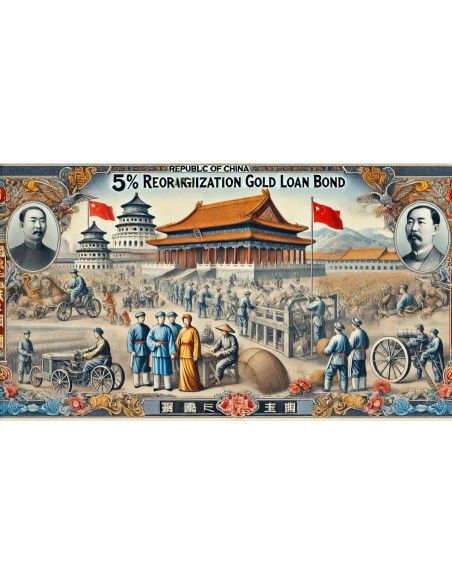
The bond is distinguished by its orange color and detailed engravings, including depictions of Chinese economic activities and traditional cultural elements. It bears the signatures of high-ranking Chinese officials and validation stamps, ensuring its authenticity.
Historical Context and Description:
In 1913, the Chinese government issued a series of bonds known as the 5% Reorganization Gold Loan to stabilize and restructure its finances during a period of political and economic transition. This period followed the Xinhai Revolution of 1911, which ended over two millennia of imperial rule and established the Republic of China. The reorganization loan was part of broader efforts to modernize the country’s infrastructure and financial systems, attracting foreign investments to support these initiatives.
The bond issued in 1913 is notable for several reasons:
- Multi-Currency Denomination: The bond's value was represented in multiple currencies, reflecting China's engagement with various global financial markets. The principal amounts were £20 Sterling, 505 Francs, 409 Marks, 189.40 Rubles, or 193.92 Yen, demonstrating the bond's international appeal.
- Interest Rate and Terms: The bond offered a 5% annual interest rate, a competitive return designed to attract investors. Interest payments and the principal repayment were guaranteed in gold, ensuring stability against currency fluctuations.
- Engravings and Design: The bond's elaborate design includes engravings of Chinese agricultural and industrial scenes, symbolizing the nation's economic potential. Traditional Chinese motifs and official seals add to its aesthetic and historical value.
- Signatures and Stamps: The bond is authenticated by the signatures of Chinese government officials and the stamp of the Banque de l'Indo-Chine in Paris, highlighting its legitimacy and the involvement of international financial institutions.
Issued by
1913 - 5% Reorganisation Gold Loan The Reorganisation Gold Loan of 1913 was for the capital sum of £25,000,000. The Loan was, "...authorized by Presidential Order of 22nd April 1913 officially communicated by the Wai Chiao Pu to the Ministers in Peking of Great Britain, Germany, France, Russia and Japan." The newly appointed President of the Republic of China, Yuan Shih Kai, initially approached Britain, France, Germany and United States of America seeking a substantial loan to assist the fledgling government of the Republic of China. Later this group was expanded to include Japan and Russia, but eventually the United States of America withdrew from participation, leaving five countries which agreed to assist the Chinese Government with financial aid. The principal financial institutions which participated in the loan arrangements were the Hongkong & Shanghai Banking Corporation, Deutsch-Asiatiche Bank, Banque de I'Indo-Chine and Russian Asiatic Bank. The Yokohama Specie Bank participated on behalf of Japan, but did not issue separate bonds, countersigned by the bank. Arrangements were made as to convertibility into Japanese Yen of the bearer bonds issued by the other four issuing banks. The banks all received 6% commission allocated to each bank together with bonds issued are detailed in the data tables below: Hongkong & Shanghai Banking Corporation £7,416,680 Deutsch-Asiatiche Bank £6,000,000 Banque de I'Indo-Chine £7,416,660 Russian Asiatic Bank £2,777,780 Russian Asiatic Bank (Belgium) £1,388,880 It should be noted that the original Russian issue bonds which were brown coloured, were subsequently withdrawn and exchanged for a series of green coloured bonds. The original brown coloured bonds, sometimes referred to as "Yellow Bonds" were annulled. In consequence there may still be bonds in existence of two different colours from the Russian issue carrying identical serial numbers. The purpose of the loan was to enable the new government of the Republic of China to meet financial liabilities inherited from the previous organization of government institutions and to meet the administrative costs. The loan was secured upon the entire revenues of the Salt Administration of China. In some ways this was a rather dubious security for such a large-scale loan as the entire Salt Gabelle (Salt Tax) had already been committed for other purposes with any surplus being pledged as a security against the Crisp Loan of 1912. However there was a further provision that foreigners would assist in the reorganisation of the collection of Salt Tax revenues and if the loan was at any time in default, the Salt Tax revenues were to be administered by the Maritime Customs Administration which was primarily under the control of foreigners. Coupons were payable on 1st January and 1st July each year. The loan has been in default since 1939. As an interesting footnote to this loan, Mr. M.E. Weatherall, who was a senior official of the Chinese Maritime customs Service in 1921 was quoted in the publication "Wayfoong" as making the following observation; "I believe that I am correct in saying that the greater part, if not all, of the reorganisation loan of 1913 was accounted for by statements and vouchers, but that in actual fact very little of it was ever applied to the purposes for which it was lent. It disappeared mysteriously and nobody knows where it has gone."
----
The Republic of China or the Chinese Republic was the political entity that was formed in China at the fall of China's last emperor, Pu Yi in 1912 following the success of the Xinhai Revolution.
The flag of the Republic of China until 1928, used by the Beiyang government of warlords
Following a series of events in the period between 1912 and
The People's Republic of China was founded by Mao Zedong on 1 October 1949 and the first activity of the new political system, established with the revolutionary victory, was to bring peripheral territories such as Tibet and Xinjiang (1951) under the sovereignty of China.
Only for collection not financial value