Shopping Cart
There are no more items in your cart

Historical Profile of the Kingdom of Romania - External Loan 1922
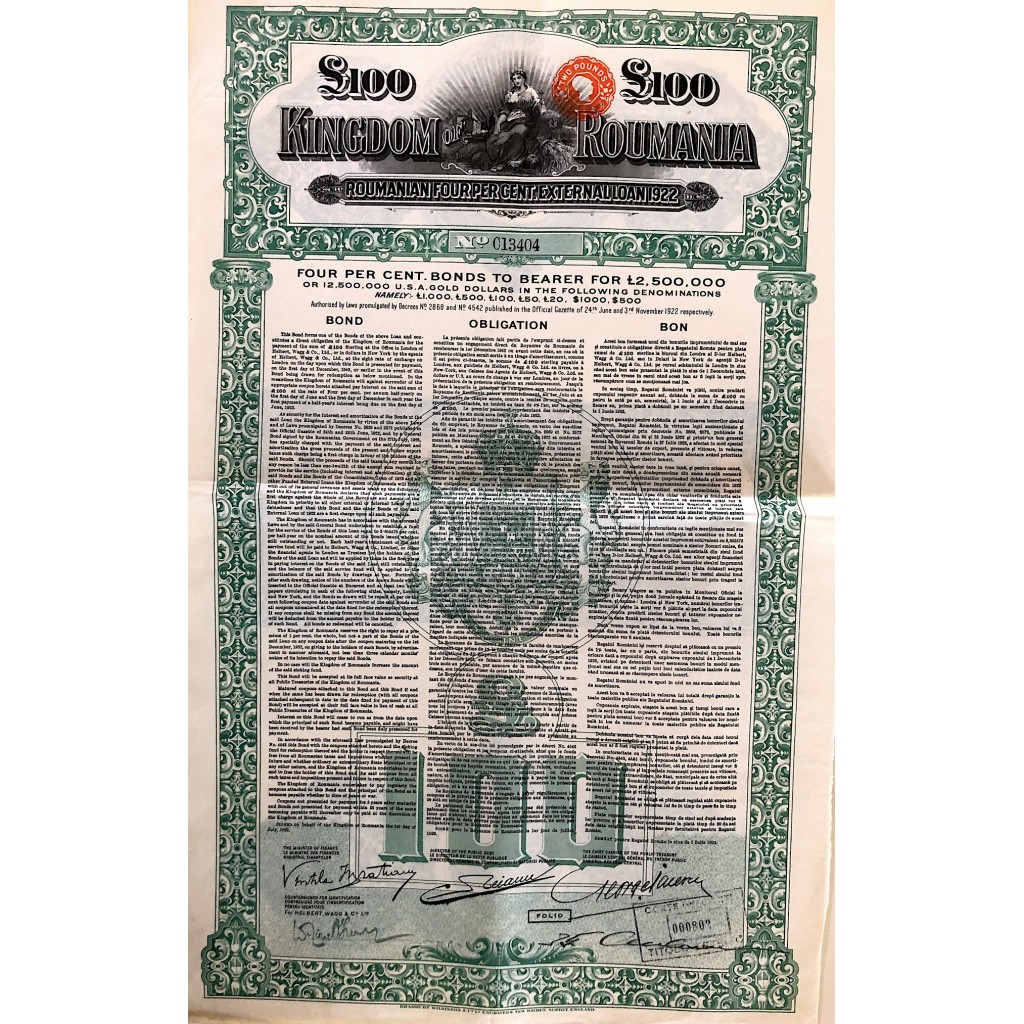
The 1922 external loan was issued by the Kingdom of Romania to finance economic stabilization and infrastructure modernization following World War I. This international loan, gold-backed, carried a 4% interest rate and was offered in several currencies, including the US dollar. The bond displayed is a $100 bond, part of a series issued for a total of $12,500,000.
The external loan was crucial for Romania, which sought to recover from the immense economic costs of the war and attract foreign investment. These bonds were widely purchased by foreign investors, especially in Britain and the United States, and were considered relatively safe due to their gold backing.
Historical Data of the Company
| Company Historical Data | Information |
|---|---|
| Year of Establishment | 1922 |
| Headquarters | Bucharest, Kingdom of Romania |
| Year of Stock Exchange Listing | 1922 |
| Year of Delisting from Stock Exchange | Not available |
| Year of Dissolution | Not available |
| Share Capital at Establishment | Not available |
| Share Capital at Dissolution | Not available |
| Annual Revenue (1922) | Not available |
Certificate Characteristics
| Characteristic | Description |
|---|---|
| Number of Certificates | N/A |
| Type of Certificate | External Gold Bond |
| Nominal Value | 100 dollars |
| Serial Number | C13404 |
| Interest Rate | 4% |
| Maturity Date | Not specified |
| Issue Date | 1922 |
| Signed by | Ministry of Finance of the Kingdom of Romania and other officials |
| Condition of Document | Very good preservation |
| Authenticity Status | Authentic |
| Language of Document | English, French, German, Italian |
| Stamps and Seals | Official stamps from the Romanian Ministry of Finance and London authorities |
Historical Context
This bond was issued after World War I, a period of great economic difficulty for Romania, which sought to rebuild its country and modernize its infrastructure. The gold-backed bonds offered investors the opportunity to support Romania’s economic recovery with the promise of a gold-backed return. The 1920s were a period of intense financial activity for the Romanian government, which sought to attract foreign capital to support domestic development.
Artistic and Typographical Details
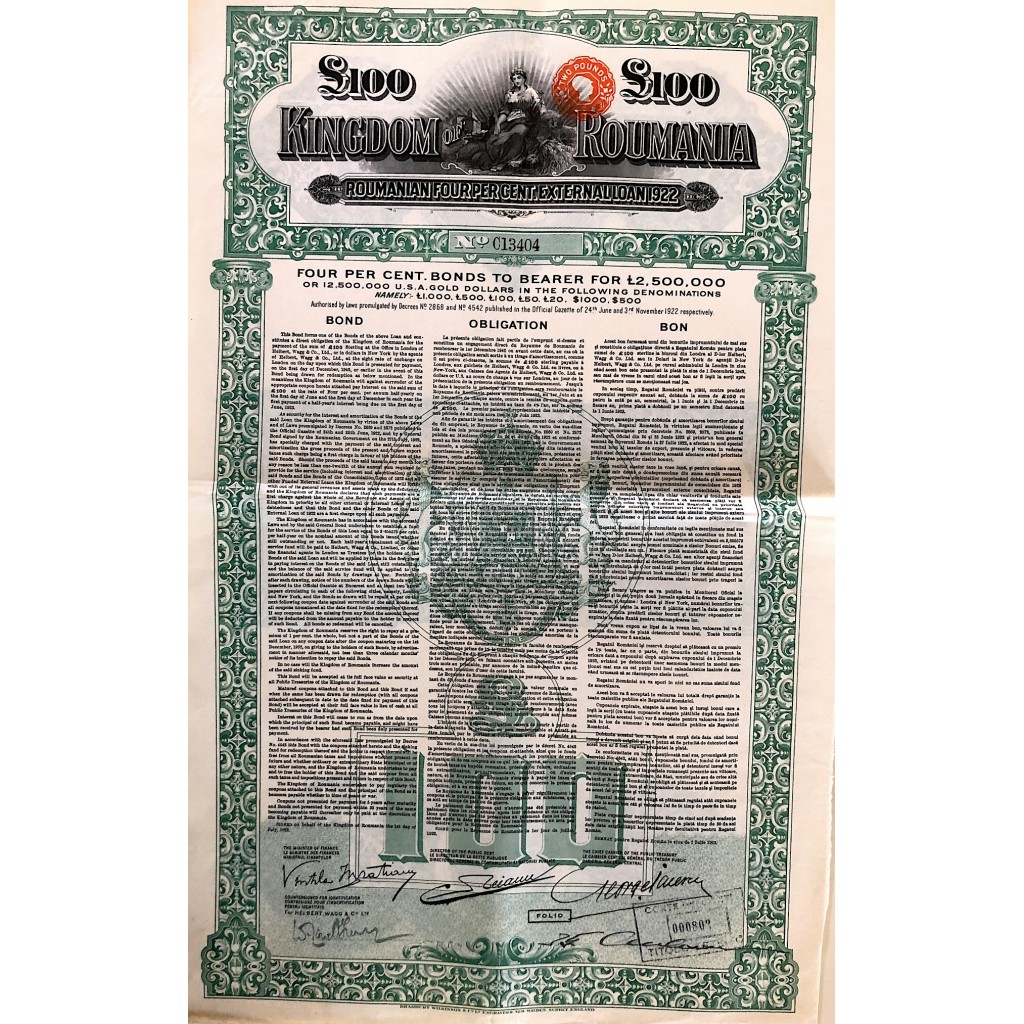
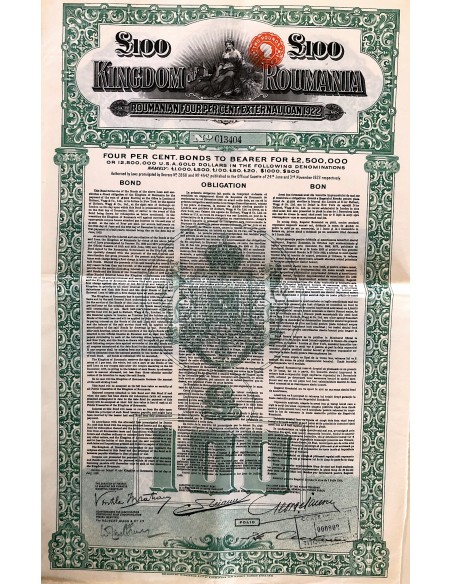
The certificate features an intricate green frame and a central graphic depicting an allegorical personification of Romania. The design of the bond is refined, and the use of multiple languages reflects the international nature of the loan. The main text describes the bond terms in English, with translations in French, Italian, and German, highlighting the wide scope of the offering to global investors.
Provenance of the Certificate
This bond was part of an international loan widely distributed across Europe and the United States. This particular bond has been part of a private collection for decades before entering the scripophily market.
Evaluation and Rarity
The bonds from the 1922 Kingdom of Romania external loan are relatively rare, especially in excellent condition like this example. The market value for collectors can range between 150 and 500 euros, depending on the quality of preservation and provenance.
The Importance of Scripophily Collecting
Collecting historical certificates like this allows one to relive a significant moment in European economic and political history. These bonds are not only financial instruments but also tell stories of economic growth, international investment, and post-war stabilization. For collectors, they represent not only historical value but also artistic merit.
Preserving these certificates is important: they should be kept in protective frames or albums. In addition to being valuable collector’s items, they can also be used as decorative pieces that add a touch of history and prestige to any space.
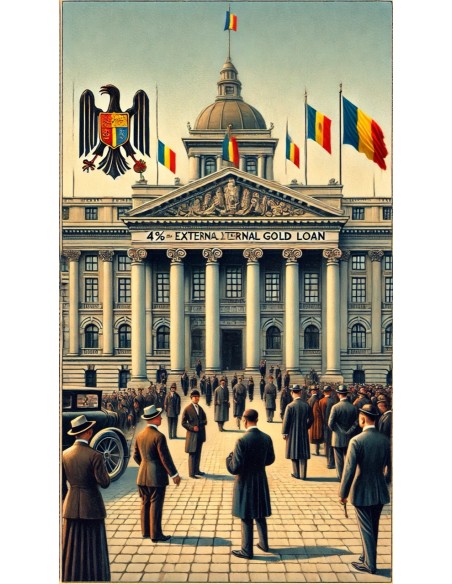
All historical documents for sale are considered collectible. They have no economic or financial value (no economic or financial value), and the images that are not of the historical document are representative of the company's object and the historical period. They are not provided but can be freely downloaded from the website and printed.