
Shopping Cart
There are no more items in your cart




In addition to the classic methods of state financing, such as taxes or revenues from monopolies (like the salt monopoly), a form of public debt already existed since the fifteenth century, which involved the sale of offices: the holders of these venal offices, often merely honorary, were then compensated either with revenues from the respective services or from general income. However, after the Lutheran storm and the Anglican schism, new forms of financing had to be resorted to. Although forms of public debt existed in Venice, Genoa, and Florence as early as the twelfth century, it was Clement VII Medici who first made systematic use of this new instrument: in 1526, the Monte della Fede was issued, and its proceeds were used to support Charles V in the war against the Turks.
In 1670, Secretary Arrighi was accused of unjustly collecting the price of unrestricted places (more expensive) by passing them off as restricted. As a consequence, Clement X convened a special Congregation tasked with recommending a reform of the office. In 1671, Clement decided to abolish the venality of the position and reorganize the Secretariats under a single secretary. The choice fell on Diego Ursaja, clericus polycastrensis, who had been secretary of three mounts until then. The price of the life tenure contract was 5500 scudi per year: essentially a venal office under another name. However, Ursaja failed to balance the accounts, and his requests for a reduction in the contract price were not accepted. In 1688, Ursaja abandoned the office and disappeared. In the same year, Innocent XI reformed the office again, creating four Secretariats. In the following decades, the organization of the Secretariats was the subject of constant debate and frequent changes in direction: in 1701, Clement XI abolished the venality of the office and entrusted the position to a single General Administrator. Additionally, he decided to concentrate the offices, which were previously located in the homes of the secretaries, in a single location, near the newly completed Palazzo di Montecitorio, the seat of the Pontifical Curia. This allowed for better control of the staff's activities. After several other reforms, in 1743, Benedict XIV incorporated the Depositeria into the Monte di Pietà of Rome, thus completing the bureaucratization process of the administration of the mounts.
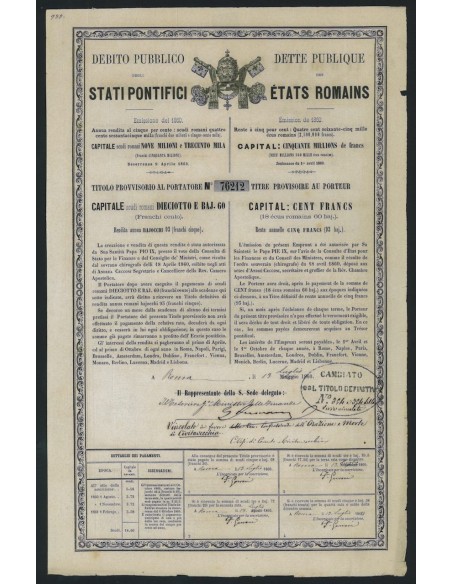
Introduction The bonds presented date back to 1860, issued by the Papal States under the papacy of Pope Pius IX. These documents represent an important historical testimony of the public debt accumulated by the States of the Church during a crucial period in Italian and Vatican history. The bonds were issued in multiple languages (Italian, French, German, and English), reflecting the international nature of the financial markets of the time.
Document Details The bonds feature several crucial pieces of information, including:
- Issuance: 1860.
- Capital: 50 million francs (nine million three hundred thousand Roman scudi).
- Annual Yield: 5% (4.65% in some variants).
- Languages: Italian, French, German, English.
Document Structure
- Header: The Papal States, with papal symbols (crossed keys and the papal tiara).
- Capital Description: Specifications on the issued capital and annual yields in various currencies and measurement systems.
- Payment Details: Information on the due dates and methods of interest payment, including details for payment in various European cities (Rome, Naples, Paris, Brussels, Amsterdam, London, Dublin, Frankfurt, Vienna, Munich, Berlin, Lucerne, Madrid, Lisbon).
- Authorization and Signature: The creation and sale of the annuities were authorized by His Holiness Pope Pius IX, with authenticated signatures and official stamps.
Historical Context The issuance of these bonds occurred during a period of significant changes for the Papal States and Italy. In 1860, Italy was in the midst of the Risorgimento, the movement for Italian unification. The Papal States, governed by the Pope, were among the last obstacles to the complete unification of Italy under the Kingdom of Victor Emmanuel II. Pope Pius IX, who ruled from 1846 to 1878, faced numerous political and social challenges, including the loss of temporal power with the capture of Rome in 1870.