
Shopping Cart
There are no more items in your cart
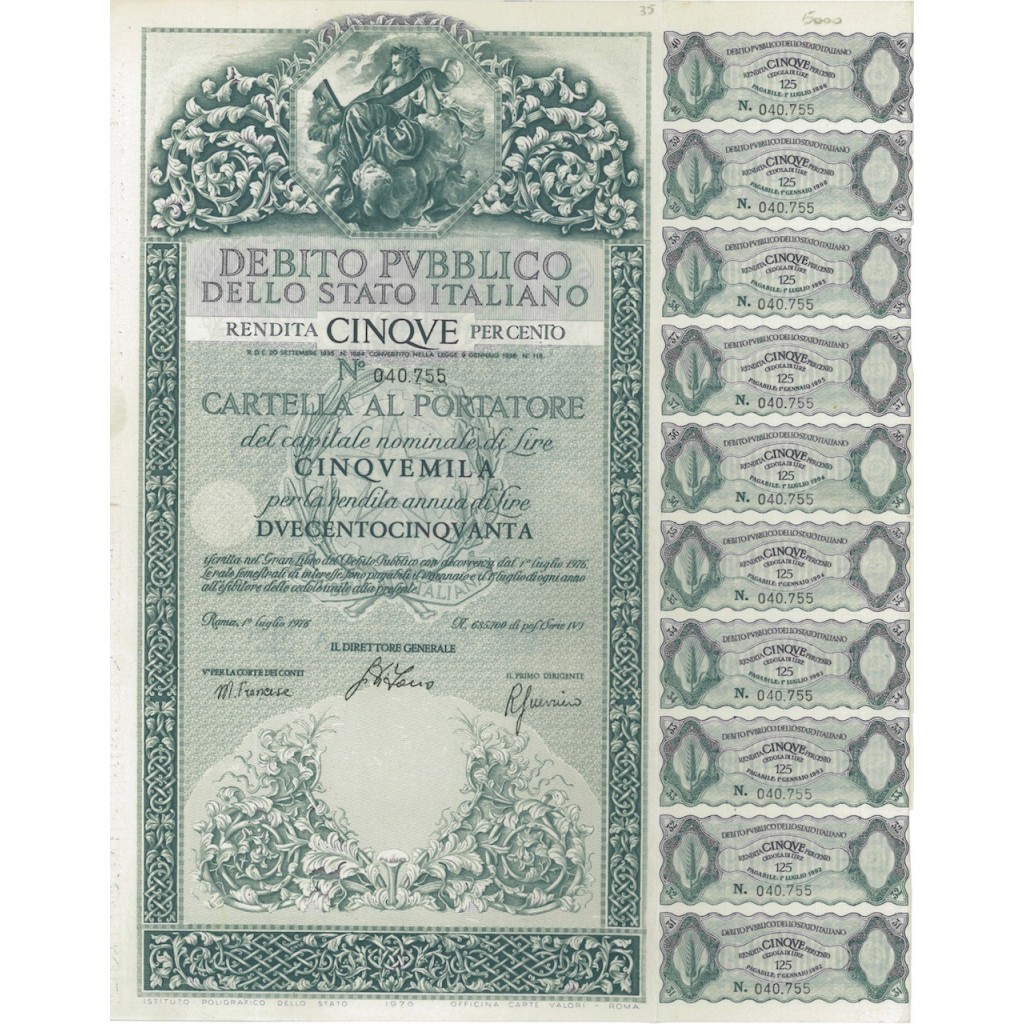

Title: "Bearer Bond of the Italian State's 5% Public Debt: A Document from 1976"
Introduction The document we are examining is a Bearer Bond issued by the Italian State in 1976 with an interest rate of 5%. This certificate represents one of the instruments used by the Italian government to finance its public spending needs during the 1970s, a period marked by economic instability and high inflation.
Historical Context The year 1976 was a challenging one for Italy, with the economy grappling with the aftermath of the 1970s energy crisis and rampant inflation. To finance public debt, the government issued bonds such as these 5% Bearer Bonds, aimed at raising domestic capital by offering guaranteed returns.
These financial instruments were very popular among Italian savers who were seeking stable and secure investments during a time of economic uncertainty. Government bonds like this one provided an attractive investment option thanks to tax-exempt interest and the security guaranteed by the State.
Document Analysis The design of the document is richly decorated with neoclassical motifs and a central engraving depicting an allegorical figure representing Italy, symbolizing strength and prosperity.
The document includes a series of numbered coupons for interest payments, each worth 125 lire, which could be used to collect semi-annual payments. The coupons are arranged on the right side of the certificate, making it easy to detach them for redeeming the interest.
Features of the Certificate The 5% Bearer Bond guaranteed a fixed annual interest rate exempt from any present and future taxes, as established by the legislation in force at the time. Being a bearer bond, the certificate did not require registration to a specific name, allowing the physical holder to collect the interest without additional formalities.
The detachable coupons could be presented at Treasury offices or other authorized banks to collect the accrued interest every six months. This type of bond was an ideal solution for savers looking for a secure investment during a period of high inflation.
The Role of Bearer Bonds in State Financing In the 1970s, issuing bearer bonds was a key strategy for the Italian government to raise funds and finance public debt without further increasing direct taxes. This instrument helped attract private capital by offering a competitive fixed interest rate and the security of state backing.
Significance for Collectors Today, documents like this one are highly valued in the world of scripophily, both for their historical significance and their relevance in the economic context of 1970s Italy. The presence of intact coupons and the handwritten signatures of the Director General and the Chief Officer enhance the collectible value of this certificate.
Conclusion The 5% Bearer Bond of the Italian State issued in 1976 is not just a financial instrument but also a testament to Italy's economic transition in the 1970s. Collecting and preserving such documents means safeguarding a piece of the country’s financial history, providing unique insight into the economic policies adopted to combat inflation and stabilize the economy.
