Shopping Cart
There are no more items in your cart
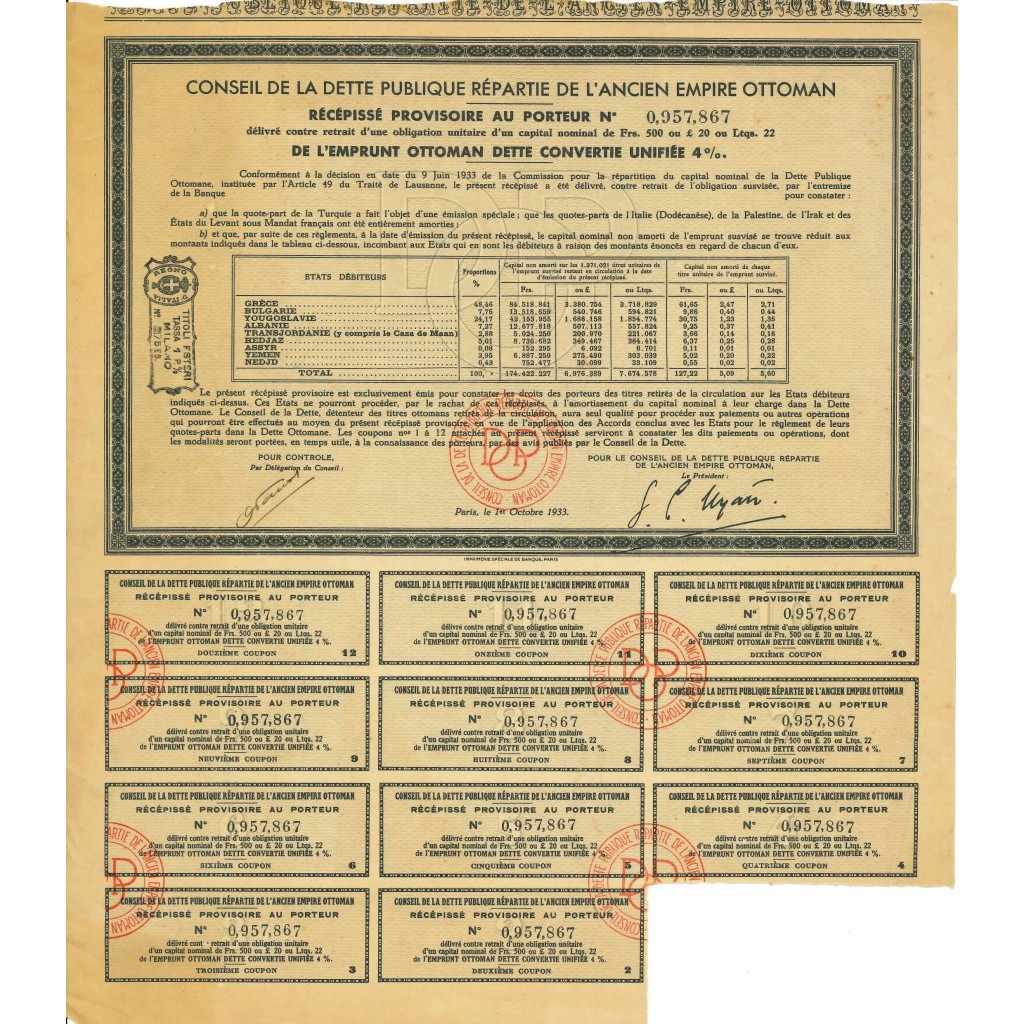



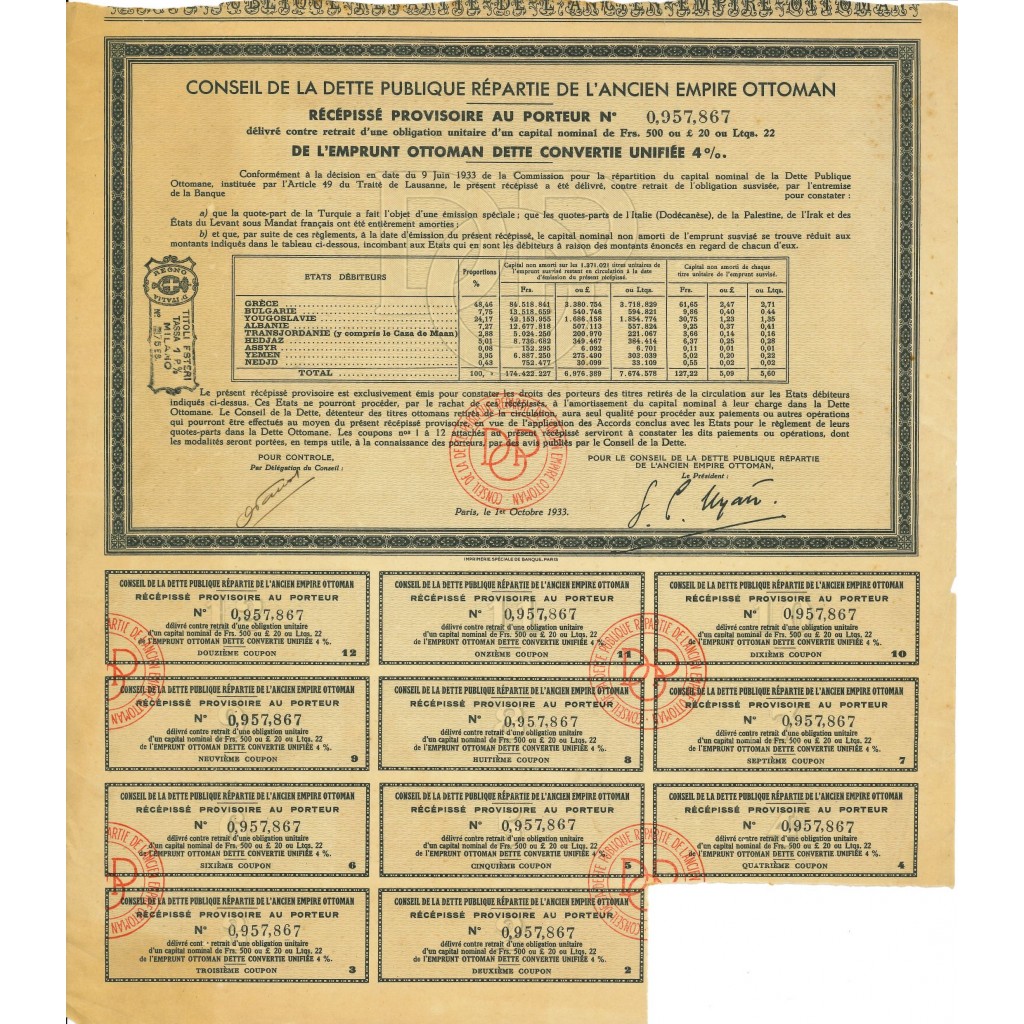
The presented certificate belongs to a series of bonds issued in the context of the distribution of the Ottoman Public Debt. This specific title was issued on October 19, 1933, following the Treaty of Lausanne (1923), which established the division of financial responsibilities of the former Ottoman Empire among successor states, particularly Turkey and other debtor states. These certificates represent the payments of arrears by the debtor states of the former Ottoman Empire.
Historical Data of the Loan
| Year of Issue | Issuer | Nominal Value per Bond | Interest Rate | Duration | Location |
|---|---|---|---|---|---|
| 1933 | Ottoman Public Debt Administration | 500 French Francs | Not applicable | Not available | Paris |
Document Characteristics
| Document Type | Number of Coupons | Nominal Value per Coupon | Date of Issue | Signatures |
|---|---|---|---|---|
| Récépissé Provisoire | 12 | Not specified | October 19, 1933 | Members of the Ottoman Public Debt Administration |
Historical Context
Following the collapse of the Ottoman Empire after World War I, the peace treaties imposed a division of the empire’s debts among the new states that inherited its territorial responsibilities. The Treaty of Lausanne (1923) outlined the payment mechanisms for the arrears of the Ottoman Public Debt. Successor states, including Turkey, Greece, and Bulgaria, were tasked with paying the owed amounts, as detailed in the certificate. This process was overseen by the Ottoman Public Debt Administration, established specifically to manage the debt distribution.
Artistic and Typographical Details
The certificate features a straightforward design, with a clear and easily readable layout. At the center is a table listing the debtor states and their respective owed amounts, while the lower part contains the numbered coupons. Several official stamps are present, including the red seal of the Ottoman Public Debt Administration.
The certificate is signed by official representatives of the Debt Administration, providing authenticity and historical value. The design is minimalist yet formal, typical of official documents of the period.
Provenance and Authenticity
These certificates were primarily issued in France and are tied to investors who participated in the Ottoman debt repayment process. The document in question was likely held by a French or international investor who held rights to a portion of the Ottoman debt. For an additional fee, an official certificate of authenticity documenting the history of the title and related transactions can be requested.
Valuation and Rarity
These certificates are particularly rare, as they represent one of the final phases of the Ottoman Empire’s debt management. Their rarity is enhanced by the historical and political complexity surrounding the division of debts among various successor states. Documents like this are highly valued by scripophily collectors for their historical significance and connection to crucial geopolitical events.
Importance for Scripophily Collectors
For collectors, these certificates represent not only a part of the financial history of the former Ottoman Empire but also an example of how international debt was managed and divided after the fall of an empire. Displaying it in a protective frame can preserve its historical and aesthetic value, making it a fascinating and educational object for any collection.
These documents are perfect for personal collecting but can also make a valuable historical gift or a unique decorative object.
All historical documents for sale are intended for collection purposes only. The documents have no economic or financial value (no economic or financial value), and images that are not the historical document are representative of the company and the relevant historical period; they can be freely downloaded from the website and printed.