Shopping Cart
There are no more items in your cart
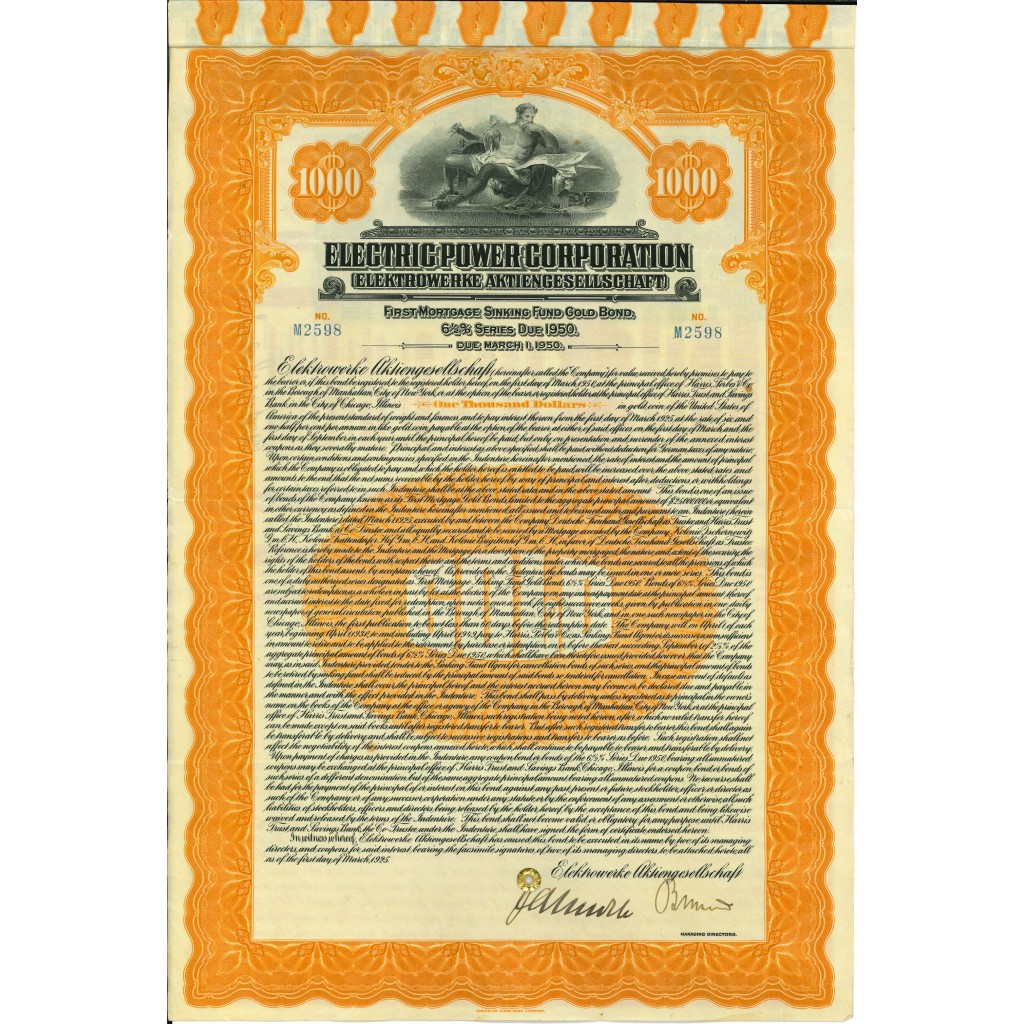
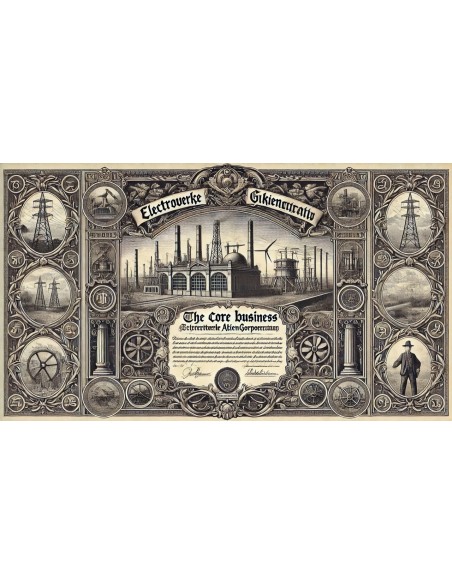
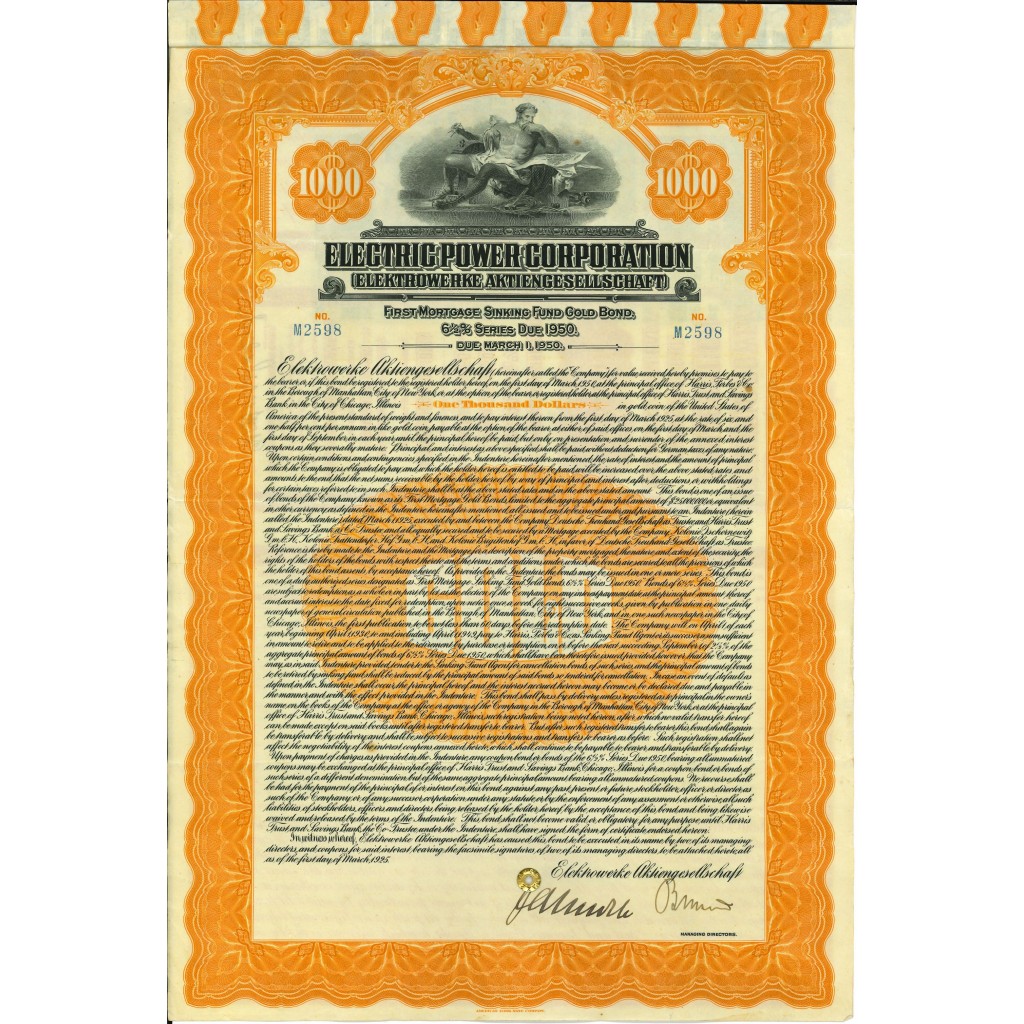
The Electric Power Corporation (Elektrowerke Aktiengesellschaft) was one of the leading German companies in the production and distribution of electrical energy. Founded in 1920, the company played a fundamental role in developing Germany's electrical infrastructure, contributing to the modernization and industrialization of the country during the 20th century.
Historical Data of the Company
| Data | Value |
|---|---|
| Year of Establishment | 1920 |
| Headquarters | Berlin, Germany |
| Name at Delisting from Stock Exchange | Elektrowerke Aktiengesellschaft |
| Year of Stock Exchange Admission | 1925 |
| Year of Delisting from Stock Exchange | 1945 |
| Year of Company Cessation | 1950 |
| Initial Capital | 2 million Marks |
| Final Capital | 10 million Marks |
| Revenue in 1930 | 50 million Reichsmark |
| Revenue in 1940 | 75 million Reichsmark |
Characteristics of the Historical Document
| Characteristic | Detail |
|---|---|
| Type of Document | Bond (Gold Bond) |
| Nominal Value | $1000 |
| Interest Rate | 6.5% |
| Duration | 25 years |
| Issue Date | March 11, 1925 |
| Maturity Date | March 11, 1950 |
| Issuer | Electric Power Corporation (Elektrowerke AG) |
| Country | Germany |
| Language | English and German |
Scripophily collecting offers a unique opportunity to own a piece of economic and industrial history. Each document tells a story of innovation, growth, and transformation, reflecting the economic dynamics of a bygone era. The aesthetic beauty of these documents, with their intricate details and illustrations, makes them art pieces as well as historical testimonies.
The bond of the Electric Power Corporation represents a significant piece of German and world industrial history. Issued in Germany, it symbolizes the power and influence of the electrical sector in the modern era. Collecting a document like this not only enriches one's collection but also provides a tangible link to the past, allowing for exploration and understanding of the roots of the modern global economy.
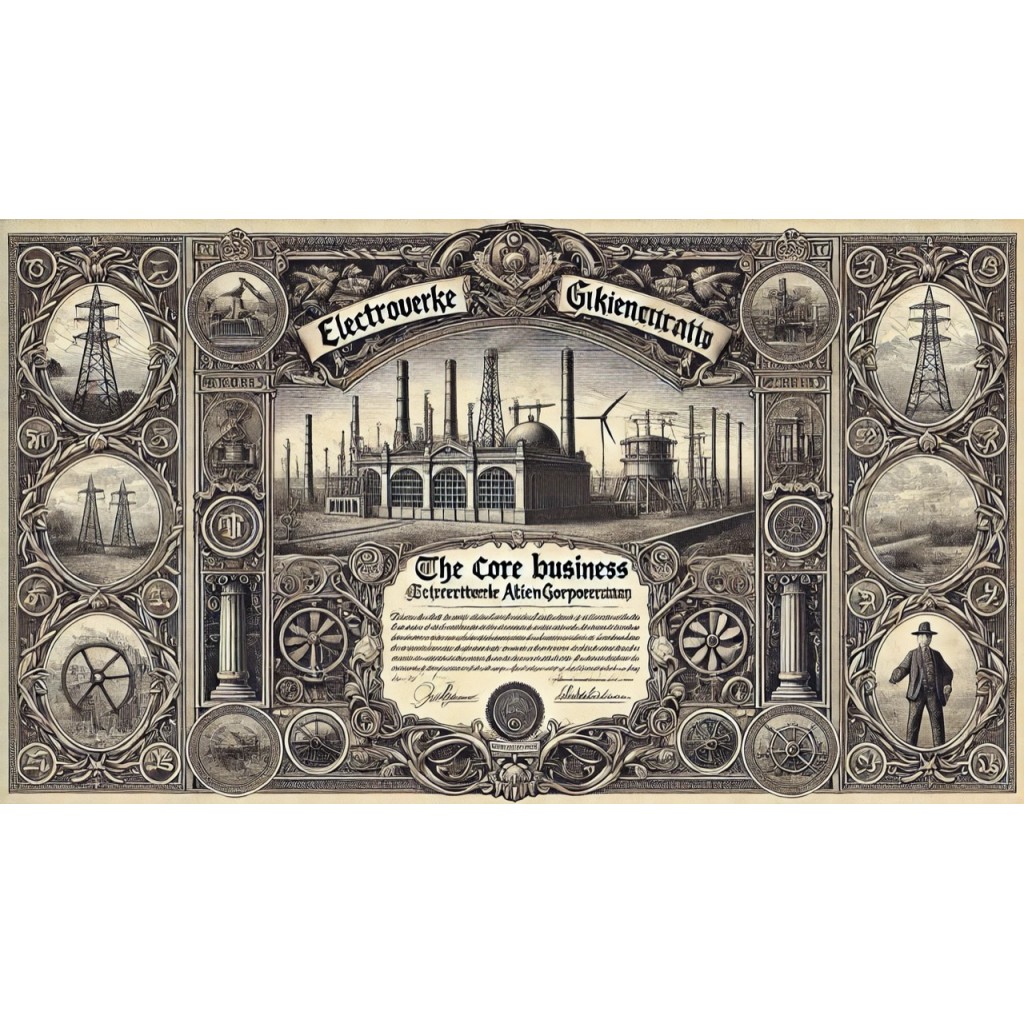
All historical documents for sale are intended for collection purposes only. The documents have no economic or financial value (no economic or financial value), the second image is only representative of the company's business.
The Electric Bond and Share Company (Ebasco) was organized by General Electric and prior to its breakup was the largest electric power holding company in the United States. It was forced to divest its holding companies and reorganize due to the passage of the Public Utility Holding Company Act of 1935. Ebasco filed suit against the act, claiming it was unconstitutional, but lost.[1] The U.S. Securities and Exchange Commission took twenty-five years of legal action to break up Ebasco and the other major U.S. electric holding companies until they conformed with the 1935 act. It was allowed to retain control of its foreign electric power holding company known as the American & Foreign Power Company (A&FP). After its reorganization, it became an investment company but soon turned into a major designer and engineer of both fossil fuel and nuclear power electric generation facilities. Its involvement in the 1983 financial collapse of the Washington Public Power Supply System's five nuclear reactors led to Ebasco's demise because of the suspension of nuclear power orders and lawsuits that included numerous asbestos claims. The U.S. nuclear industry stopped all construction of new facilities following the 1979 nuclear meltdown at Three Mile Island, going into decline because of radiation safety concerns and major construction cost overruns.
History
The Electric Bond and Share Group was organized in 1905 as a holding company for electric utility company securities by the General Electric Company using its employees' retirement investment fund. The General Electric Company was originally known as the Edison Electric Company until J. P. Morgan pushed Thomas Edison and its president Samuel Insull out of the company in 1892. Morgan was known for his style of monopolization of major U.S. industries, called Morganization,[2] that included AT&T, U.S. Steel and a substantial part of the country's railroad companies. Morgan's takeover of General Electric took place just as Thomas Edison was losing his battle against Nikola Tesla and George Westinghouse over the contract to light the 1893 Chicago World's Fair as well as build the world's largest hydro-electric system at Niagara Falls. At the height on the war of the currents, Westinghouse was forced to sell all of Tesla's alternating current patents to Morgan.
Teddy Roosevelt's warning
With Morgan's acquisition of General Electric he used his position as the country's most powerful financier to set in motion a plan to monopolize the entire country's electric industry via the Electric Bond and Share Group. Until his death in 1913, Morgan was opposed to any form of government regulation. His firing of Samuel Insull resulted with Insull moving to Chicago, where he organized the second-largest holding company in the country, the Middle West Utilities Company or what is known today as Exelon. Insull would actively promote the idea of a regulated monopoly because of the high cost of electrical infrastructure. About the same time as Teddy Roosevelt's trust-busting campaign against Morgan, Rockefeller and other elites was gaining national attention, the National Civic Federation (NCF) was formed. It carried out extensive investigations and debates among prominent businessmen and organized labour over the issue of public vs. private ownership of electric power. Insull's public support for regulation helped popularize NCF's model legislation that quickly spread nationwide after the state of New York adopted its own variation. Morgan's son J. P. Morgan Jr. carried on with the House of Morgan, including his father's goal of a national electric monopoly but was up against the reformist progressive era.
By 1925, General Electric's Electric Bond & Share Group was the largest owner of U.S. and foreign electric companies holding over 10% of the country's companies as subsidiaries organized into five major holding companies. General Electric made a purely symbolic gesture to reduce growing public anger by divesting control of the company leaving Morgan still in financial control. The Commonwealth and Southern Corporation, known today as the Southern Company, and the reorganized Electric Bond And Share Company (EBASCo) were both parts of J. P Morgan's syndicate via his J.P. Morgan & Co. In 1926, its headquarters in New York City had over 1,000 employees and controlled companies in 33 states worth $1.25 billion.
As public concern continued to mount by ratepayers of private electric power companies, the Federal Trade Commission[7] carried out extensive investigations between 1928 and 1935. The commission's 48,000-page report included entire volumes for each of the country's major utility companies. The FTC valued EBASCo and its five holding companies at $3.5 billion, along with major investments in dozens of other major U.S. companies. Within the five main holding companies were 121 U.S. subsidiaries, along with a foreign holding company that operated in 16 countries and had 70 subsidies.
Because he was a strong proponent of public power, Franklin D. Roosevelt used the collapse of Samuel Insull's Middle West Utilities electric empire in June 1932 as one of his most important election campaign issues. The failed assassination attempt on his life in February 1933 later became part of U.S. Marine Corps General Smedley Butler's claim of a Business Plot against Roosevelt by J. P. Morgan. Franklin's inaugural address contained one of the century's most dramatic speeches where he would proclaim "that the only thing we have to fear is fear itself", but unknown to most Americans the rest of the speech spoke of America's money changers and their role in the depression.[9] On Roosevelt's first day in office, following his inauguration, he ordered the closure of the nation's banks, known as the bank holiday of 1933. In a joint session of the House and Senate, he pushed through the Emergency Banking Act along with Executive Order 6102 that blocked the hoarding of gold and stopped the major New York banks from taking gold supplies out of the country. Roosevelt then selected Ferdinand Pecora to investigate Morgan and the country's other major banks. Both Pecora and the Federal Trade Commission investigations exposed the fact that the electric industry was the most capital intensive industry. The May 24th, 1933 Pecora hearings rocked the country, focusing on J.P. Morgan and his financial empire, whose top lieutenants paid no taxes. In his 1939 book Wall Street Under Oath: The Story of Our Modern Money Changers, Ferdinand Pecaro stated that "Undoubtedly, this small group of highly placed financiers, controlling the very springs of economic activity, holds more real power than any similar group in the United States." Tutti i documenti storici in vendita si intendono da collezione. I documenti non hanno nessun valore economico o finanziario (no economic or financial value).