Shopping Cart
There are no more items in your cart

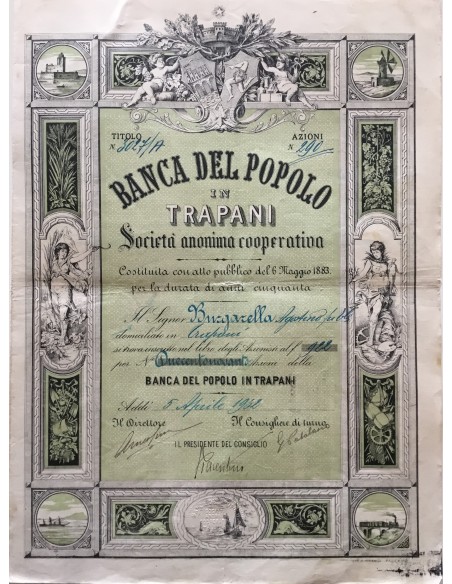
Description: This certificate represents a stock issued by the Banca del Popolo di Trapani, a cooperative joint-stock company founded on May 6, 1883. The document, measuring 25 x 35 cm, is a fascinating example of the art and design of the era, designed by A. Terzi. The bank operated as a popular credit institution, based in Trapani, a city located in western Sicily. This certificate is signed by Gilberti Leonardo, the bank's secretary.
Visual Features:
- Frame: The certificate is framed by elaborate illustrations and decorative motifs. At the four corners of the document, there are allegorical depictions symbolizing prosperity, security, and trust.
- Decorative Elements: Along the edges of the certificate are detailed images of columns and friezes, with small landscape scenes including views of Trapani and other regional symbols.
- Main Title: The name of the bank, "Banca del Popolo di Trapani," is written in elegant and prominent characters in the center of the document.
- Central Illustrations: At the top of the document, there is a sculptural group representing allegorical figures of abundance and commerce, surmounted by an eagle, a symbol of power and protection.
History of the Bank: The Banca del Popolo di Trapani was one of the first cooperative banks in Sicily, created to support the local economy and provide accessible financial services to the citizens of Trapani. During its activity, the bank played a crucial role in financing trade and economic development in the region, contributing to the growth of local businesses and improving the economic conditions of its members.
Historical and Collectible Value: This certificate not only represents a financial investment of the time but is also a historical artwork that reflects the culture and decorative art of late 19th-century Italy. Collectors of historical documents and banking history enthusiasts will find this certificate a valuable piece of financial and artistic history.
The Banca del Popolo in Trapani is a cooperative joint-stock company. It was established by public deed on May 6, 1883. In 2000, the Banca Popolare di Vicenza acquired Banca Nuova of Palermo and Banca del Popolo of Trapani. In 2002, Banca Nuova of Palermo and Banca del Popolo of Trapani merged into Banca Nuova, which has almost one hundred branches in Sicily, Calabria, and Puglia. The historical certificate has significant artistic value, designed by Aleardo Terzi. Born in Palermo on January 6, 1870, and died in Castelletto sopra Ticino on July 15, 1943, Terzi was an Italian painter, designer, and advertiser.
Aleardo Terzi was born into an affluent and cosmopolitan family: his father Andrea Terzi was a famous illustrator; his mother Rose Engel, of Swiss origin, also came from a family connected to the book industry; his brother Amedeo John Engel Terzi would become a scientific illustrator, and at times in his career collaborated with Aleardo.
He attended the Academy of Fine Arts in Palermo but left to collaborate with "La Tribuna Illustrata." In the editorial office of the magazine, he met one of the fathers of Italian advertising posters, Giovanni Maria Mataloni. During this period, Terzi began to refine his graphic style, particularly featuring the female figure, which remained among his favorite subjects. Alongside his graphic production, he also pursued painting, and in 1894, with the painting Azalea, he won first prize at the "Exhibition among Sicilian artists" held in his hometown. From 1897, he began collaborating as an illustrator with publisher Enrico Voghera in Rome, his maternal publisher Emil M. Engel, and the Istituto d'Arti Grafiche of Bergamo. For the latter, he created his first advertising poster, Wanda, for a seaside resort in Savona (1900).
In 1898, Terzi moved to Milan at the invitation of his friend Mataloni to work at Officine Ricordi. Here he met all the most important advertising poster artists of the time: Adolfo Hohenstein, Marcello Dudovich, Leopoldo Metlicovitz, and Leonetto Cappiello.
He began his activity as an advertising poster artist, creating posters for important Italian companies and institutions, as well as cinema posters. Notable are the advertisements for the Mele Stores in Naples. He gradually abandoned classical pictorial style for the Art Nouveau style that was predominant at the time and already typical of Ricordi.
He continued working as an illustrator, collaborating with various magazines, notably "La Lettura" (a monthly magazine of "Corriere della Sera"), "Natura ed Arte," "Vita Internazionale," and "Novissima." In 1903, he moved briefly to London to be with his brother Amedeo. In 1904, he was appointed director and designer at the Danesi publishing house in Rome. In 1905, he married Adele Bonfiglio from Brescia. They had three children. In 1906, he won the competition for a cover design organized by "Il Giornalino della Domenica" directed by Vamba and printed by R. Bemporad & son in Florence. He also won the competition for the illustration plates for a children's book (Cantilene dei bambini, poesiole e ritornelli di tradizione popolare) printed by the magazine's publishing house "Novissima," where he was already a collaborator. These episodes were significant in Terzi's career, marking the beginning of his activity as a children's book illustrator. Notably, he formed a lasting partnership with the then-newborn "Corriere dei Piccoli" (a supplement of "Corriere della Sera," founded in 1908 by Silvio Spaventa Filippi).
In 1910, his contract with Danesi ended, and "Novissima" ceased publication. From 1911, Terzi began collaborating with publisher Edoardo Chappuis of Bologna. Seeking new expressive forms, he also engaged in decorating ceramics for Richard-Ginori and creating stage sets and costumes for the theater during this period. In 1913, he participated in the first exhibition of the Roman Secession, also curating the illustrated catalog. However, some of his most important works were still for advertising: notably the realistic and impressionist poster for Dentol toothpaste in 1914, depicting a monkey hanging from a branch brushing its teeth. In 1914, he also participated in the World Book Exhibition in Leipzig. In 1921, with the poster for the MaxMeyer paint factory commissioned by Chappuis, he created one of the icons of Italian industry: the dog holding a paintbrush in its teeth. He joined the GRIA, the Roman Group of Artist Engravers, and participated in the group's exhibitions.

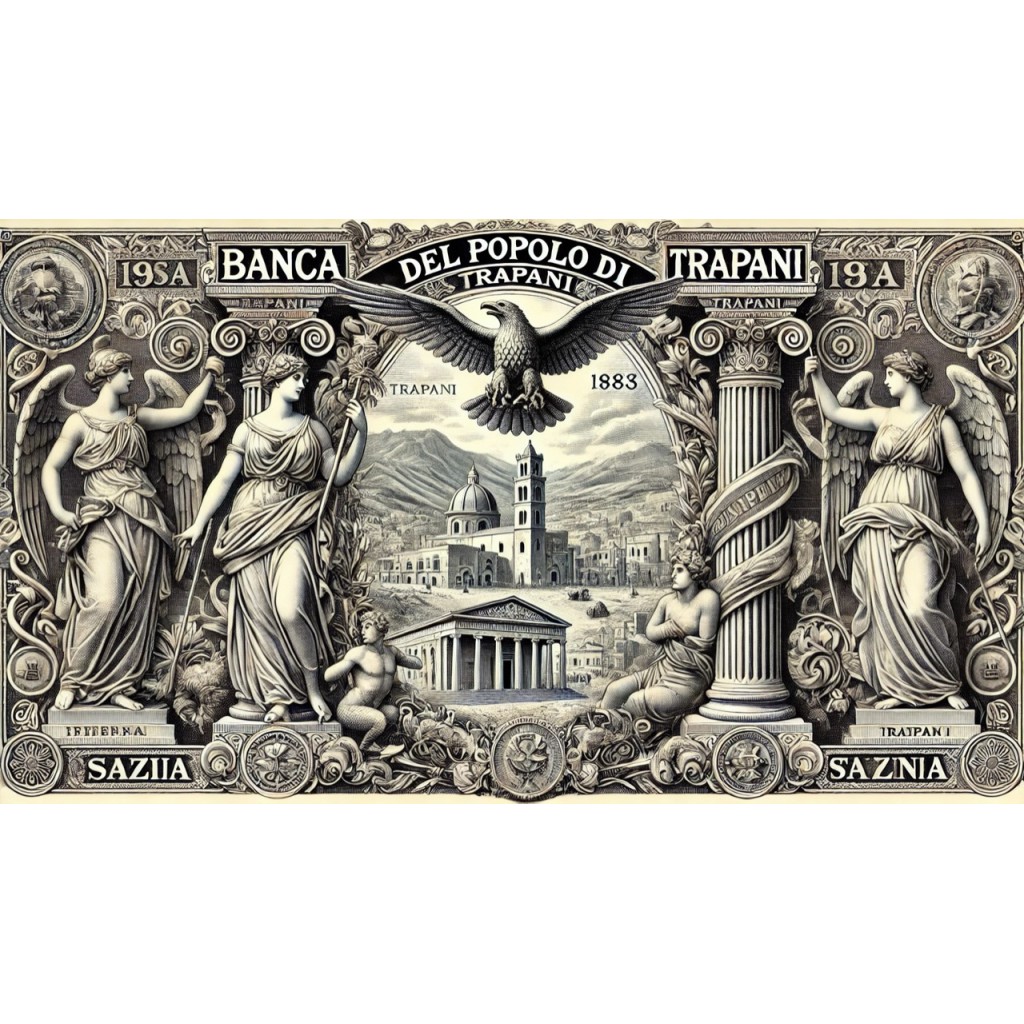
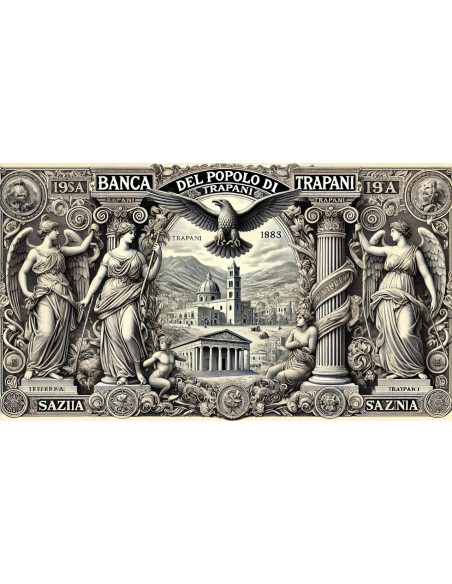
Here is an artistic representative image inspired by the Banca del Popolo di Trapani from 1883, featuring historical and decorative elements from the late 19th century. The image includes allegorical figures of prosperity and security, detailed column motifs, panoramic views of Trapani, and an eagle symbolizing power and protection, along with other regional symbols of Sicily. The style reflects the elaborate and elegant design seen in the original bank certificate.