Shopping Cart
There are no more items in your cart
Document Features
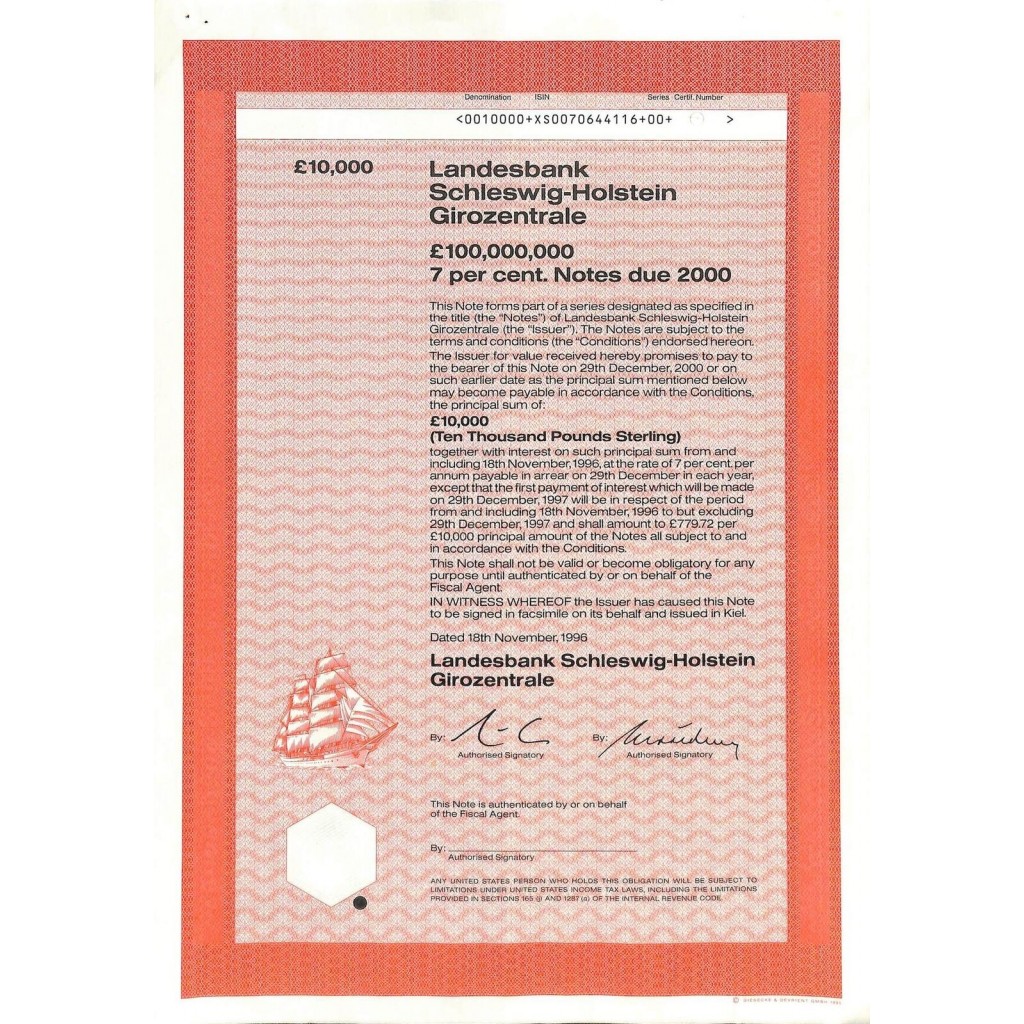
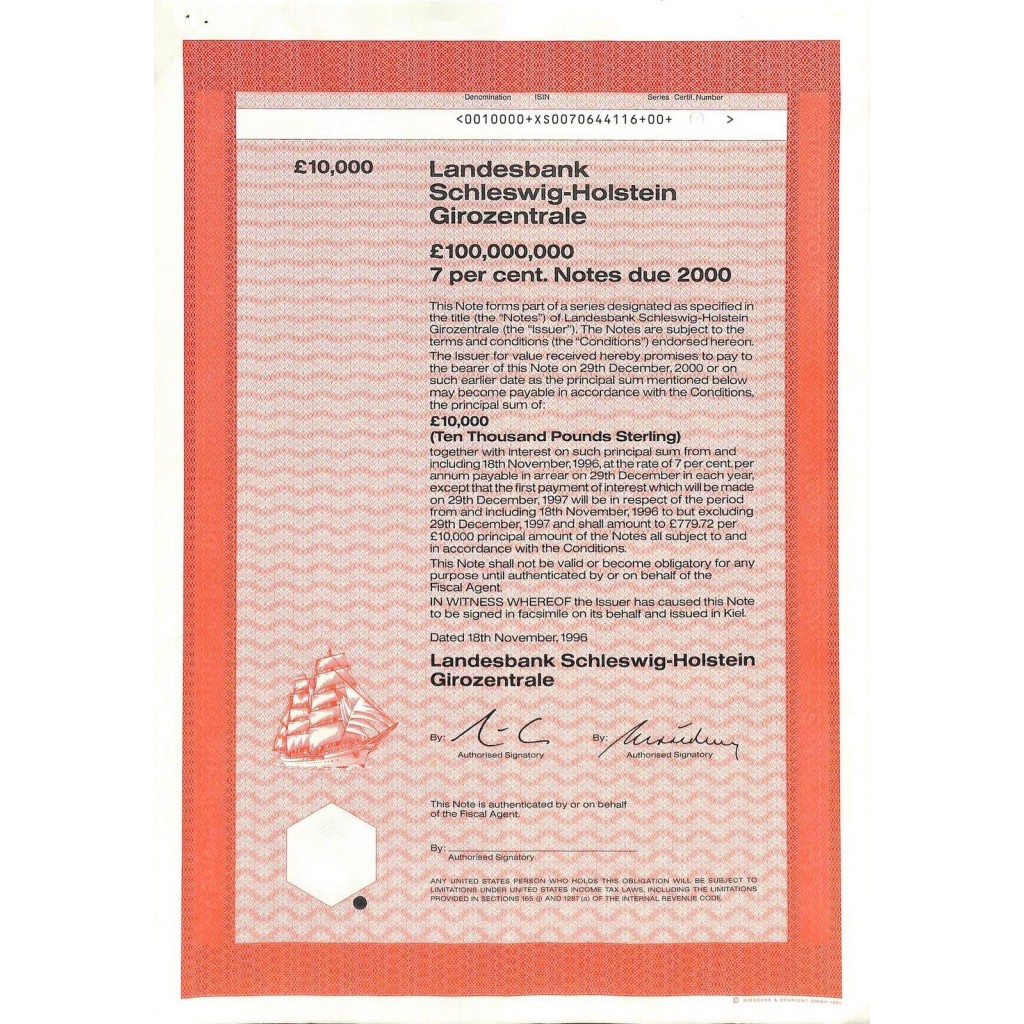
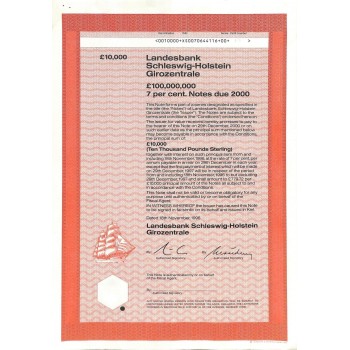
- Issuer: Landesbank Schleswig-Holstein Girozentrale.
- Denomination: £10,000 (Ten Thousand Pounds Sterling).
- Issue Amount: £100,000,000 (One Hundred Million Pounds).
- Interest Rate: 7% per annum.
- Maturity Date: The note is due on 29th December 2000.
- Issue Date: 18th November 1996.
- Design:
- Border: The document features a red border, symbolizing financial importance and urgency.
- Seal: A red ship symbol, representing trade and commerce, is embossed on the document.
- Hexagonal Security Feature: A security feature in the shape of a hexagon is included.
- Legal and Financial Terms:
- The document details the terms and conditions governing the note, including the interest calculation and payment schedule.
- It includes clauses specifying that the note is only valid when authenticated by or on behalf of the fiscal agent.
- Signatures:
- The document is signed by authorized signatories of Landesbank Schleswig-Holstein Girozentrale, ensuring its authenticity.
History of Landesbank Schleswig-Holstein Girozentrale
Landesbank Schleswig-Holstein Girozentrale (LB Kiel) was a prominent regional bank in Germany, established to support economic development in the state of Schleswig-Holstein. The bank played a crucial role in providing financial services, including lending, investment, and advisory services to businesses and government entities within the region.
During the late 20th century, LB Kiel issued several bonds and notes to raise capital for various developmental projects. The 1996 note is a testament to the bank's efforts to engage with international financial markets and secure funding for regional growth. LB Kiel later became part of HSH Nordbank, continuing its legacy of supporting economic development in Northern Germany.
Conclusion
This note is not just a financial instrument but a piece of history, showcasing the financial practices of regional banks in Germany. It highlights the importance of Landesbank Schleswig-Holstein Girozentrale in the economic development of the region and its engagement with international markets.
Collectors and historians value these documents for their historical significance and the glimpse they provide into the financial strategies of the past.