
Shopping Cart
There are no more items in your cart
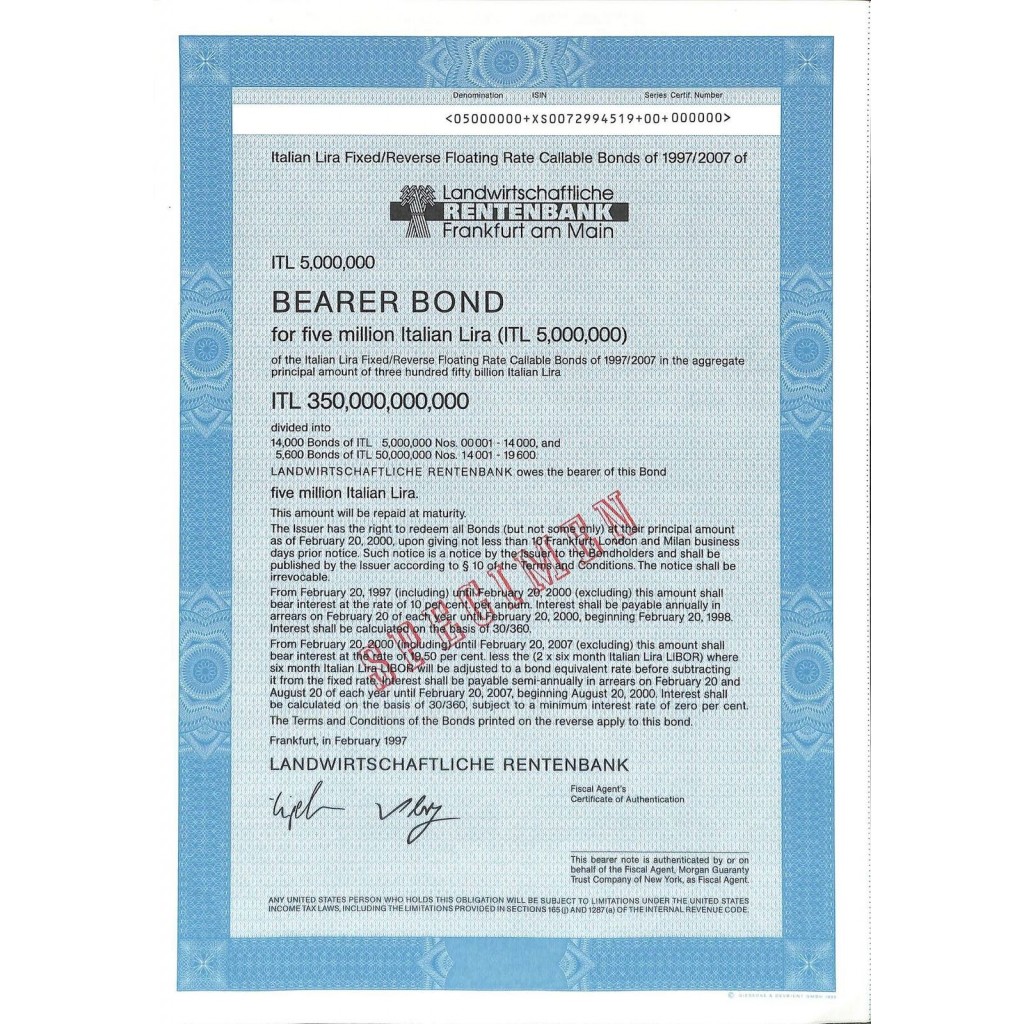


The bond details are printed on a blue-bordered certificate, emphasizing the security and authenticity of the document. The terms specify that the issuer can redeem the bonds at their principal amount starting from February 20, 2000, with a notice period of no less than ten banking days in London and Milan. The interest rate for this bond is structured in two phases: from February 20, 1997, to February 20, 2000, the bond bears interest at a rate of 10 percent per annum, payable annually in arrears. From February 20, 2000, to February 20, 2007, the interest rate is calculated as 9.50 percent less the six-month Italian Lira LIBOR rate, with a minimum interest rate of zero percent.
This bond is authenticated by signatures from the fiscal agent's certificate of authentication, ensuring its validity and trustworthiness. The certificate is a specimen and includes a clear stipulation that it is subject to U.S. income tax laws, specifically sections 165(j) and 1287(a) of the Internal Revenue Code.
Historical Context of Landwirtschaftliche Rentenbank
Landwirtschaftliche Rentenbank was established in 1949 to provide financial support to the agricultural sector in Germany. As a development bank, it offers low-interest loans and financial services to promote rural development and ensure the stability of agricultural markets. The bank plays a crucial role in funding projects related to agriculture, forestry, fisheries, and rural infrastructure.
Over the decades, Landwirtschaftliche Rentenbank has expanded its reach and adapted its financial products to meet the evolving needs of the agricultural sector. It is a key player in supporting sustainable agricultural practices and enhancing the competitiveness of German agriculture on a global scale.