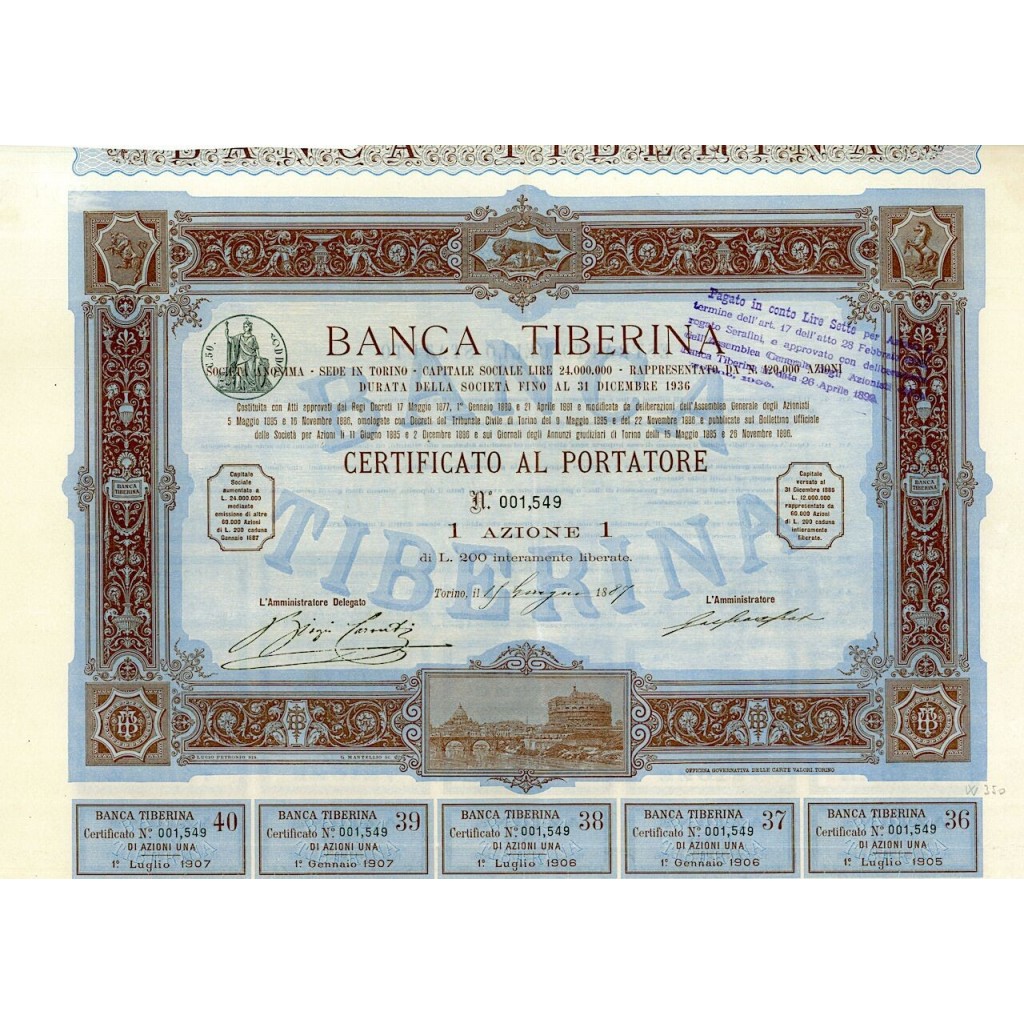
The bank was founded in 1877 noting among other things the failed Italo-Germanic Bank. He was one of the institutions most involved in the speculative sale of building land between Rome, Turin and Naples. Overwhelmed by the Roman building crack of 1899 and by the scandal of the Roman Bank of 1893, which involved various other credit companies, she was forced to liquidate in 1895 and then declared bankruptcy two years later, in 1897.
The parable of the Banca Tiberina, one of the main credit institutions swept away by the building crack of 1889. A story whose roots date back to the late sixties, when the bankers Geisser and Servadio built a network of real estate companies headed by the Italo-Germanic Bank , true group holding company. Invested together with the real estate sector by the crisis of 1873, the Italo-Germanic is absorbed by the newly formed Banca Tiberina (1877) which, after the initial difficulties, benefits from the changed situation. In the early Eighties, in fact, the increase in the circulation of money (thanks to the abolition of the forced market and the new strategies of the issuing banks) and the spending policies supporting the redevelopment of the cities unlocked the building-real estate market. The investments inherited in the sector from the Tiberina become from immobilizations instrument to promote the traditional banking operations, in particular the mortgage credits to the builders. A profitable but risky mechanism: at the end of the eighties the discrepancy between supply and housing demand deflates the housing bubble and Tiberina finds itself victim of its scarce liquidity. The 40 million loan granted by the National Bank will save Banco Discount and Sete, a reference Turin-based institution of the Tiber, but not the Capitoline bank, forced to liquidate (1895). Strengthened by the intersection of different sources and situated on the border between economic history and bank history, the research offers the opportunity to reflect on some issues. First of all, the decisive role played by the public hand and by deficit spending policies that allow the rescue of the system but discharge the costs of adventurous choices onto the community: thus the losses of the building crack are absorbed by the issuing banks, and the Municipality of Rome intervenes only to ratify the disordered building interventions of private capital, the true organizer of the urban space. A second central node is then constituted by the limits of a banking oriented economy, like the Italian one, with respect to market oriented systems, although the story of the Tiberina is marked by a specific speculative component and does not allow too casual generalizations.