(1887-1893) Crisis of the Italian banking system
Protectionism and trade war Italy-France - The protectionist tariff launched by the Crispi government in 1887 further aggravated the Italian economic condition. Crispi was convinced that whatever the customs regime was, this would not affect trade relations with France to which Italy exported raw materials indispensable for French industries, in particular flock silks and cutting wines. Instead the following year, after a series of ambiguous and inconclusive negotiations, the commercial treaty that bound Italy and France was canceled and a real commercial war began which upset the Italian traffic to foreign countries, directed for more than a third in France. The consequence on Italian agricultural production was heavy and was added to the crisis already underway in the sector. The viticultural and raw silk productions struggled to find an alternative outlet market to France and the transformation of cereal crops into citrus fruit crops, olive trees and vineyards was hampered with considerable damage to the economy of the southern and island regions. Thousands of farmers fell into disrepair, a huge amount of labor was released (in the south, but also in Veneto) that was forced to emigrate, especially to America. The commercial war also had important repercussions on the relations of Italian banks with those on the other side of the Alps, which had financed the major Italian banking institutions, and with the Paris Stock Exchange which was the square on which the negotiations of Italian public debt securities took place.
Type of investment - In the aftermath of the Unit the banks operating in Italy had only marginal interests in the industrial field: the banks granted loans or participated in the establishment of capital only for "safe" companies, such as railway, iron and steel and insurance companies, which could rely on substantial state support. Bank capital usually did not favor the creation of new businesses and also looked with suspicion on requests for financing from solid and established companies. Moreover, even the demand for credit was small, because many industries, in particular the textile one, resorted to self-financing, making use of the conspicuous family assets of the owners of the company.
Strangely, however, the same banks, which showed they did not like the risk of investments in the still weak industrial system, during the 1980s directed their capital in the real estate and construction sector.
Building Speculation - In Rome, between 81 and 88, and in Naples, after the 1884 Restructuring Law, many operators embarked on building speculation. Companies specialized in construction, makeshift builders, businessmen and speculators from various regions of northern and central Italy, but above all from Piedmont and Veneto, set up specialized banking institutions that had the function of collecting private capital, but above all of serve as a means to obtain credit from the major ordinary banks and issuing institutions. The speculation assumed colossal proportions especially after 1883. It seemed that it was enough to buy building land, even procuring high-interest money, in order to realize gains of 200 and 300% in a few months. The banks most involved in the sale of land were Banca Tiberina and the Esquilino Company.
Banca Tiberina was closely linked to the Discount Bank and Sete of Turin; it had expanded purchases of manufacturing land in Rome and Naples so extensively that it not only increased its capital from 15 million to 30 million,but was forced to resort widely to the credit of Banco Discount Sete and the National Bank. Similarly, the Esquiline Society was linked to the Turin bank. But a sudden narrowing of the real estate market in 1888, caused in part by the withdrawal of French capital following the trade war, caused the speculative bubble to burst. The crisis created serious liquidity difficulties not only for banks that were more closely linked to construction companies, such as Banca Tiberina, the Esquilino Company and Banco Discount and Sete, but also of the two largest Italian securities institutions, namely the General Bank and the General Company of Credit Mobilization.
However, the banking crisis was delayed in part by the relief that the first application of the 87 tariff seemed to assure the largest, most dangerous industries, and to a greater extent monetary and credit inflation, which they resorted to many bailouts were possible, and in fact allowed many companies to slow down their production.
But in reality, with the bailouts and inflation, the crisis has only been delayed and aggravated.
Since 1890, also due to the repercussions of the crisis that has been affecting all over Europe, the indices of Italian economic life give evidence of a general worsening of prices, in agricultural, mining and industrial production, in the railway movement, in foreign trade and especially in the imports of raw materials, and also of many types of industrial machines, which cannot yet be supplied by domestic production.
Building speculation, which had assumed ever greater proportions in Rome after 1883 and in Naples after 1884, had found the major sources of credit in some banks in Turin, and at the forefront of Banca Tiberina, Banco Discount and Sete, in the Banca di Torino and in the Subalpine Bank. Some of these banks were interested in other large companies and their difficulties in turn had repercussions on the issuing institutions, and among them, more seriously, on the Banca Nazionale, on the Banco di Napoli, on the Banca Romana, while it remained the Banca di Toscana is almost completely exempt. Often the person in charge was the same government, which, in order to give the issuing institutions the possibility of coming to the rescue of the unsafe banks, authorized from time to time the individual banks, and above all the National Bank and the Banco di Napoli, to exceed the limits set by the law to their fiduciary paper issues. The almost immediate and inevitable consequences of the excessive increase in fiduciary circulation, to which was added in the same years a serious deterioration in the situation of state finances, were the decline in the prices of public debt securities and the factual return to the forced price, which the banks implemented, delaying by any means the conversion of their tickets into metallic currency.
In those same years, rumors of serious abuses began to spread, which were allegedly committed by some banks, and mainly by the Banca Romana.
The Roman Bank was established in 1835 under Pope Gregory XVI as the Bank of the Papal States; it supported the interests of the class of merchants and of the Roman ruling class. After the Unification, the Italian State decided to keep the institute alive and to grant it the right to issue, although the bank had been showing signs of bad management for some time. The institution was in fact too tied to Roman and pontifical society and closing it would have seemed an act of force against the Pope himself.
Banca Romana Scandal - In 1889, at the height of the banking crisis in Turin, closely connected with the Rome building crisis, the Minister of Agriculture, Industry and Commerce, Miceli, took the initiative to order an inspection on the situation of the issuing banks and entrusted the task to Senator Giacomo Alvisi assisted by a senior Treasury official, Gustavo Biagini. The Alvisi-Biagini report was officially presented as a mere formality, an internal administrative matter and it was decided to keep it secret, in order not to damage the credit of the Italian banking and financial system. This move, however, had the effect of increasing distrust and suspicion, reinforced also by some indiscretion leaked on the results of the inspection. Above all there was talk of the more serious fact that it would have ascertained, that is, the existence of fake tickets put into circulation by the Banca Romana. However, the overcoming of the Turin banking crisis, the improvement of the international situation and the death of Senator Alvisi made us forget the Alvisi-Biagini report, a copy of which was delivered by Alvisi himself, shortly before his death, to the economist Leone Wollemborg. This copy ended up in the hands of Maffeo Pantaleoni who in turn delivered it in December 1892 to the honorable Napoleone Colajanni, a member of the extreme left.
In those days the Giolitti bill was being discussed in the Chamber on the extension of the issuing privilege for six years, then three months, to all the institutions that already had it; Giolitti, aware of the real conditions of the issuing banks, perhaps believed that he could thus restore the institutions. This bill came to block the merger projects between the six issuing banks, carried out on and off by the National Bank.
The scandal broke out on December 20, 1892 when Colajanni in a House session made the content of the Alvisi-Biagini report public. The report of three years before had established that the Banca Romana lent money without guarantees to people who did not pay or at the very most renewed bills of exchange indefinitely; the same governor Tanlongo and the Cashier Lazzaroni had withdrawn money from the coffers of the banca for personal use. Debtors of the bank were mainly politicians who had requested loans for election campaigns, for the expenses of the ministries and to subsidize the newspapers to keep the press under control. In addition, Biagini had ascertained that the Roman had clandestinely printed nine million lire in denominations of one thousand, two hundred and fifty lire and that there was a cash vacuum of almost ten million. The results of the investigation produced an enormous impression and led to a new administrative inquiry by a commission of officials, chaired by the Hon. Gaspare Finali and then, given the involvement of numerous politicians, a parliamentary inquiry was carried out entrusted to a commission of seven members, chaired by the Honorable Antonio Mordini.
The Governor Tanlongo and the Cashier Lazzaroni were arrested in January 1993 and from the interrogations a very serious situation came up. In the last three years, Tanlongo was pressured by constant requests for money from ministers, deputies and journalists, and since it was not possible for him to increase clandestine traffic beyond the limit reached, the governor had duplicated a large number of tickets. Italian institutes used English companies to print their paper money. From 1972 the Romana turned to the H.C. Sanders & Co. Di Londa, which also stamped the progressive number on the tickets. In the 1990s, without consulting the ministerial offices or even the internal ones (and with the complicity of Lazzaroni), Tanlongo had commissioned the British company to print some stock of tickets with a series of numbers twenty years before, citing the want to replace old and crumpled banknotes with new ones. To put them into circulation, Tanlongo, his son and Lazzaroni printed on the banknotes the signatures of the deceased governor and of the censors. Of these notes, about nine million lire was put into circulation.
Part of the cash vacuum was caused by loans granted in various capacities to influential politicians, including Giolitti (who since the outbreak of the scandal had always denied knowing the true situation of the Romana) and Crispi.
Similar controls were carried out in the other issuing institutions; irregularities and a shortfall of over two million were also found in the Roman branch of the Banco di Napoli.
The scandal ended at the end of the same year 1893 with the reading of the report of the Commission of the Seven, followed by the resignation of the Giolitti Ministry and, a short distance away, from the closure of the criminal trial against Tanlongo and Lazzaroni. The liquidation of the Banca Romana and its merger with the National Bank in the Kingdom, the Banca Nazionale Toscana and the Banca Toscana di Credito were approved.
From this merger the Bank of Italy was born, which was joined by the Banco di Napoli and the Banco di Sicilia. The three institutes should have acted in a coordinated manner, and no longer according to unbridled competition; moreover many decisions, such as the discount rate and the quantity of printed money, would have been taken by the Treasury and unified for all three institutes.
Falling Credit Mobiliare and General Bank - The collapse of the Banca Romana was accompanied or immediately followed by the almost total ruin of the Italian banking system.
Turin, which for almost thirty years had been the maximum banking center of the new Kingdom, was in full crisis since 1887; despite the bailouts, the Turin banks fell between 1992 and 1993 and Turin ceased to be the great financial center that had been until then.
An even more serious blow to the Italian economy was the fall of the two most powerful ordinary credit institutions, which extended their action throughout the Kingdom, which combined credit to the exercise of credit in the short and medium term. long term: the General Company of Credit Mobiliare and the General Bank. Both the institutions had overcome the crises of the previous years, they had a reputation of unquestionable solidity and to them were supported, to a greater or lesser extent, all the major Italian companies and other banking institutions.
The Credito Mobiliare, through the Real Estate Company, had begun to participate in the building speculation of Rome, and - shortly afterwards - through the Società del Risanamento, whose creation was also contested in Naples. For these participations it registered a loss of 30 million in six years, from 1886 to 1891. The immediate consequence of these losses was the rapid disappearance of the reserve. At first, in 1891, an attempt was made to transform the institution into a bank of pure short-term commercial credit and the results seemed good, but at the end of 1894 the bank was put into liquidation, with a loss of 53 million. , the share capital reduced from 60 to 7 million ni and reserve nothing.
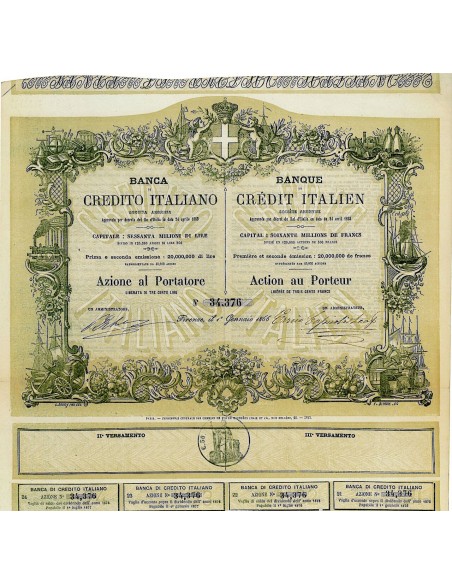
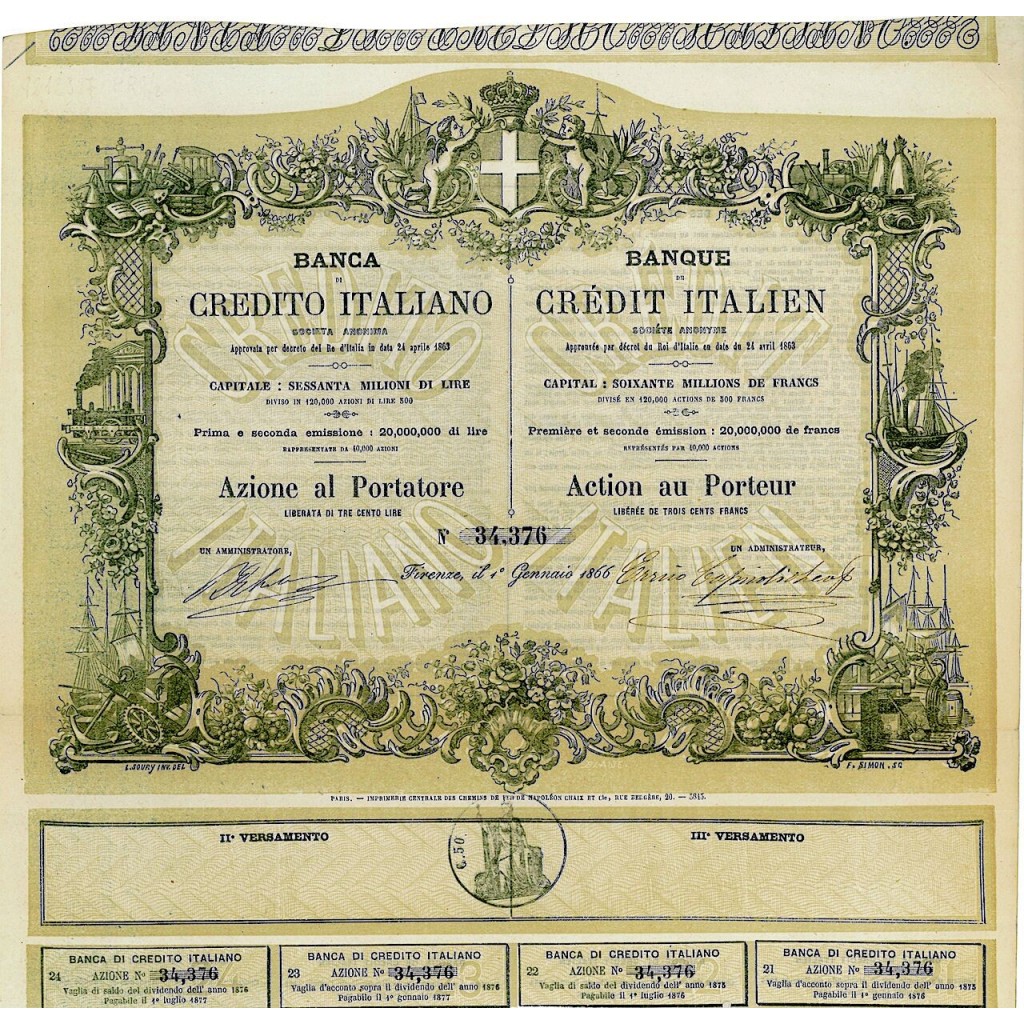
A few weeks later the General Bank also fell. Beginning in 1884, the bank had engaged in large-scale business of creating new banking and industrial financing institutes in Terni, Naples, the Mediterranean Railways, Milan and abroad, with initially excellent results. But from 1887 it suffered great losses due to the industries of Terni, to the useless rescue of the Esquiline, to the building speculation in Milan and to Naples, to the trade war with France that put in crisis the relationships with the banks of beyond the Alps. Quotations of shares on the stock exchange began to fall, panic spread among the depositors, who flocked to the branches to collect their deposits. The liquidation was assumed by a group of foreign banks and bankers, Germans in particular, giving birth to Credito Italiano.
Conclusion - The very serious crisis that began in 1887 closes towards the middle of 1893, with the almost total collapse of the Italian banking system. Not only does Italy remain completely lacking in large ordinary credit institutions, but only very few and very poor potentials survive. Alongside these, the ordinary and postal savings banks and the cooperative banks remain alive.
The issuing banks have suffered very serious losses and for many years they are condemned to a sharp decrease in their activity, due to the large fixed assets they have had to bear, especially as a result of the construction crisis and the credit policy that is too compliant and imprudent that they have exercised in the decade 1881-90.