Shopping Cart
There are no more items in your cart
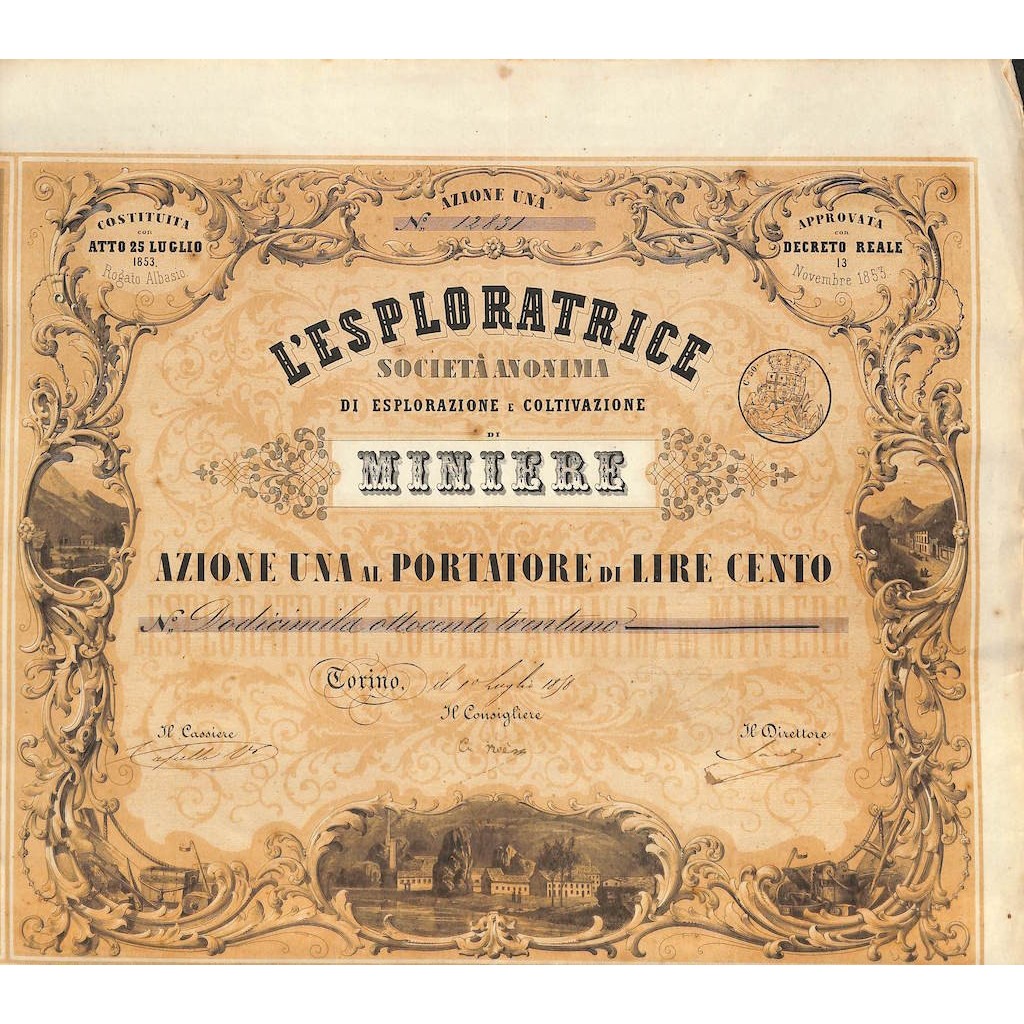
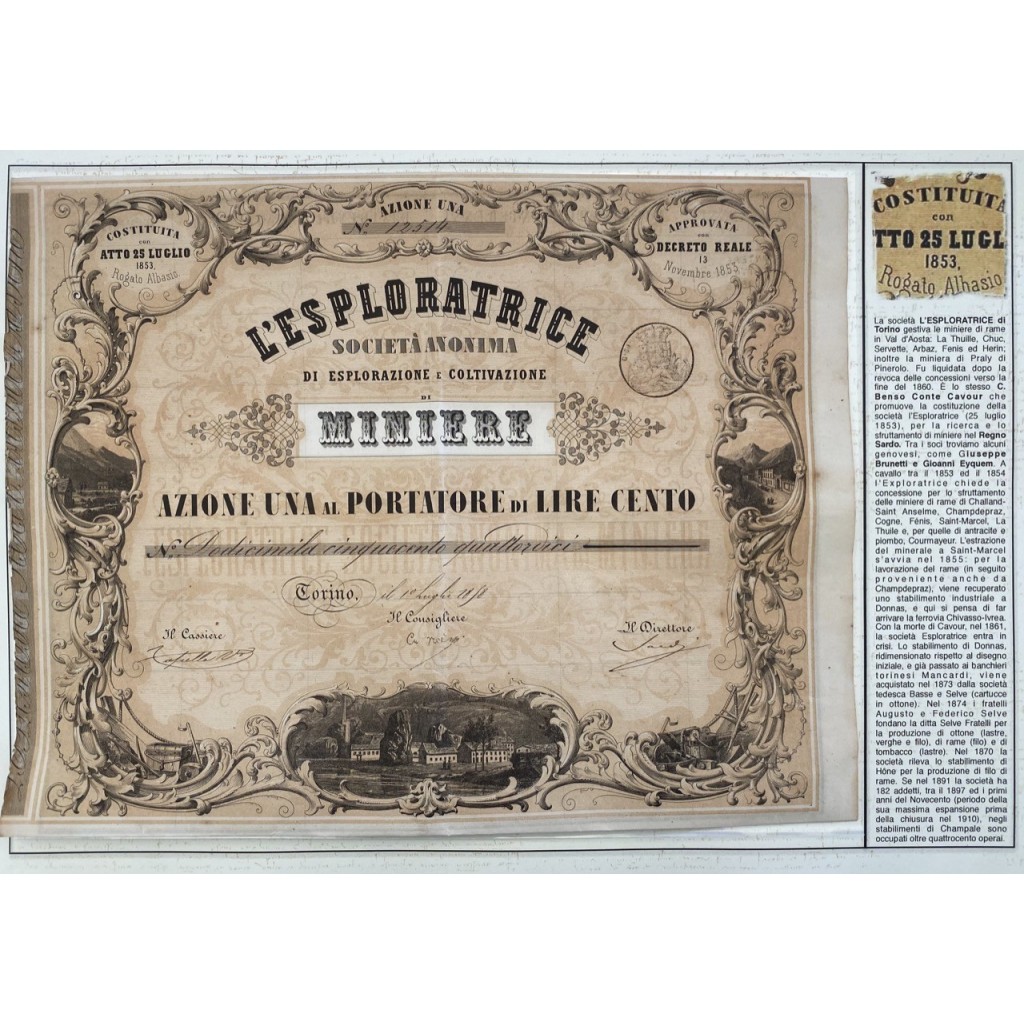
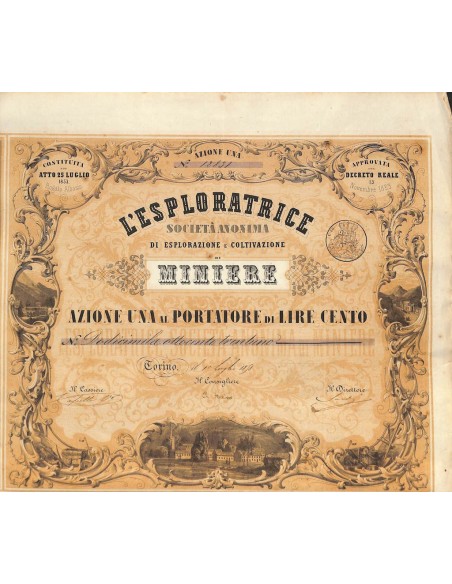
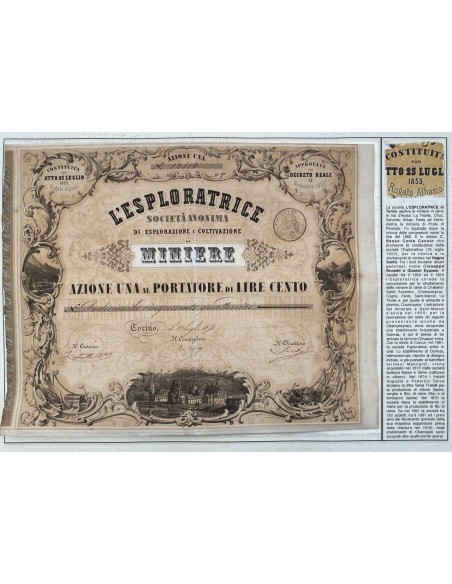
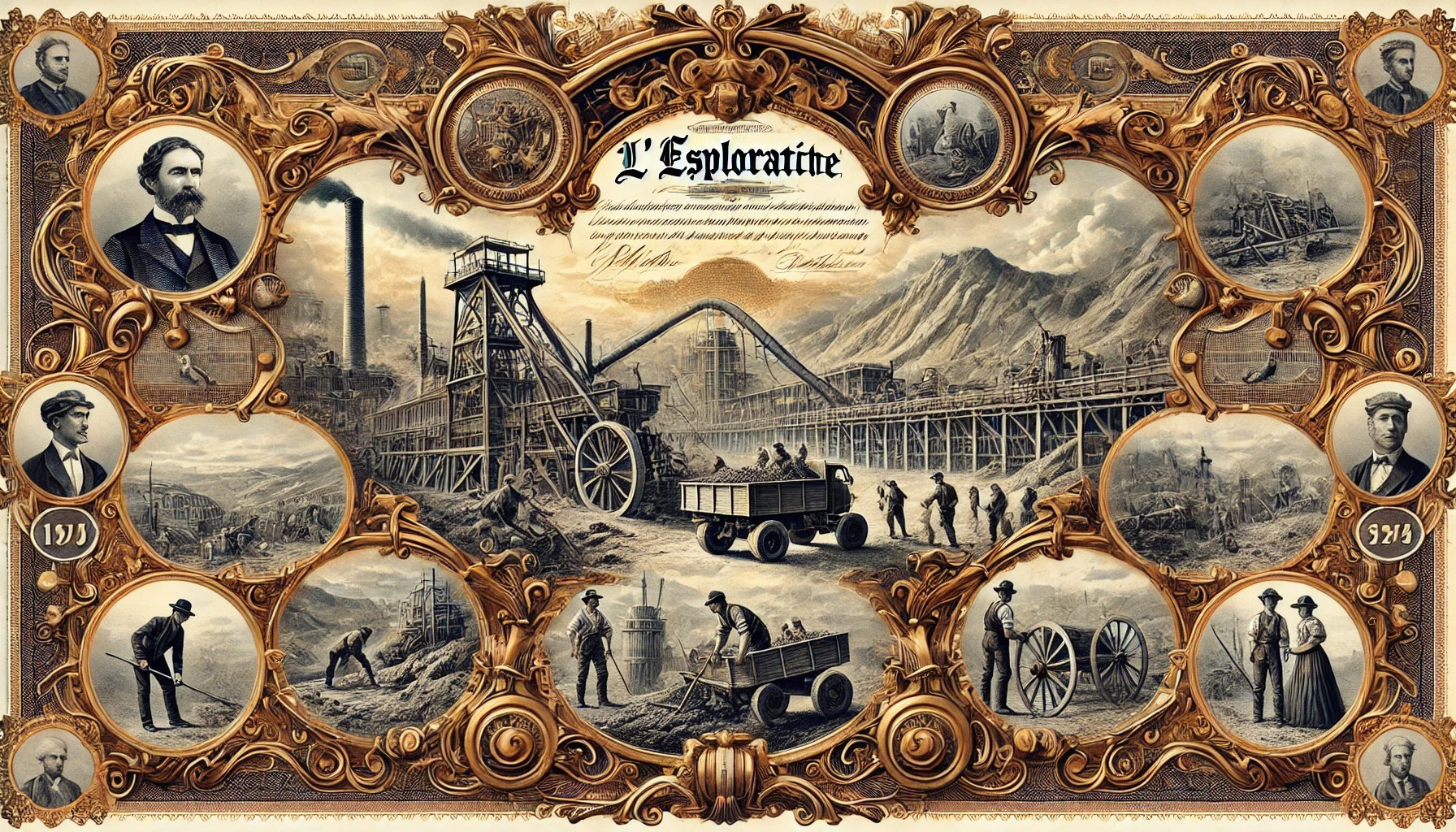
A document that brings us back to preunity Italy, or at 1858. Specifically, these are one action to the bearer of one hundred lire each issued by the explorer, an anonymous company of exploration and cultivation of mines of Turin.
The company manages the copper mines in the Aosta Valley: the Thuille, CHUC, Servette, Arbaz, Fenis and Herin; In addition, the Praly's Mine of Pinerolo.
The company has a short life: seven years, from 1853 to the end of 1860 when it is liquidated after the revocation of concessions. But let's see the vicissitudes briefly again. The architect of the birth of the explorer is Count Camillo Benso di Cavour. On July 25, 1853 the company sees the light with the aim of seeking and exploiting the mines in the Sardinian Kingdom.
The Genoese Giuseppe Brunetti and Gioanni Eyquem become members. Between 1853 and 1854 the explorer is asking for the concession for the exploitation of the copper mines of Challand-Saint Anselme, Champdepraz, Cogne, Fénis, Saint-Marcel, the Thuile and, for those of Anthracite and Lead, Courmayeur.
The extraction of the mineral in Saint-Marcel starts in 1855: for the processing of copper (later also coming from Champdepraz), an industrial factory in Donnas is recovered, and here we think of getting the Chivasso-Ivrea railway. While the unit of Italy is being made, the company enters crisis and the important women's factory, is detected by the Turin bankers Mancardi.
In 1873 he passed into the hands of the German company Basse and Selve. The Aosta Valley has a history linked to the research and extraction of minerals that dates back to the second century before Christ, when the room, probably population of Ligurian origin, begin to rudimentally exploit the deposits of the area. In the eighteenth and eighteenth centuries, the iron and copper mines are used to cope with the growing demands of the Arsenal Sabaudo.
Currently the mines are all abandoned and are found in very suggestive places with breathtaking views and have been becoming destinations for years that attract tourists as they combine the interest in industrial archeology in the opportunity to hike. For this reason, the Valle d'Aosta region has recently started a disused mines recovery project, with the dual purpose of giving the local community the way to revive the traces of their past and to convert them into tourist attraction sites.
Among the latter we include the mines of Brusson and Saint-Marcel who are capable of attracting tourists all year round. Even the mines of Cogne are no different, here the remains of the cablets for the transport of the material are clearly visible, the cable car for passengers who came from Cogne to column and numerous buildings. Also in Cogne, the ancient silver mine of Valeille, that of copper of Ecloseur and that of Larsinaz magnetitis should be reported.
Interesting is the stage at the visitors center of the Gran Paradiso Alpinart National Park and its permanent exhibition on the Cogne magnetite mine. Here you can admire the illustration of history, geology, mining complex and production activity. But it is the whole of the Aosta area that is rich in underground structures, plants, connection and transport systems.
To make all this accessible and visited, the Region has created a system of visiting and accompaniment paths with specific itineraries, safety of the slopes, opening of portions of gallery, specific museum and archival structures including numerous centers of documentation.
Representative image