Shopping Cart
There are no more items in your cart


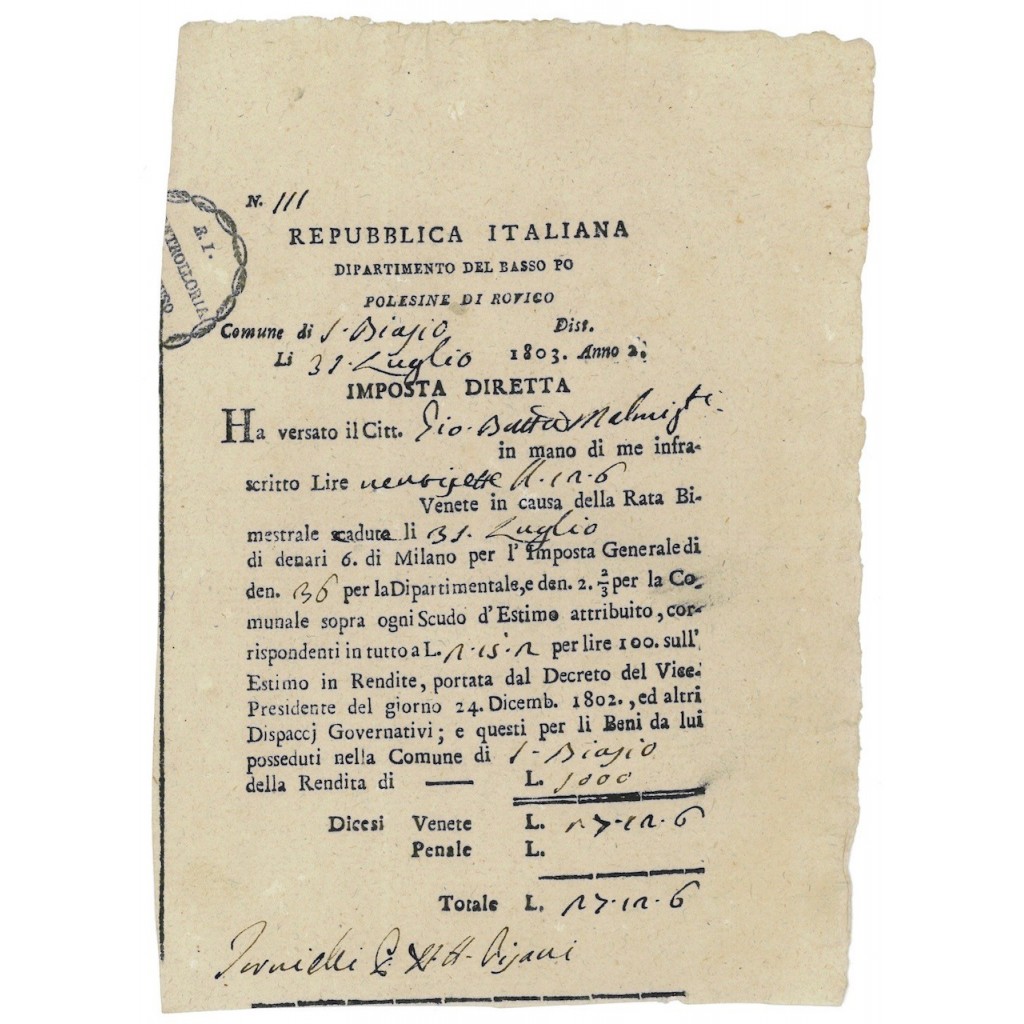
The document under review is a tax payment receipt issued on July 31, 1803, by the Department of the Lower Po under the Italian Republic. This document represents an important example of the fiscal practices during the Napoleonic era in Italy, a period characterized by significant political and administrative changes.
Historical Context
In 1802, the Italian Republic was established as a satellite state of Napoleonic France, encompassing much of northern Italy. The administrative and fiscal system was reorganized based on the French model, introducing new forms of taxation and financial control. The Department of the Lower Po, which included the municipality of San Biagio, was part of this new administrative structure.
Direct taxes, such as the one documented in this receipt, were essential to fund the public administration and military commitments of the Republic. The document records the payment made by citizen Gio. Battista Schivetti, with the amount specified in Venetian lire, one of the currencies used at that time.
Historical Data of the Society
| Historical Data | Information |
|---|---|
| Year of Establishment | 1802 (Italian Republic) |
| Headquarters | Department of the Lower Po, Italy |
| Share Capital at Establishment | Not available |
| Share Capital in 1803 | Not available |
| Year of Stock Exchange Listing | Not applicable |
| Year of Delisting | Not applicable |
| Year of Company Cessation | 1805 (when the Italian Republic became the Kingdom of Italy) |
| Type of Document | Tax payment receipt |
Certificate Features
| Feature | Detail |
|---|---|
| Issue Date | July 31, 1803 |
| Type of Document | Direct Tax Payment Receipt |
| Text | Handwritten and printed, in Italian |
| Signature | Signed by a local official |
| Stamp | Present, circular, with inscription "A. I." and "Administration" |
| Printing | Partially printed and handwritten document |
| State of Preservation | Good, with signs of wear consistent with age |
Artistic and Typographical Description
The document features a combination of printed and handwritten text. The printed portion uses a clear and legible typographic font, typical of official documents from the Napoleonic period. The handwritten section completes the specific payment information. The circular stamp reinforces the document's authenticity, while the official's signature confirms the payment's registration.
Provenance of the Certificate
This document was found in a private collection and represents a rare testimony to the fiscal and administrative practices of the Italian Republic under Napoleonic control. Its authenticity is evidenced by the presence of original stamps and signatures.
Valuation and Rarity
The tax payment receipt from 1803 is considered rare, as such fiscal documents rarely survive intact to the present day. Its preservation in good condition and its historical and geographical specificity increase its interest for collectors and scholars. Compared to other similar documents, its rarity is significant, especially considering the short existence of the Italian Republic.
The Importance of Scripophily Collecting
Collecting historical documents such as this tax payment receipt allows the preservation and study of crucial aspects of Italy's economic and political history. These documents offer a window into the past, illustrating how public administrations functioned and how citizens interacted with tax authorities. Scripophily collectors help keep historical heritage alive, ensuring that these important documents are not lost.
Display and Preservation Tips
To best preserve this document, it is advisable to store it in a frame with anti-reflective and UV-protected glass, away from direct light and humidity. It can be displayed as part of a larger historical collection or as a single item of particular interest, representing an important fragment of Italian tax history.
All historical documents for sale are intended for collection purposes only. The documents have no economic or financial value (no economic or financial value), and images that are not the historical document are representative of the company's object and the historical period of reference. They are not provided but can be downloaded freely from the website and printed."