Shopping Cart
There are no more items in your cart
Introduction
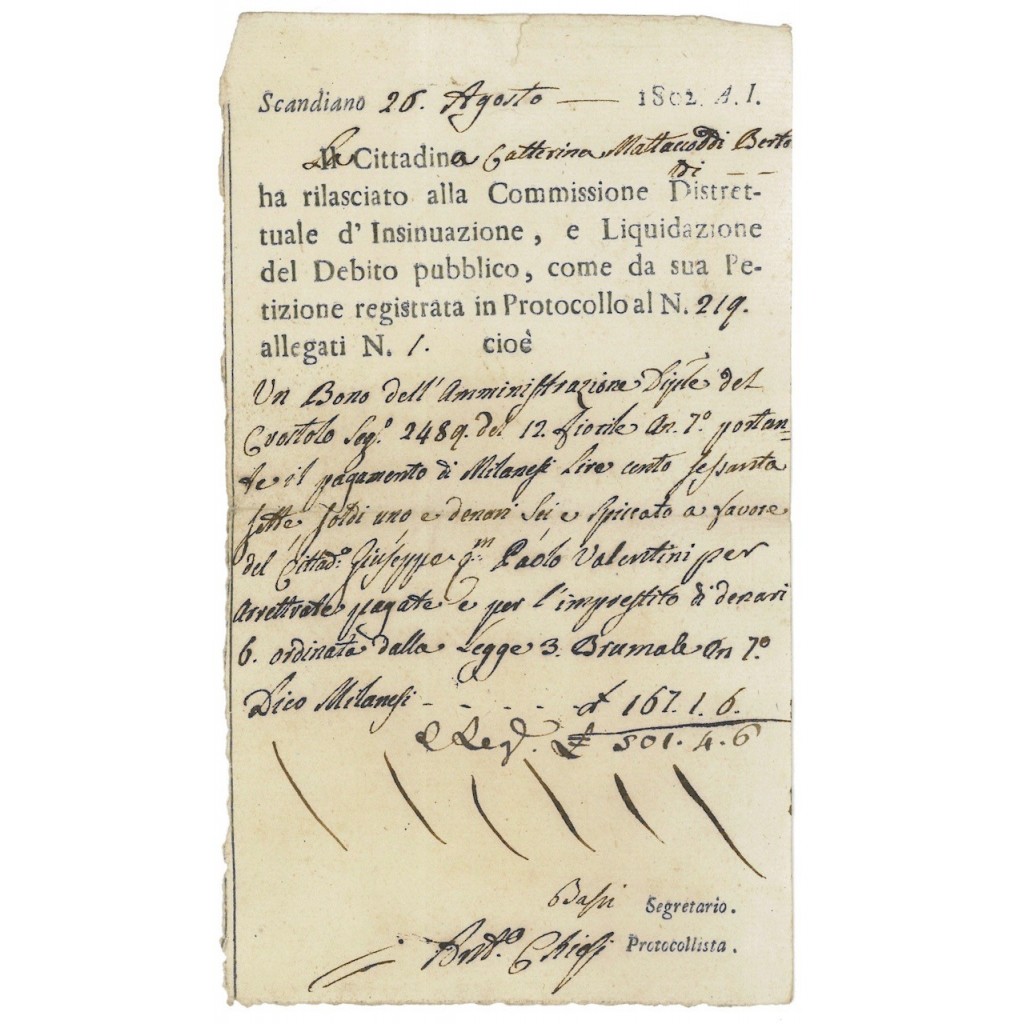
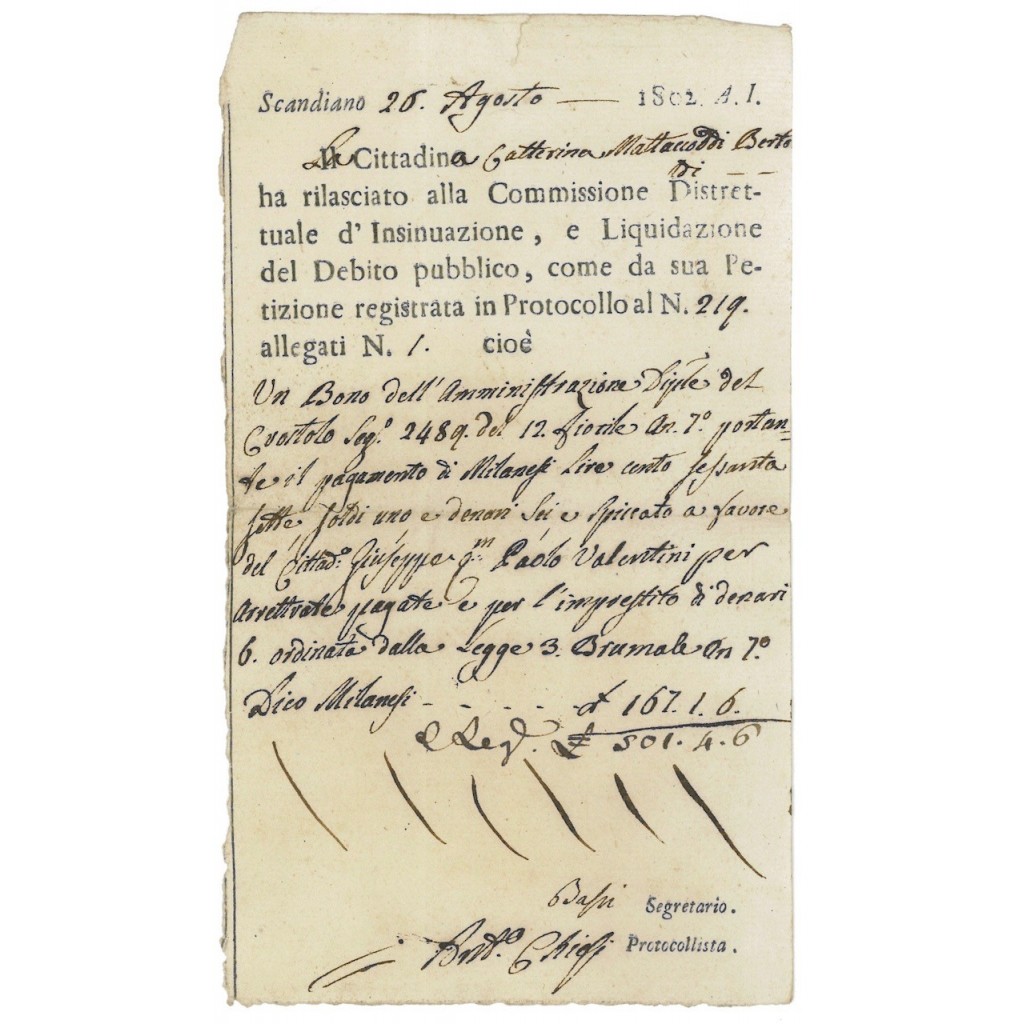
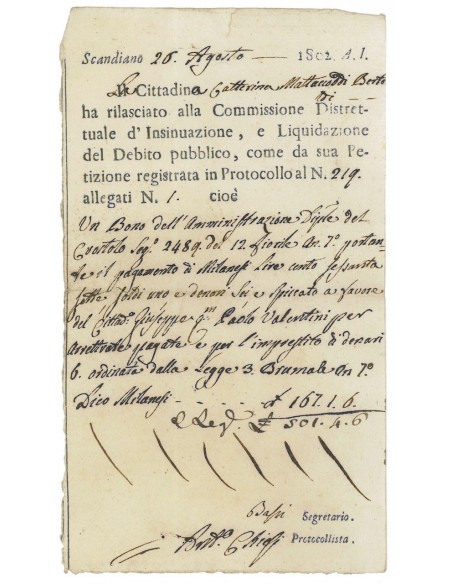
The document under review, dated August 26, 1802, is an important testament to the activities of the District Commission for the Registration and Liquidation of Public Debt in Scandiano. During this historical period, the administration of public debt was a matter of primary importance for local governments, especially in a political and social context characterized by instability and frequent changes.
Historical Context
At the beginning of the 19th century, Italy was fragmented into a myriad of states and statelets, each facing its own economic difficulties. In this context, managing public debt was crucial to ensuring economic and social stability. Scandiano, a small town in northern Italy, was no exception. The District Commission for the Registration and Liquidation of Public Debt was responsible for recording and liquidating debts contracted by the local administration, ensuring that creditors received what was due.
The document under review concerns the citizen Catterina Mattiadi, who submitted a petition for the liquidation of public debt. The nature of the debt and its payment are detailed in the document, which also mentions a "Bono dell'Amministrazione," a form of debt acknowledgment by the authorities.
Historical Data of the Society
| Historical Data | Information |
|---|---|
| Year of Establishment | Not available |
| Headquarters | Scandiano, Italy |
| Share Capital at Establishment | Not available |
| Share Capital in 1802 | Not available |
| Year of Stock Exchange Listing | Not applicable |
| Year of Delisting | Not applicable |
| Year of Company Cessation | Not available |
| Type of Document | Public Debt Liquidation Certificate |
Certificate Features
| Feature | Detail |
|---|---|
| Issue Date | August 26, 1802 |
| Type of Document | Public Debt Liquidation Certificate |
| Text | Handwritten, in Italian |
| Signature | Signed by local officials |
| Printing | Handwritten document |
| State of Preservation | Good, with signs of wear consistent with age |
Artistic and Typographical Description
The document features a handwritten text with clear and legible script, typical of administrative documents of the time. The use of well-defined cursive writing indicates the importance of the document and the care taken in its drafting. There are no particular decorative elements, as the document's function was purely administrative. The text is divided into clearly distinguishable sections, with some key words emphasized.
Valuation and Rarity
The certificate issued by the District Commission of Scandiano in 1802 is considered rare, especially for its specific historical and geographical context. Documents related to public debt liquidation are particularly sought after by scripophily collectors, for their ability to reveal little-known aspects of Italian economic and administrative history. The good preservation of the document further enhances its value.
The Importance of Scripophily Collecting
Collecting historical documents such as this public debt liquidation certificate from Scandiano is an activity that allows the preservation of important testimonies from our past. These documents offer a unique insight into the administrative practices and economic challenges faced by local communities. Scripophily collectors play a crucial role in keeping historical memory alive, helping to protect and enhance documents that might otherwise be lost.
Display and Preservation Tips
To ensure optimal preservation of this document, it is advisable to store it in a frame with anti-reflective and UV-protected glass, to prevent damage caused by light and humidity. This certificate can be displayed as part of a larger collection or as a single piece of historical art, representing an element of great interest for anyone passionate about economic history.
All historical documents for sale are intended for collection purposes only. The documents have no economic or financial value (no economic or financial value), and images that are not the historical document are representative of the company's object and the historical period of reference. They are not provided but can be downloaded freely from the website and printed.