
Shopping Cart
There are no more items in your cart



Article on the Russian State Loan of 1905 - Second Issue
History of the Russian State Loan of 1905
The Russian State Loan of 1905, in its second issue, represents another significant financial document of the Russian Empire, issued during a critical period for the nation. This loan was issued in the context of the Russo-Japanese War and the subsequent social turmoil that culminated in the 1905 Revolution, an event that profoundly marked the history of the Empire and accelerated its decline.
The second issue of this loan followed the same lines as the first, with an interest rate of 4½% and offered in various currencies: rubles, German marks, Dutch guilders, and British pounds. This diversification of currencies was a clear attempt to attract international capital, as the Russian government needed to finance the growing deficit caused by war expenses and internal disorder.
The loan was launched in a context of political and economic instability, with the aim of raising sufficient funds to support the war effort and attempt to maintain investor confidence. However, like the first issue, this one also faced difficulties due to growing uncertainty and ongoing political changes.
Historical Context of 1905
The year 1905 was a turning point in Russian history. After the defeat in the Russo-Japanese War, the Russian Empire was shaken by a series of revolts and strikes that culminated in the 1905 Revolution. This wave of protests led to the creation of the Duma, a parliament with limited powers, and marked the beginning of the decline of the tsarist autocracy. The economic situation was equally precarious, with a fiscal crisis that necessitated external and internal loans to support the government and finance military expenses.
Historical Data of the Loan
| Loan Data | Value |
|---|---|
| Year of Issuance | 1905 |
| Issuing Government | Russian Imperial Government |
| Nominal Value | 2315 Rubles - 2940 Dutch Guilders |
| Total Amount Issued | 231,500,000 Rubles |
| Interest Rate | 4½% |
| Loan Type | State Loan |
| Maturity Date | December 19, 1985 |
Document Characteristics
| Document Characteristics | Description |
|---|---|
| Title Type | Bond |
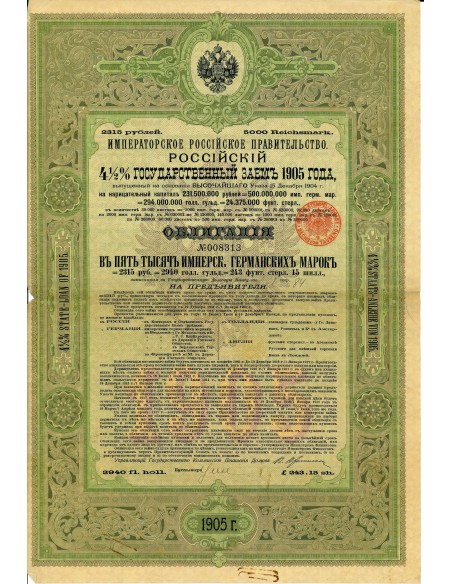
| Issuance | 4½% State Loan of 1905 |
| Currency | 2315 Rubles |
| Serial Number | 008313 |
| Date of Issue | 1905 |
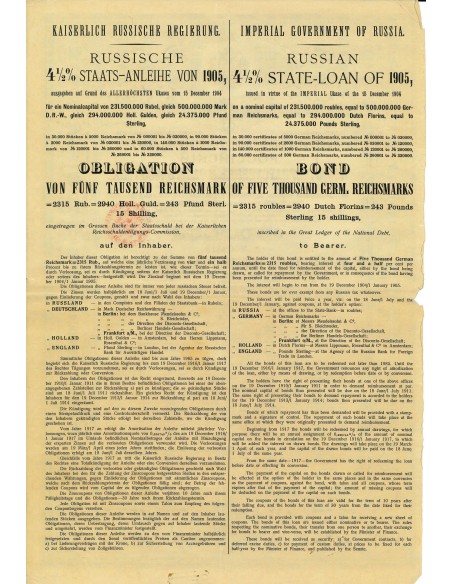
| Language | Russian, German, English |
| Nominal Value | 2315 Rubles, 2940 Dutch Guilders |
| Guarantee | Russian Imperial Government |
| Maturity | December 19, 1985 |
Artistic and Typographic Details
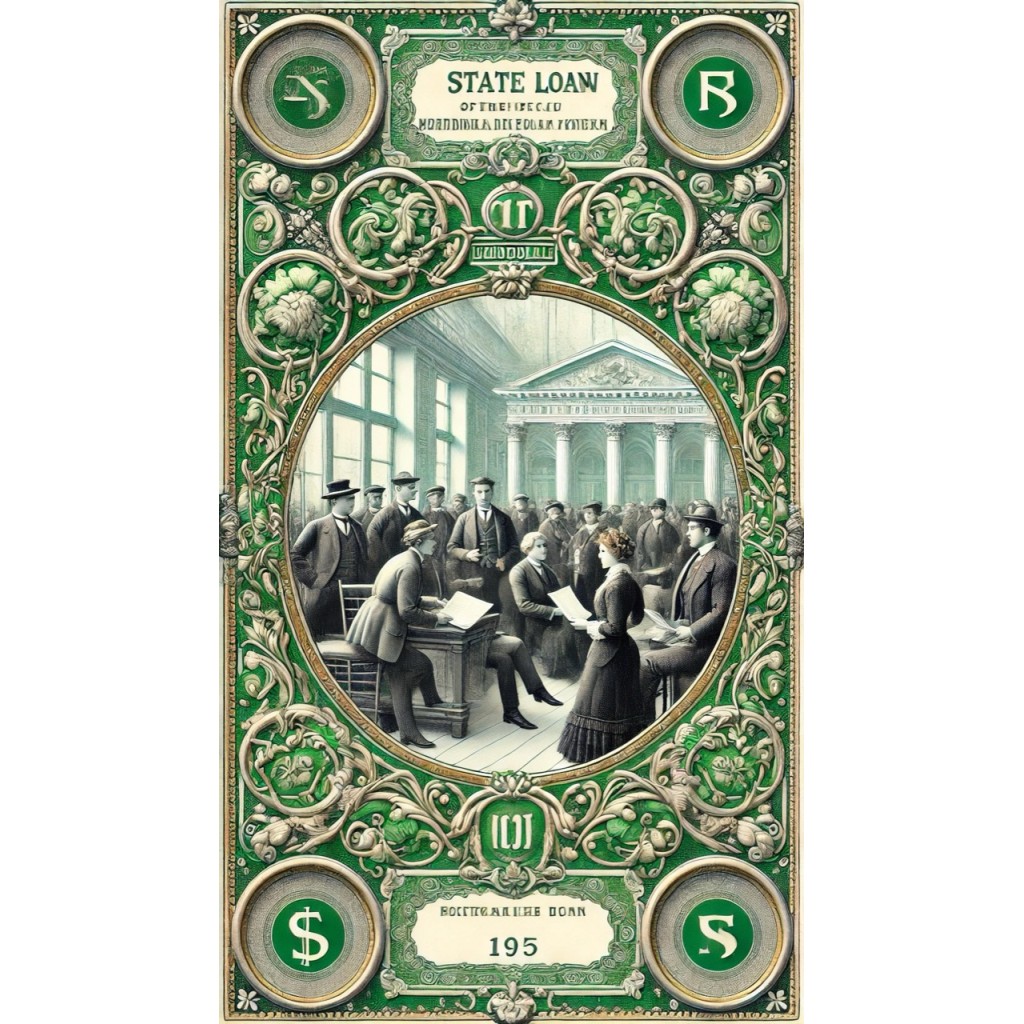
This document is characterized by a sophisticated and detailed design, typical of state bonds from the Russian imperial era. The decorative frame is adorned with intricate floral and geometric patterns, printed in shades of green that reflect the importance and solemnity of the document. At the center is the Russian imperial crest, symbolizing the authority of the state. The typography is precise and clear, enriched with texts in Russian, German, and English, demonstrating the attempt to attract investors from different countries.
Provenance of the Title
This bond was issued by the Russian Imperial Government during a period of intense political and economic crisis. Its preservation to the present day makes it a document of great interest to scripophily collectors. Its rarity and good state of preservation contribute to making it a valuable piece of Russian financial history.
Valuation and Rarity
The Russian State Loan of 1905, second issue, is considered rare, especially if preserved in good condition. The value of this bond has increased in recent years, fueled by interest in pre-revolutionary Russian financial documents. Currently, the estimated value of a bond like this ranges between 500 and 1,000 euros, depending on specific conditions and market demand.
The Importance of Scripophily
Collecting historical documents such as stocks and bonds is not just an economic investment but also an opportunity to own a fragment of history. Scripophily allows exploration of the economic, political, and social events that shaped the modern world. This document, with its unique history and artistic design, is not only a work of art but also a testament to an era of great change.
For those wishing to preserve this certificate, it is advisable to frame it with UV-protective glass to prevent deterioration and preserve the artistic details. These documents, in addition to being valuable for collectors, can be used as prestigious gifts, decorative pieces, or works of historical art.
All historical documents for sale are considered collectibles. The documents have no economic or financial value (no economic or financial value), images that are not the historical document are representative of the company's object and the historical period of reference, they are not provided but can be freely downloaded from the website and printed.


