Shopping Cart
There are no more items in your cart
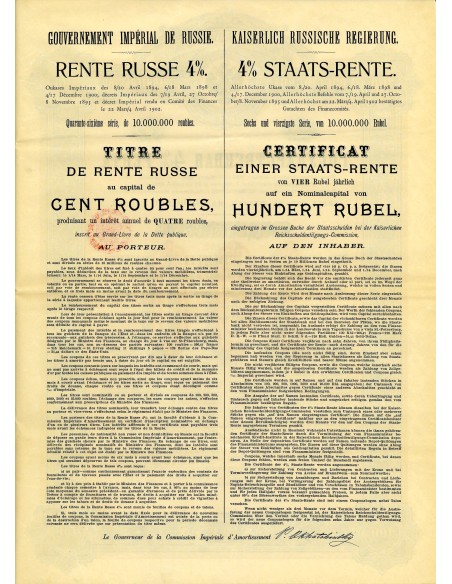

Article on the Russian Government 4% State Rent of 1894
History of the Russian Government 4% State Rent of 1894
The Russian Government 4% State Rent of 1894 is a significant financial document issued during the reign of Tsar Alexander III and continued under the rule of Nicholas II. This state rent, with an interest rate of 4%, was part of a series of financial instruments issued by the Russian Empire to fund its growing economic needs during a period of modernization and industrialization.
1894 marks a pivotal year when the Russian government sought to stabilize its finances while supporting its infrastructure development program. These state rents were issued in various denominations and sold both domestically and internationally, demonstrating the intent to attract capital from different sources to support the economic expansion of the Russian Empire.
This particular bond offered an annual yield of 4% on a capital of 100 rubles, a significant sum at the time, and was issued in a context of growing confidence in Russia's economic future. However, the unstable geopolitical and economic situation would soon pose significant challenges.
Historical Context of 1894
1894 was a period of economic growth for the Russian Empire, but also of social and political tensions. Alexander III, known for his repressive and Russification policies, sought to maintain tight control over the empire, but his sudden death brought the young Nicholas II to the throne. Under his rule, Russia continued the modernization path started by his predecessors, but would soon face a series of challenges, including the Russo-Japanese War and the 1905 Revolution, which would severely test the Empire's stability.
Historical Data of the Rent
| Rent Data | Value |
|---|---|
| Year of Issuance | 1894 |
| Issuing Government | Russian Imperial Government |
| Nominal Value | 100 Rubles |
| Total Amount Issued | 10,000,000 Rubles |
| Interest Rate | 4% |
| Rent Type | State Rent |
| Maturity Date | N/A |
Document Characteristics
| Document Characteristics | Description |
|---|---|
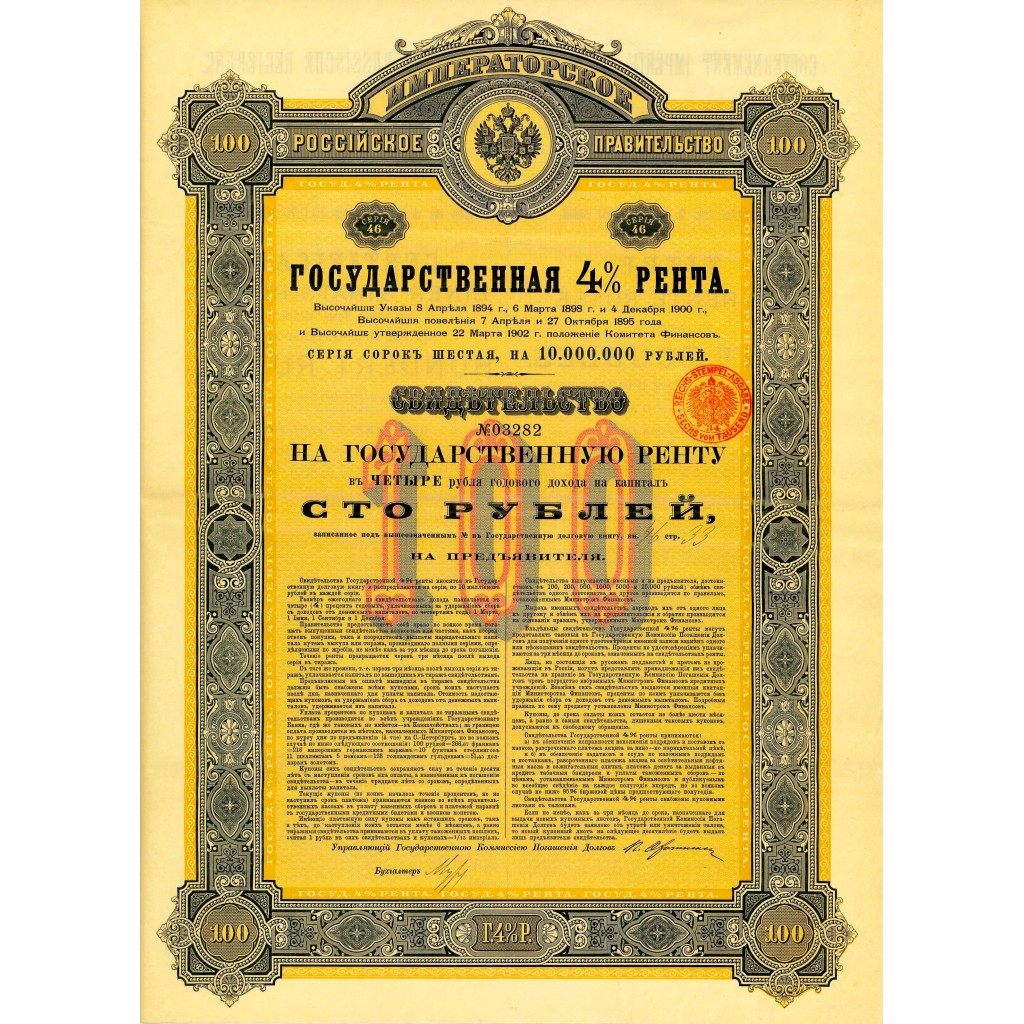
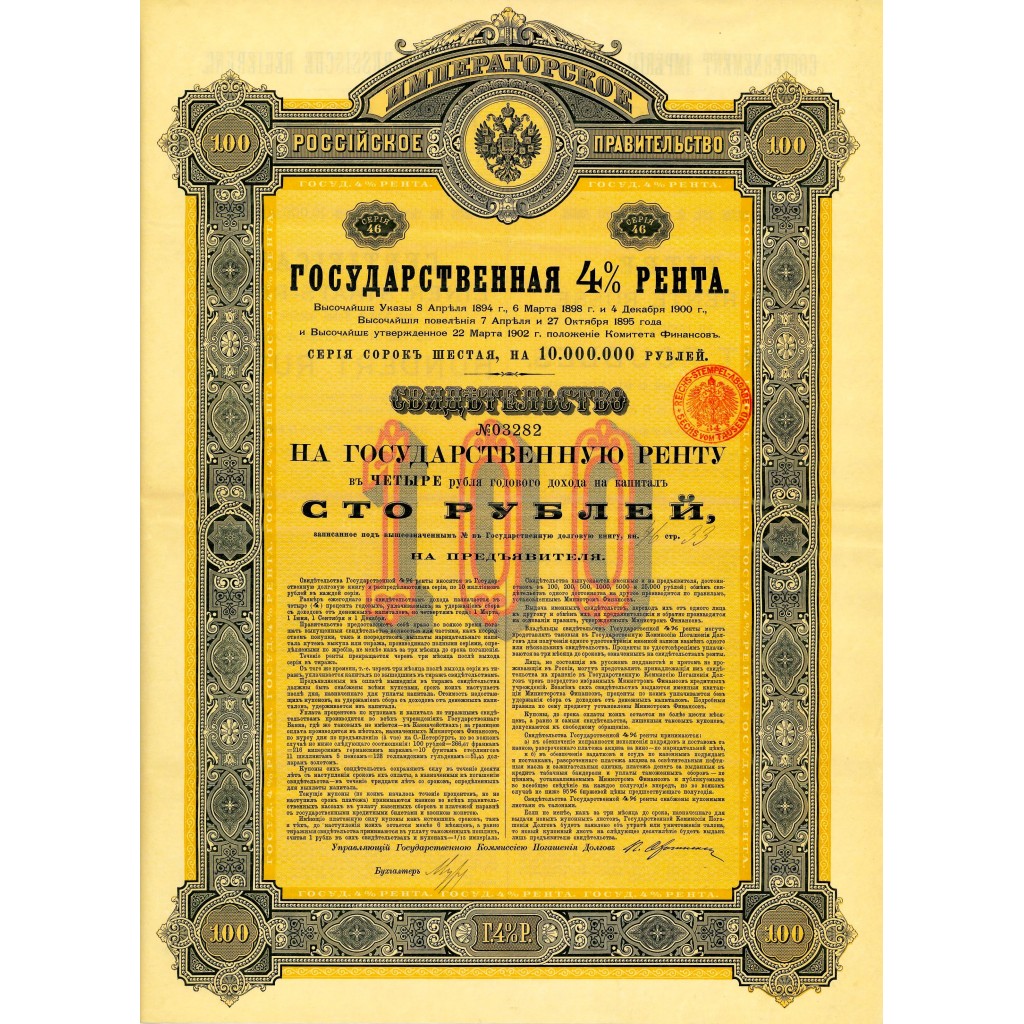
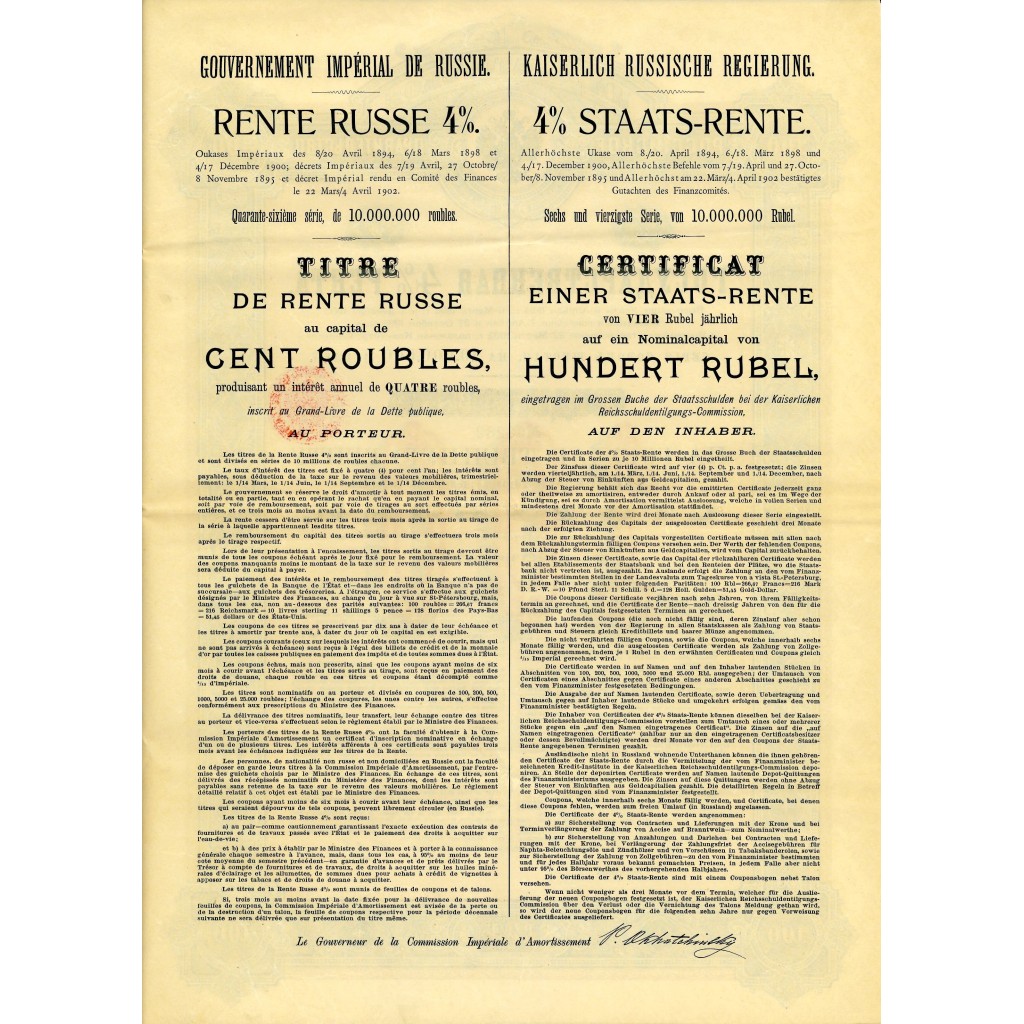
| Title Type | Rent Certificate |
| Issuance | 4% State Rent of 1894 |
| Currency | 100 Rubles |
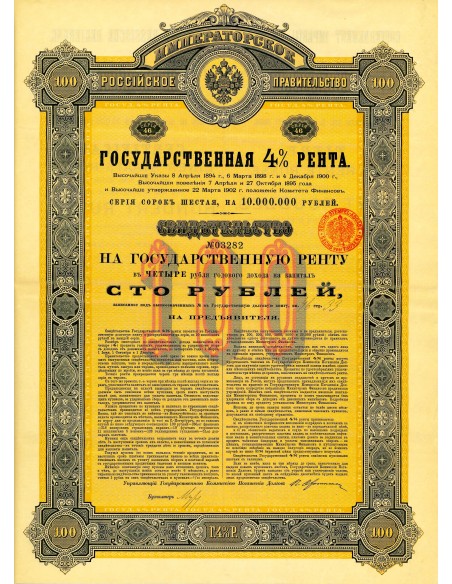
| Serial Number | 03282 |
| Date of Issue | 1894 |
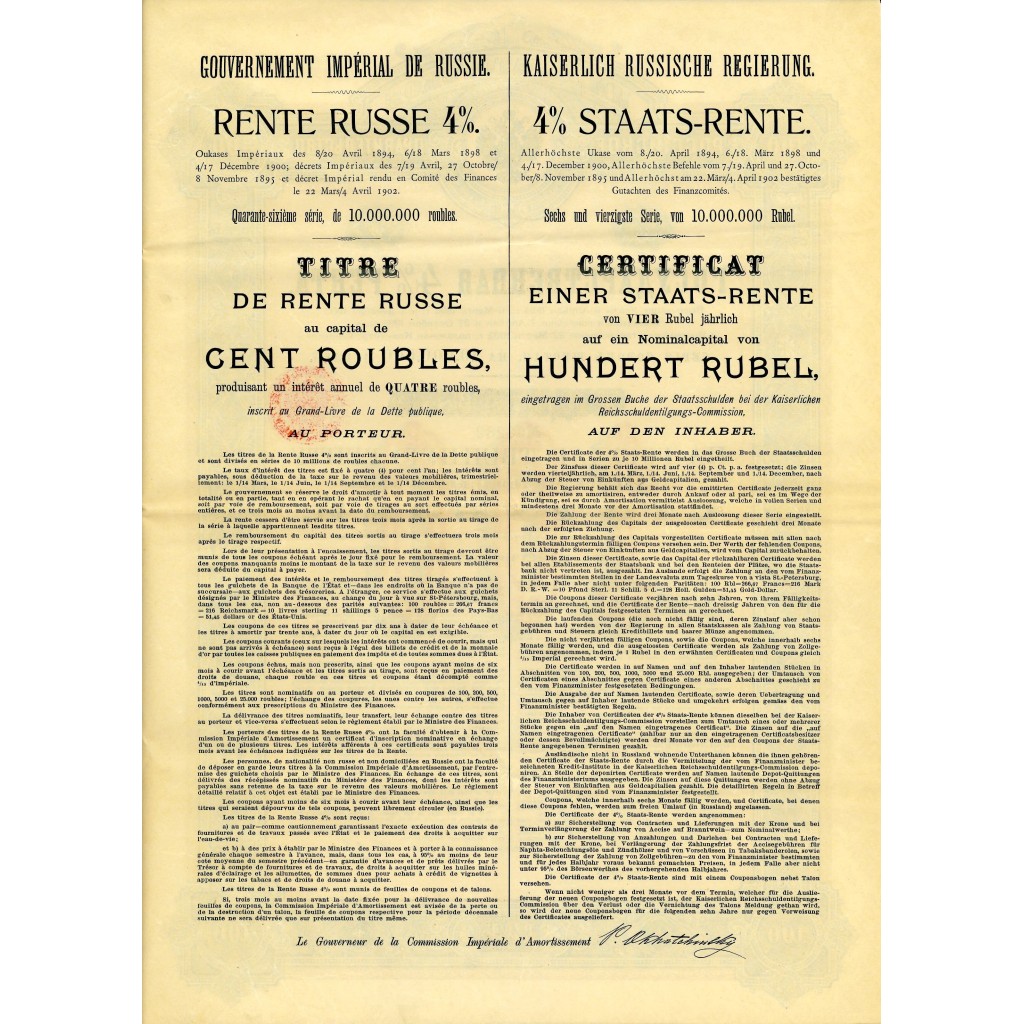
| Language | Russian, French, German |
| Nominal Value | 100 Rubles |
| Guarantee | Russian Imperial Government |
Artistic and Typographic Details
This certificate is adorned with an elegant design that reflects the wealth and power of the Russian Empire at the time. The decorative frame, with intricate floral and geometric patterns, is crafted in shades of yellow and black, giving the document a solemn and authoritative appearance. At the center, the Russian imperial crest dominates the design, emphasizing the legitimacy and importance of the certificate. The typography is clear and detailed, with texts in Russian, French, and German, highlighting the international scope of the bond.
Provenance of the Title
This rent certificate was issued by the Russian Imperial Government during a period of relative stability and economic growth. Its preservation to the present day makes it a piece of great interest to scripophily collectors. Its rarity, combined with good preservation, makes it an important piece of Russian financial history.
Valuation and Rarity
The 1894 State Rent Certificate is considered a rare bond, especially if kept in excellent condition. The value of these certificates has increased in recent years, fueled by growing interest in historical financial documents from Imperial Russia. Currently, the estimated value for a certificate like this can range between 300 and 700 euros, depending on specific conditions and market demand.
The Importance of Scripophily
Collecting historical documents such as stocks and bonds is not just an economic investment but also an opportunity to own a fragment of history. Scripophily allows exploration of the economic, political, and social events that shaped the modern world. This document, with its unique history and artistic design, is not only a work of art but also a testament to an era of great change.
For those wishing to preserve this certificate, it is advisable to frame it with UV-protective glass to prevent deterioration and preserve the artistic details. These documents, in addition to being valuable for collectors, can be used as prestigious gifts, decorative pieces, or works of historical art.
All historical documents for sale are considered collectibles. The documents have no economic or financial value (no economic or financial value), images that are not the historical document are representative of the company's object and the historical period of reference, they are not provided but can be freely downloaded from the website and printed.