
Shopping Cart
There are no more items in your cart


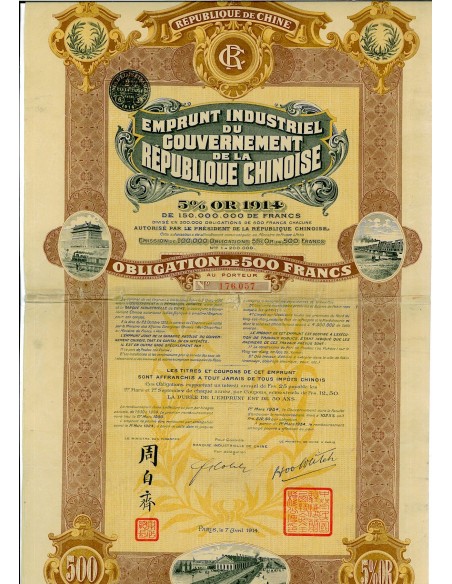

Document Features:
- Value: 500 Francs
- Interest Rate: 5% per annum
- Issue Date: April 7, 1914
- Maturity: The loan had a duration of 30 years, with interest payable on March 1st and September 1st of each year.
- Authorization: Approved by the President of the Chinese Republic, with an official statement from the Minister of Finance.
- Issue: 200,000 bonds of 500 francs each, totaling 150,000,000 francs.
- Banks Involved: Industrial Bank of China, Banks in Paris, and other financial institutions.
This document is adorned with intricate decorations and symbols representing the culture and art of the time in China. On the left and right sides of the certificate, there are illustrations depicting significant Chinese infrastructures and landscapes, symbolizing progress and industrial development. In the center of the document, there is a large red seal with Chinese characters, representing the governmental authority that guarantees the issuance of the bond.
Historical Context:
In 1914, China was undergoing a period of political and economic transition. The need to modernize industry and improve infrastructure was crucial to competing on a global scale. Bonds like these were vital instruments for raising capital from international markets, particularly from Europe, to fund development projects.
Historical Article
The Industrial Loan of the Government of the Republic of China in 1914 represents an important piece of Chinese economic history. Issued during a period of significant change and modernization, this loan reflects the Chinese government's efforts to integrate the Chinese economy into the global financial system. With the help of international financial institutions, China managed to raise significant funds that were then invested in crucial infrastructure projects for the country's development.
The artistic beauty and complexity of the design of these bonds not only served to ensure investor confidence but also reflected the cultural pride and aspiration of China to be reborn as a modern and prosperous nation. Collecting these documents today is not just a financial investment but also a journey through a significant part of China's history.
The Republic of China or the Chinese Republic was the political entity that was formed in China at the fall of China's last emperor, Pu Yi in 1912 following the success of the Xinhai Revolution.
The flag of the Republic of China until 1928, used by the Beiyang government of warlords
Following a series of events in the period between 1912 and 1949 the territory under the control of the Republic of China was reduced to the island of Taiwan, while mainland China came under the control of the newly formed People's Republic of China. This real revolution in the sixties was followed by a second one, passed into history as the great Chinese cultural revolution.
The People's Republic of China was founded by Mao Zedong on 1 October 1949 and the first activity of the new political system, established with the revolutionary victory, was to bring peripheral territories such as Tibet and Xinjiang (1951) under the sovereignty of China.
Tutti i documenti storici in vendita si intendono da collezione. I documenti non hanno nessun valore economico o finanziario (no economic or financial value).

