Shopping Cart
There are no more items in your cart



Document Features
-
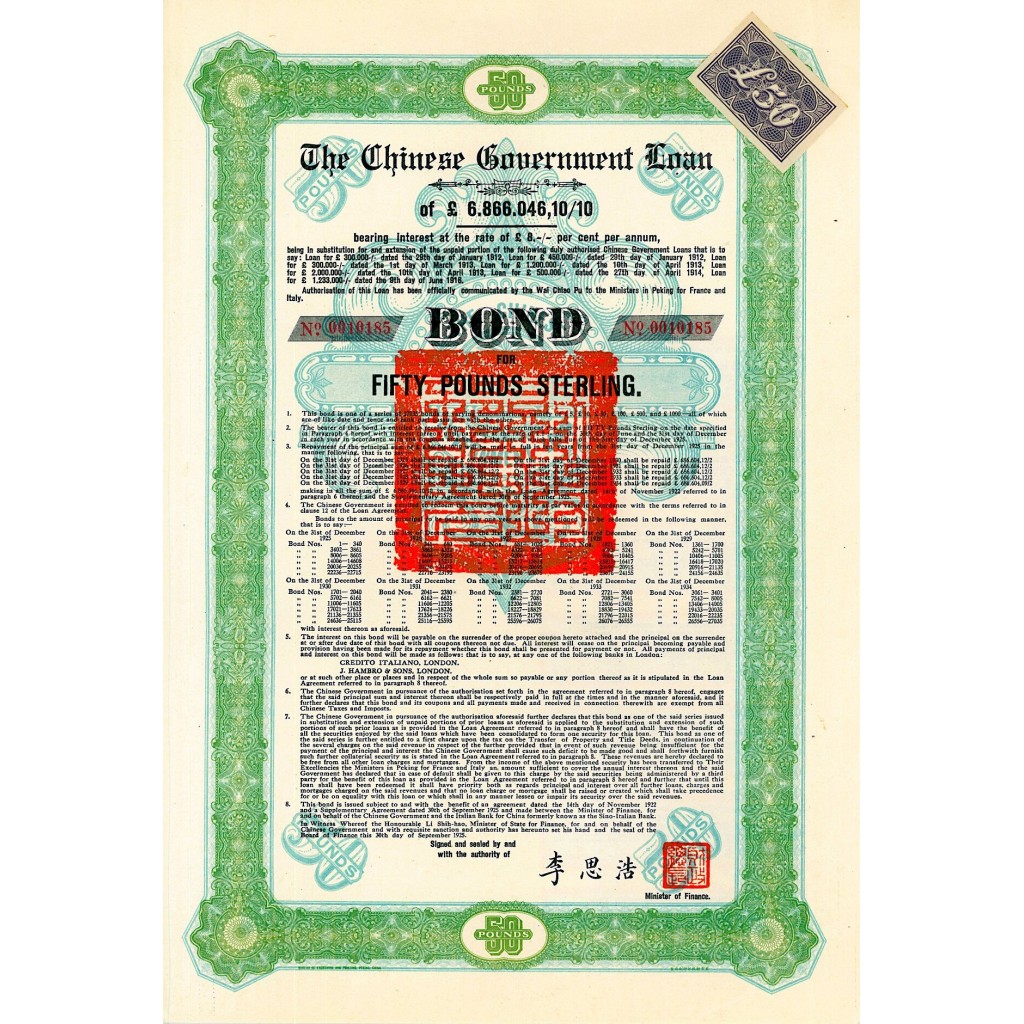
Languages: The bond is written in English, indicating its use in international markets.
-
Interest Rate: The bond offers an annual interest rate of 8%, which was quite high for government loans of that era.
-
Loan Value: The total value of the loan is £6,866,046.10, with individual bonds issued for £50 each.
-
Design and Symbolism:
- Green and Red Colors: The document features prominent green borders and a large red seal, symbolizing prosperity and authority in Chinese culture.
- Ornate Patterns: The decorative elements include floral and geometric motifs, reflecting the aesthetic values of the period.
- Official Seals: The bond is marked with official seals and signatures, adding authenticity and legal validity to the document.
-
Administration:
- The bond is signed by the Chinese Minister of Finance, underscoring the official nature of the loan.
-
Terms and Conditions: The bond includes detailed terms and conditions in English, outlining the rights of the bondholder and the obligations of the Chinese government.
Historical Context of the Chinese Government 8% Loan of 1925
In 1925, China was undergoing significant political and economic changes. During this period, the Chinese government sought to raise international funds to finance various development projects, including railways, industrial facilities, and urban infrastructure. These efforts were part of a broader attempt to modernize the country and better integrate into the global economy.
The 8% Loan of 1925 was part of these initiatives. Issued in international financial markets, it aimed to attract foreign investment to support China's modernization plans. The loan was guaranteed by the Chinese government, providing assurances to investors and demonstrating the government's commitment to honoring its debts.
Conclusion
This bond is not just a financial instrument but also a historical artifact that sheds light on China's early 20th-century efforts to modernize its infrastructure and integrate into the global economy. Collectors and historians value these documents for their historical significance and their role in China's economic history.
The Republic of China or the Chinese Republic was the political entity that was formed in China at the fall of China's last emperor, Pu Yi in 1912 following the success of the Xinhai Revolution.
The flag of the Republic of China until 1928, used by the Beiyang government of warlords
Following a series of events in the period between 1912 and
The People's Republic of China was founded by Mao Zedong on 1 October 1949 and the first activity of the new political system, established with the revolutionary victory, was to bring peripheral territories such as Tibet and Xinjiang (1951) under the sovereignty of China.
Tutti i documenti storici in vendita si intendono da collezione. I documenti non hanno nessun valore economico o finanziario (no economic or financial value).