Shopping Cart
There are no more items in your cart




Article on the Moscow-Kiev-Voronezh Railway Company
History of the Moscow-Kiev-Voronezh Railway Company
The Moscow-Kiev-Voronezh Railway Company, founded at the beginning of the 20th century, represents one of the major railway projects of the Russian Empire. Established in 1903, the company aimed to connect Moscow, the capital, with two important economic and political centers of the time: Kiev and Voronezh. The construction of this railway was part of a broader infrastructure development program promoted by the Tsarist government to enhance internal connections and facilitate the transport of goods and people across the empire. The project was an important economic and technological boost, financially supported by both Russian and European investors, as evidenced by the bond document we present.
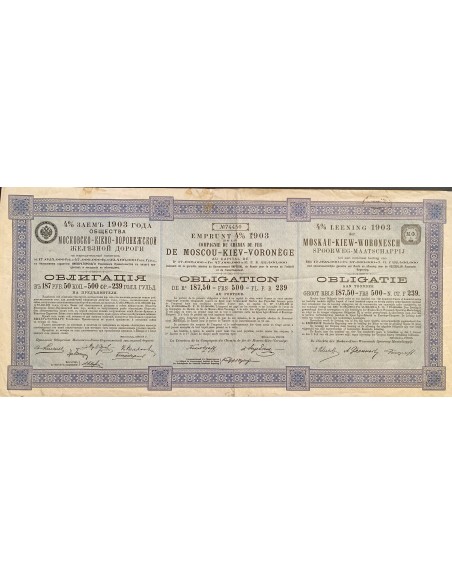
This 1903 bond is an extraordinary example of financial documentation of the time, issued to finance the construction and development of this significant railway line. The bonds were offered in various currencies, including the Russian ruble, the French franc, and the Dutch guilder, demonstrating the international involvement in the project.
The Moscow-Kiev-Voronezh railway played a crucial role not only in the regional economy but also in the political and social integration of the Russian Empire, contributing to the rapid urbanization of the areas traversed by the railway. However, with the fall of the Empire and the subsequent revolutionary events, the company, like many other imperial enterprises, faced significant difficulties that led to its dissolution in the post-revolutionary period.
Historical Context of 1903
The issuance of this bond occurred during a period of significant economic and political change for the Russian Empire. The year 1903 was characterized by relative political stability, but with signs of tension that would lead to the 1905 revolution. The country was striving to modernize rapidly, but pressure on economic resources was high. The Moscow-Kiev-Voronezh railway was seen as one of the keys to ensuring sustainable economic expansion by connecting crucial regions of the Empire.
Historical Data of the Company
| Company Data | Value |
|---|---|
| Year of Establishment | 1903 |
| Headquarters | Moscow, Russian Empire |
| Share Capital at Establishment | 17,625,000 Rubles |
| Year of Stock Exchange Admission | 1903 |
| Year of Stock Exchange Delisting | Not Available |
| Share Capital at Dissolution | Not Available |
| Year of Company Dissolution | Post-Russian Revolution (after 1917) |
Document Characteristics
| Document Characteristics | Description |
|---|---|
| Title Type | Bond |
| Issuance | 4% Loan 1903 |
| Currency | 187.50 Rubles - 500 Francs - 239 Guilders |
| Serial Number | 74450 |
| Date of Issue | 1903 |
| Languages | Russian, French, Dutch |
| Nominal Value | 500 Francs |
| Guarantee | Imperial Russian Guarantee |
| Maturity | Not specified |
Artistic and Typographic Details
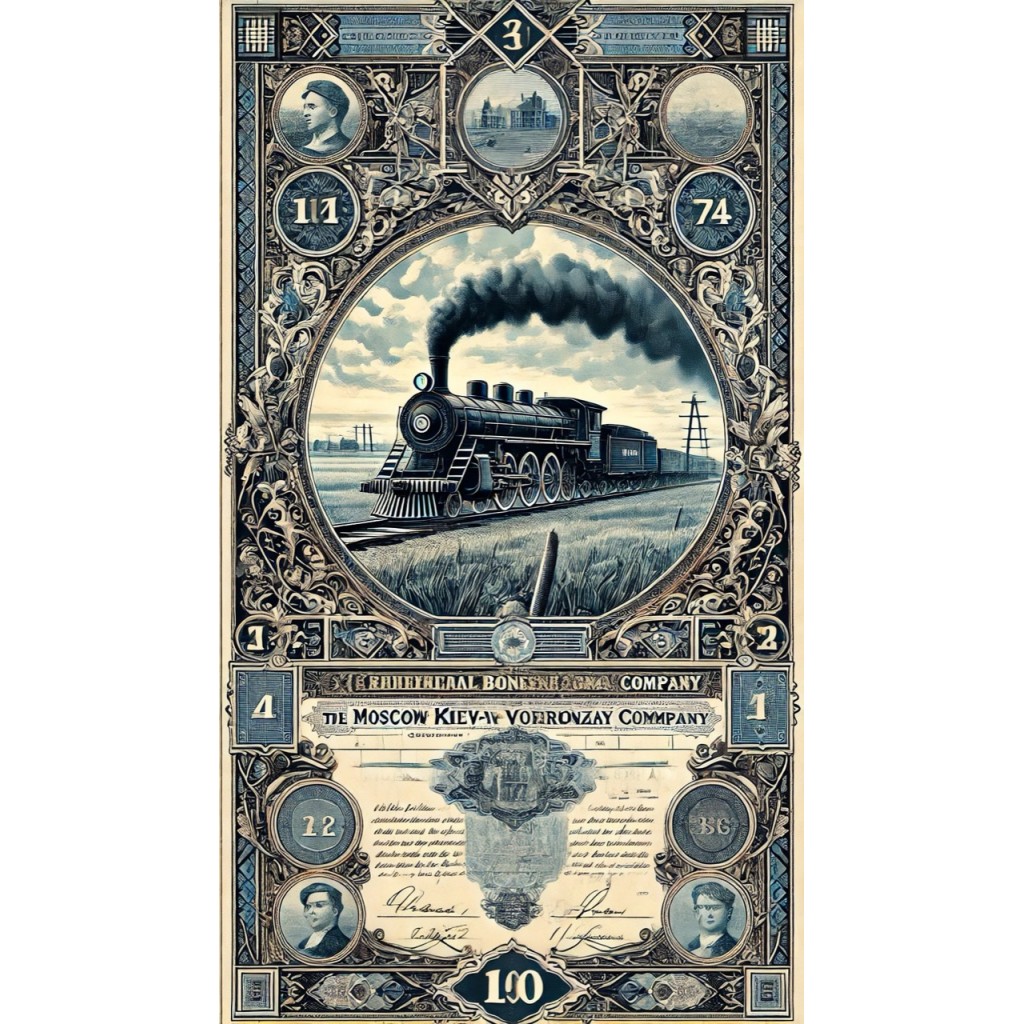
The document features a refined artistic design, with floral and geometric ornaments typical of the era. The combination of three languages (Russian, French, and Dutch) reflects the international character of the issuance. The paper used is of high quality, with a decorative border that highlights the importance and prestige of the bond. The printing, in a color range from blue to black, is of excellent craftsmanship, reflecting the significance of the railway project the bond represents.
Provenance of the Title
This certificate was originally issued to a European investor, as evidenced by the numbering in international currencies and the presence of three languages. The title has been well-preserved and was recently acquired by a collector specializing in historical Russian documents.
Valuation and Rarity
This bond is considered rare, particularly in the excellent condition in which it has been preserved. The scripophily market has seen increasing demand for pre-revolutionary Russian titles, with this type of document having appreciated significantly in recent years. Currently, the estimated value for a bond in similar conditions ranges between 500 and 1000 euros, depending on the specific condition and rarity.
The Importance of Scripophily
Collecting historical documents such as stocks and bonds represents not only an economic investment but also a way to own a piece of history. Scripophily offers a tangible connection to the past, allowing collectors to explore the economic and social events that have shaped the modern world. This document, with its rich history and artistic beauty, is not only a work of art but also a testament to an era of great change.
For those wishing to preserve this certificate, it is advisable to frame it with UV-protective glass to prevent deterioration and preserve the artistic details. These documents, in addition to being valuable for collectors, can be used as prestigious gifts, decorative pieces, or works of historical art.
All historical documents for sale are considered collectibles. The documents have no economic or financial value (no economic or financial value), images that are not the historical document are representative of the company's object and the historical period of reference, they are not provided but can be freely downloaded from the website and printed.