Shopping Cart
There are no more items in your cart

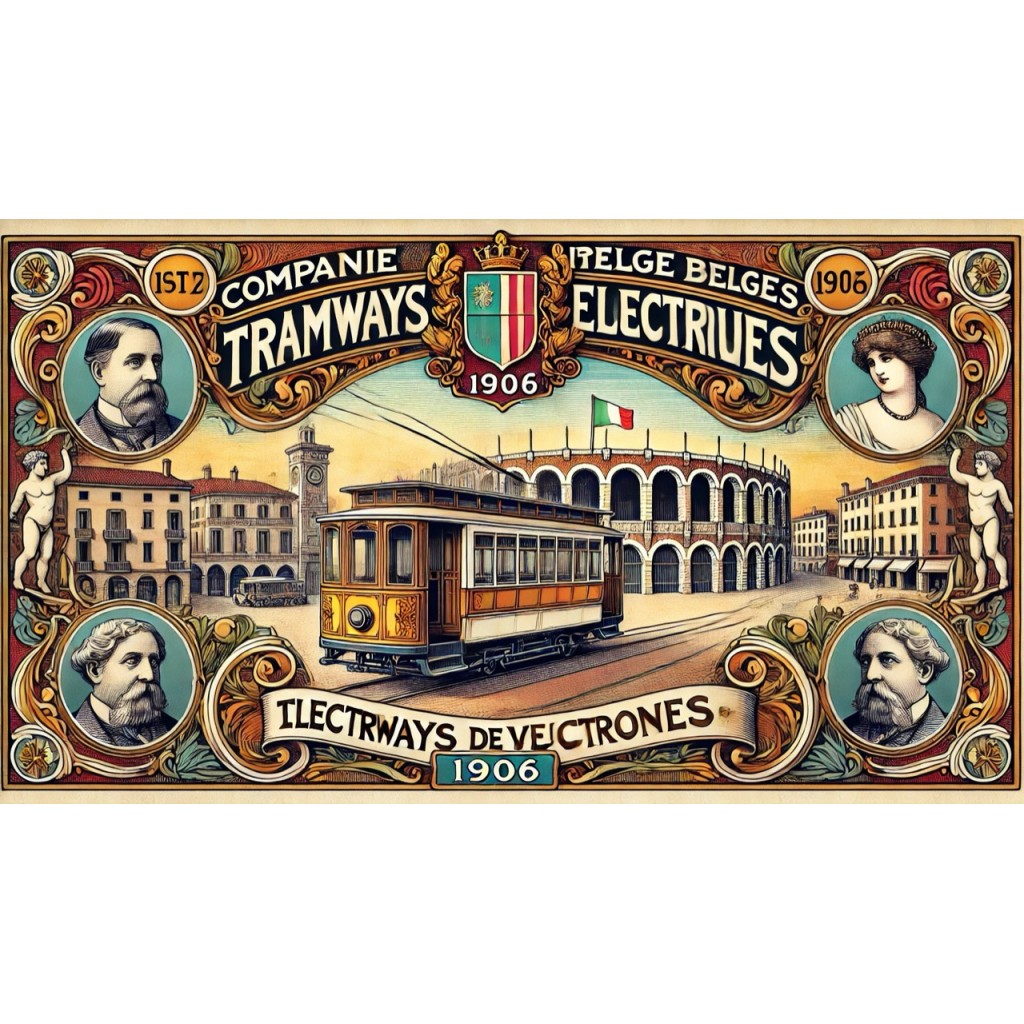
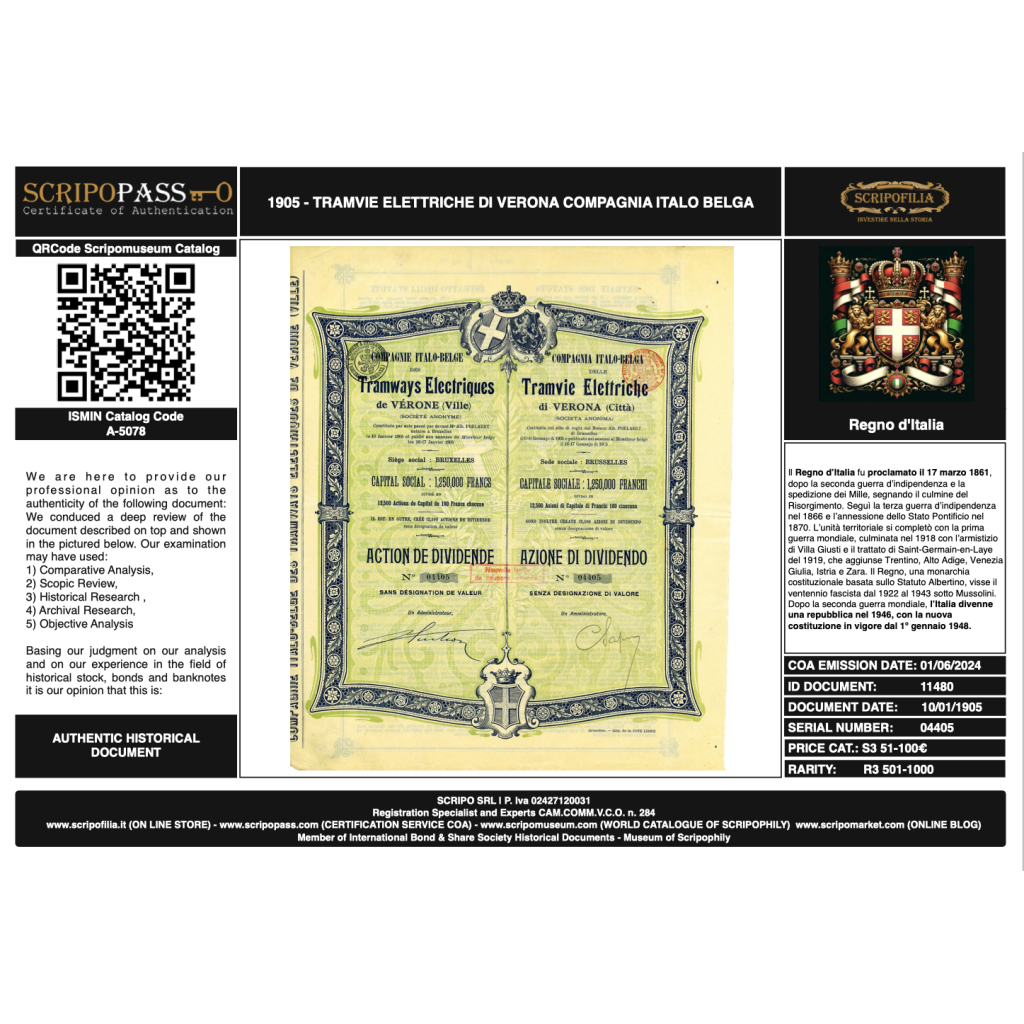
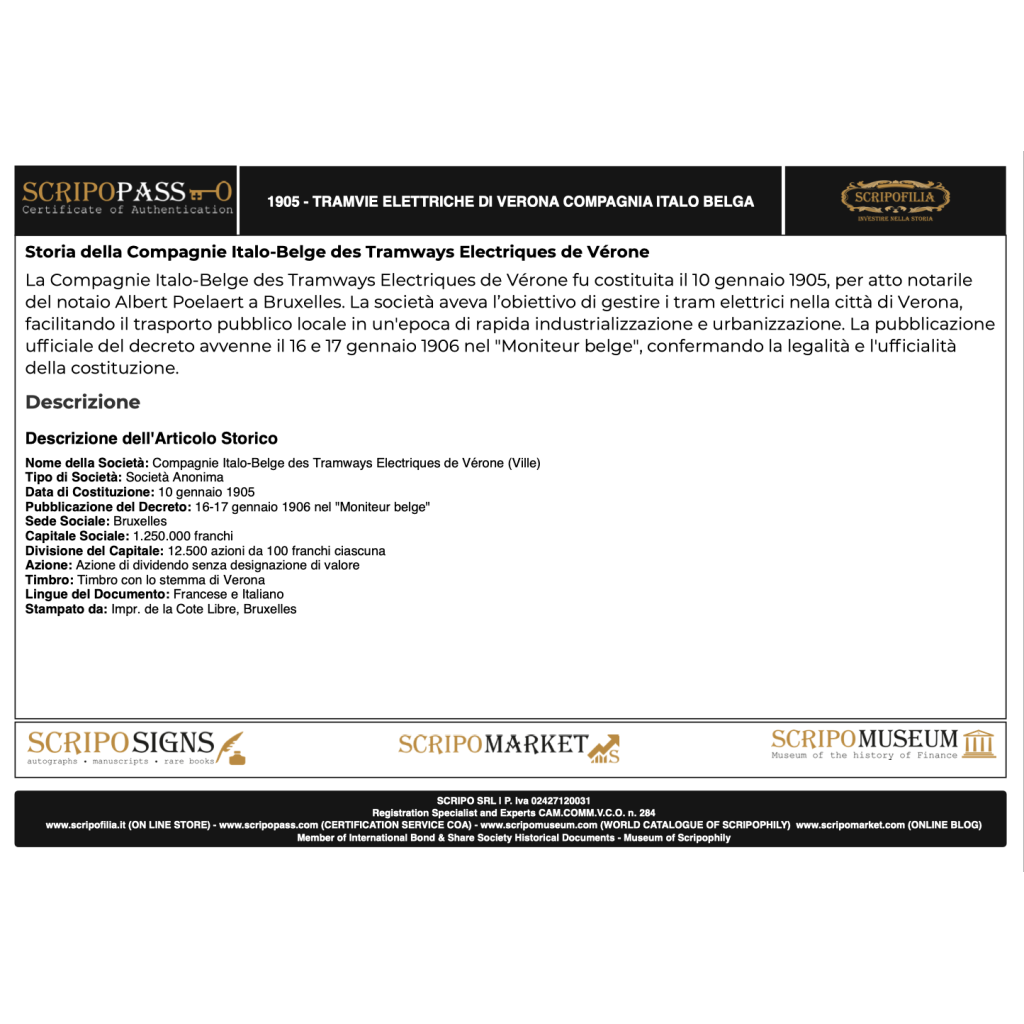
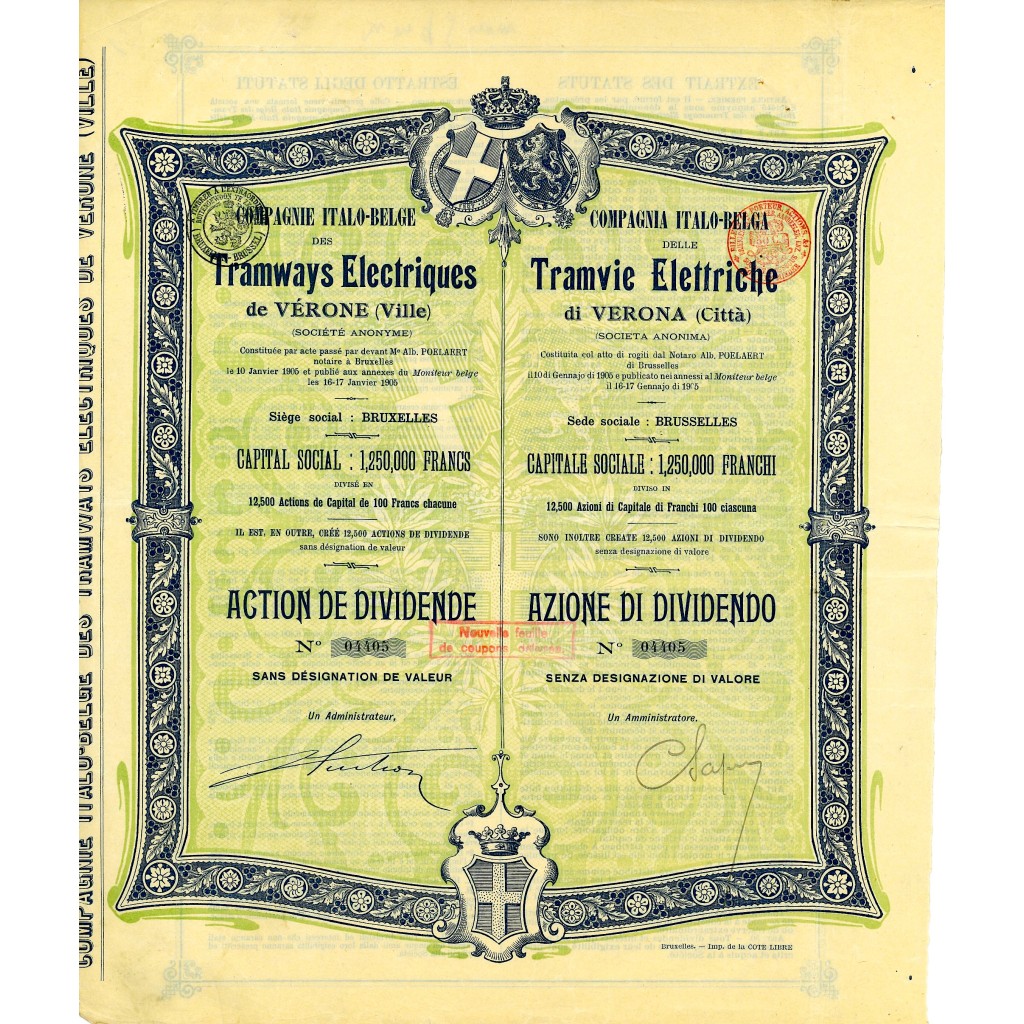
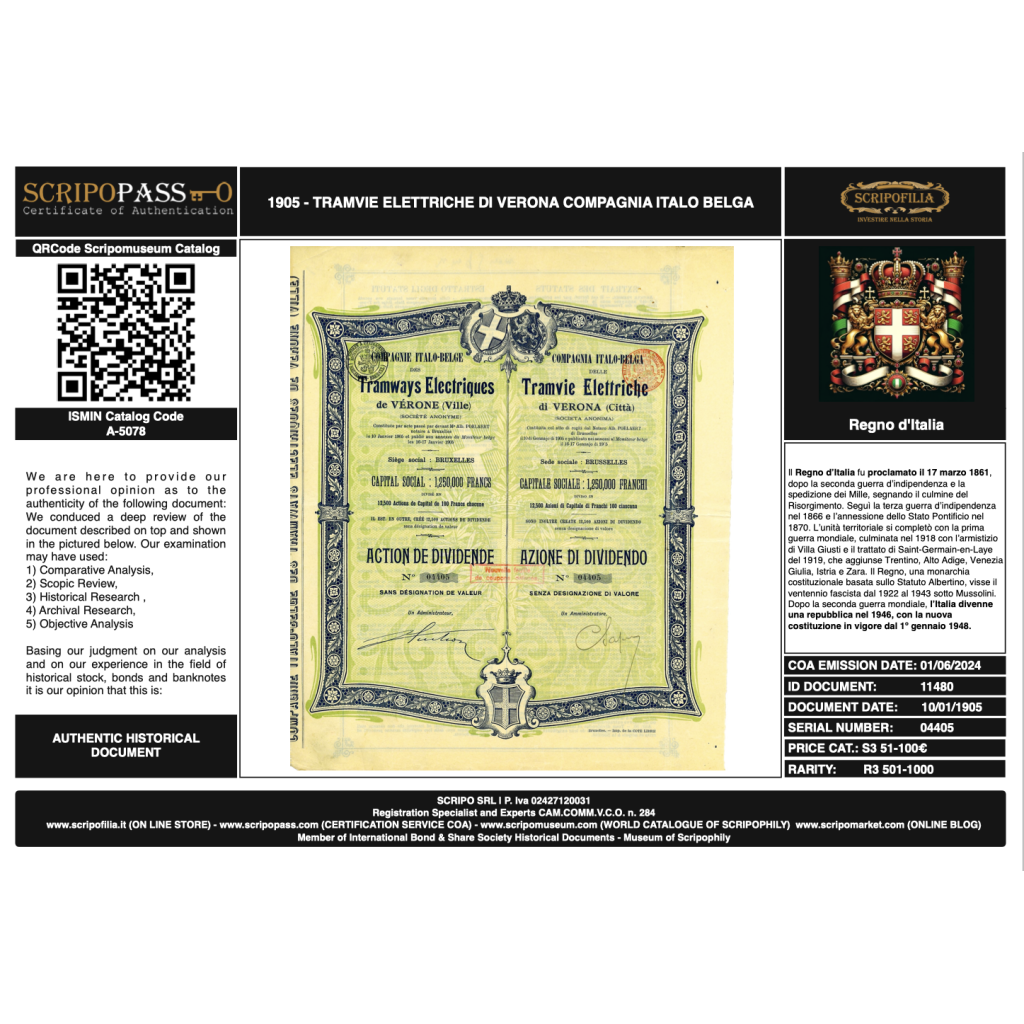
Description of the Historical Document
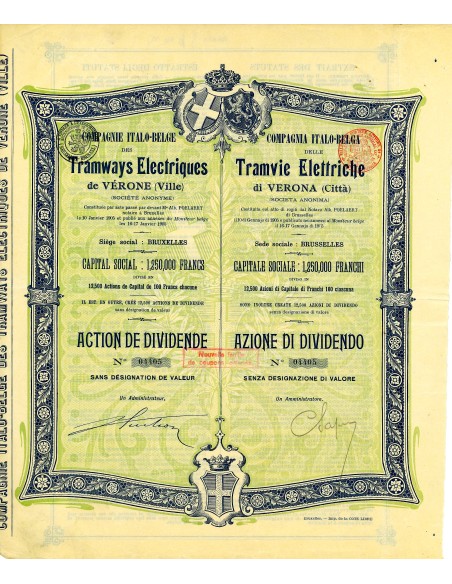
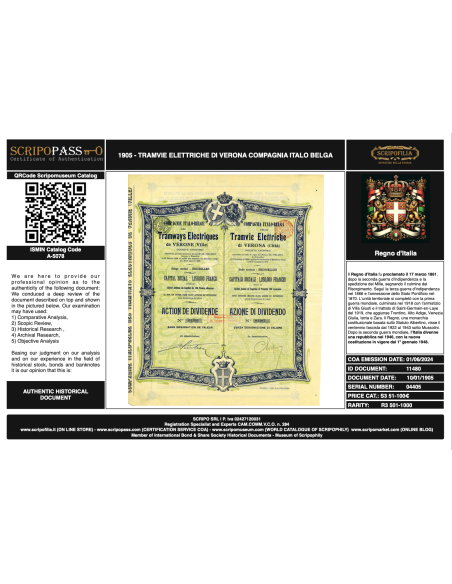
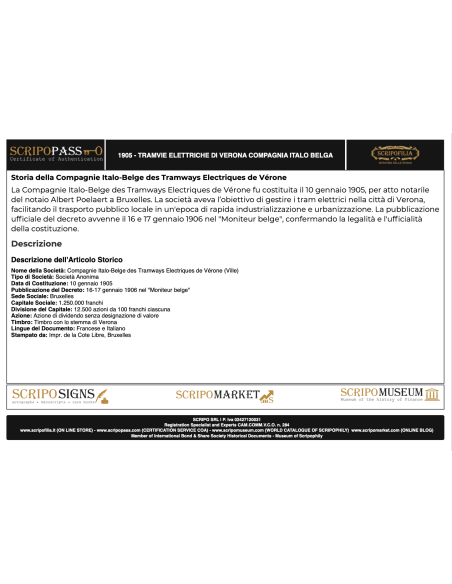
Name of the Company: Compagnie Italo-Belge des Tramways Electriques de Vérone (Ville)
Type of Company: Public Limited Company
Date of Establishment: January 10, 1905
Publication of the Decree: January 16-17, 1906 in the "Moniteur belge"
Registered Office: Brussels
Share Capital: 1,250,000 francs
Capital Division: 12,500 shares of 100 francs each
Share: Dividend share without value designation
Stamp: Stamp with the coat of arms of Verona
Document Languages: French and Italian
Printed by: Impr. de la Cote Libre, Brussels
Excerpt from the Articles of Association
The excerpt from the articles of association, printed on the back of the document, contains details about the company's purposes, capital composition, methods of convening meetings, and the responsibilities of the directors. These details are crucial for understanding the organizational structure and operations of the company.
The tram network of Verona was the central element of the Scaliger transport system between 1884 and 1951. Consisting of two lines with some shared sections, this network allowed connection to all city stations besides Borgo Trento: those of Porta Nuova and Porta Vescovo on the Milan-Venice railway, the terminus of the extensive suburban tram network located near the latter, and the Porta San Giorgio station, the terminus of the Verona-Caprino/Garda railway.
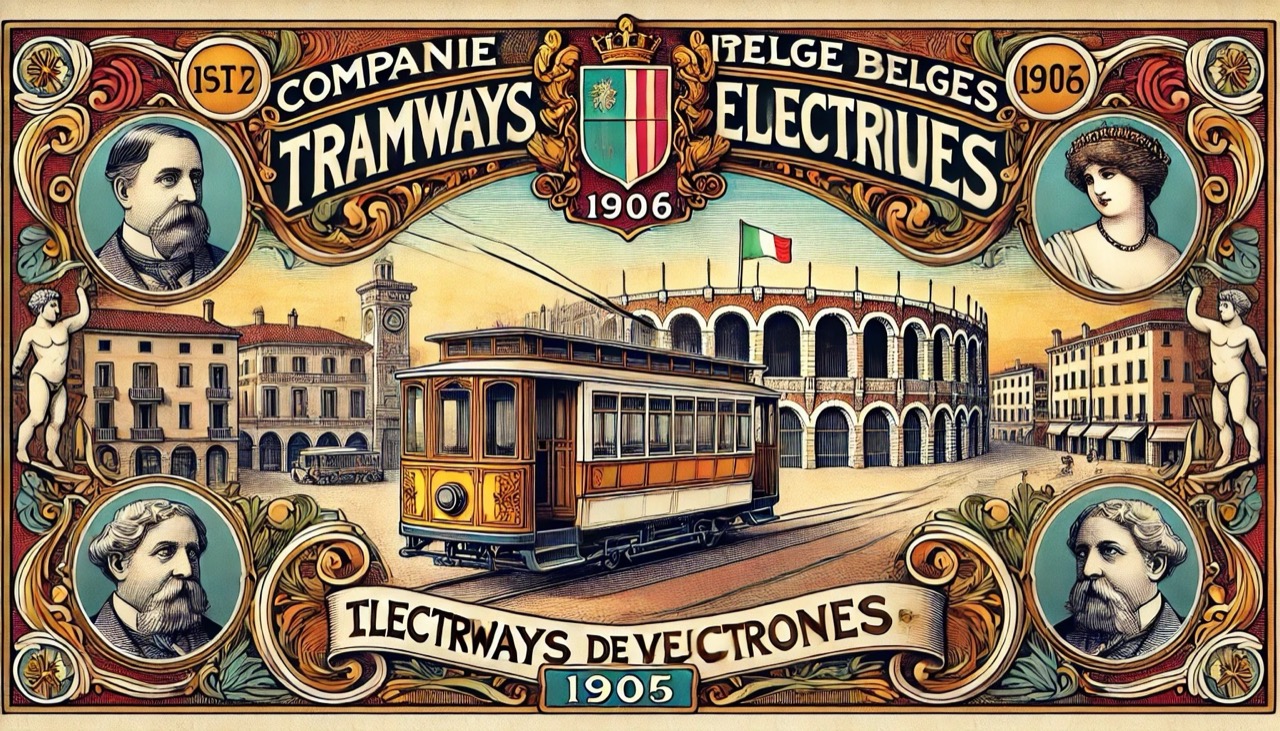
History In 1884, the Verona Tramways Company inaugurated a horse-drawn line between the Porta Nuova and Porta Vescovo stations. The majority of the shares of the Anonymous Tram Company of Verona were held, like other similar companies, by a Belgian company, the Compagnie Italo-Bélge des Tramways électriques de Vérona (Ville)-Société anonyme, based in Brussels and represented by the managing director Giovanni Franchini-Stappo and Messrs. Saint Gilles and David Pels. On July 11, 1906, the latter signed a contract with the Municipality of Verona for the construction and operation of an electric tram network, operated with Siemens-produced vehicles. The first line was inaugurated on February 22, 1908, partially retracing the route of the previous horse-drawn tramway. The gauge used was the standard one, with a power supply voltage of 550 V DC. A second line, also single-track and sharing a section with the first between Castelvecchio and Piazza delle Erbe, was inaugurated from San Zeno to Santo Stefano on March 30 of the same year. On November 22, 1914, the tram network was extended beyond the gates, reaching the terminus of Avesa to the north, which was an autonomous municipality until 1927. The management of the complex of railway and tramway lines under the Province was somewhat heterogeneous, both in terms of the material used and the status of the individual concessions. Public management was marked by a growing deficit. In 1935, the operation of the urban tram network, which then amounted to 13.407 km of double track and 9.963 km of single track, was entrusted to the Anonymous Company of United Exercises (SAER) along with that of the provincial tramways and the Verona-Caprino-Garda railway. The new operator, considering that the operation of the urban network had been in deficit for five years, decided to convert it into a trolleybus system, the first lines of which were activated in 1937. In 1951, the remaining urban tram lines were suppressed, while the last suburban lines were closed in 1957.
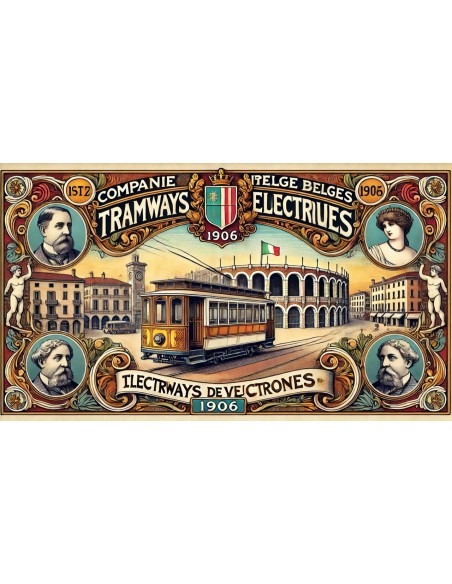
Routes The first line, from Porta Nuova to Porta Vescovo, had a total of 24 stops, with the eastern terminus corresponding to that of the Verona-San Bonifacio tramway. Among the served locations were the military district (stop on Via XX Settembre at the intersection of Via S. Nazaro), the Fatebenefratelli Hospital (later demolished), the then People's Library (near Ponte Navi), and the now-demolished Church of S. Sebastiano. The critical point of the line was considered to be Ponte Navi, due to the access ramp on the Via Leoni side: debris in the rail grooves caused several derailments, especially when trailers were towed. Another problem that characterized the Verona tramway was ice, which could block the switches; specific night service circulations were planned to counteract its formation. The second line connected Borgo Trento with the Porta San Giorgio station, the terminus of the railway to Caprino and Garda, and ran thanks to two branches that separated from the previous one: on the western side, bypassing Castelvecchio, the fork took Regaste S. Zeno to reach the terminus of Piazza S. Zeno. On the opposite side, starting from Piazza delle Erbe, it reached Ponte Umberto (later renamed Ponte Nuovo), the Interrato dell’Acqua Morta, Porta S. Giorgio, and Via Mameli. On March 1, 1909, a variant was activated that allowed direct connection from Piazza Bra to the ascent of Ponte Navi, passing through Via Dietro Anfiteatro and Leoncino, avoiding the detour of Corso Cavour and Piazza delle Erbe. The tram service was active for 16 hours a day, from 6:30 to 20:30, in the winter period and 18 hours, from 5:30 to 22:00, in the summer period. According to the concession agreement, the concessionaire was required to have at least 24 electric motor cars and 11 trailers. For operation, a series of Siemens-built electric motor cars was provided, arriving in Verona in mid-January 1908. According to a contemporary newspaper, "The internal compartment has sixteen transverse seats, with a corridor dividing them into two-thirds, forming two rows of seats, one single and one double. The backrests of the seats, like the seats themselves, are covered in crimson velvet and can be turned according to the direction of travel. The carriage doors are automatic, divided into two panels so that closing one also moves the other." At that time, equipped with bow current collectors, they had a bright canary yellow livery with red lines.
References
- Tram di Verona, in Italmodel Ferrovie, no. 222, January 1979, pp. 28-30.
- G. F. Viviani, Verona 1908 arriva il tram elettrico.
- AMT – Verona, Storia in pillole. Archived December 25, 2013, in Internet Archive. URL visited in December 2013.
- Pier Giorgio Puppini, Ferrotranvie Veronesi.
- Quando a Verona c’erano i tram, in Mondo ferroviario, no. 45, March 1990, p. 10.
Bibliography
- Giorgio Chiericato, A tutto vapore. Ferrovie e tramvie nel Veneto dal 1866 al 1900, Edizioni Bonomo, Asiago, 2013.
- Gerardo Menegazzi, Mario Peruzzi, Avanti … … c’è posto, Novastampa, Verona, 1998.
- G. F. Viviani, Verona 1908 arriva il tram elettrico, Associazione filatelica numismatica scaligera, Verona. URL visited in December 2013.