Shopping Cart
There are no more items in your cart

Historical Profile of Temesvár-Módosi Helyi Érdekű Vasút Részvénytársaság
The Temesvár-Módosi Helyi Érdekű Vasút Részvénytársaság was a local railway company founded in the 19th century to manage the railway line connecting Temesvár (now Timișoara, Romania) and Módos. The railway was essential for the economic development of the region, facilitating trade and passenger transport between these cities within the Austro-Hungarian Empire.
Founded with the purpose of boosting local trade, the company became a cornerstone of regional infrastructure. Over time, the railway played a crucial role in the empire’s transportation network, operating until the geopolitical events following World War I led to the dissolution of the empire.
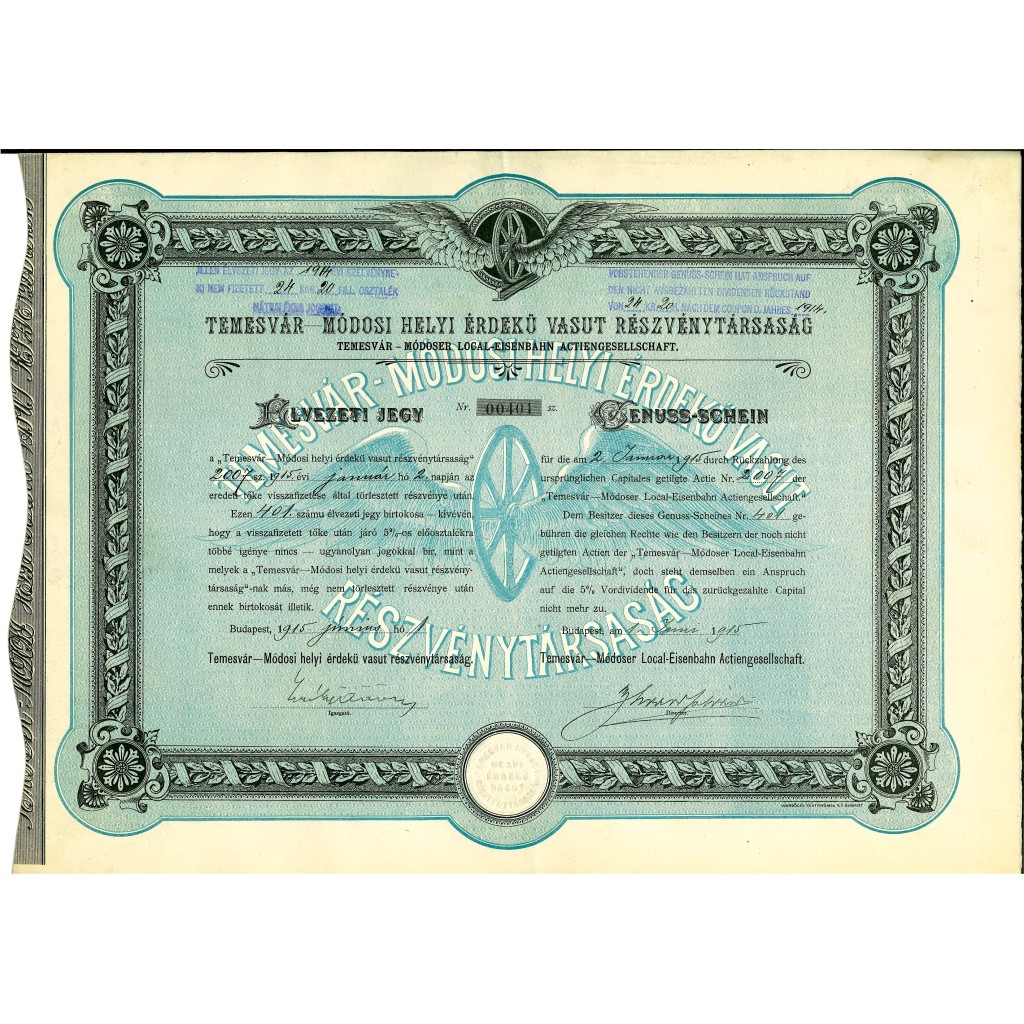
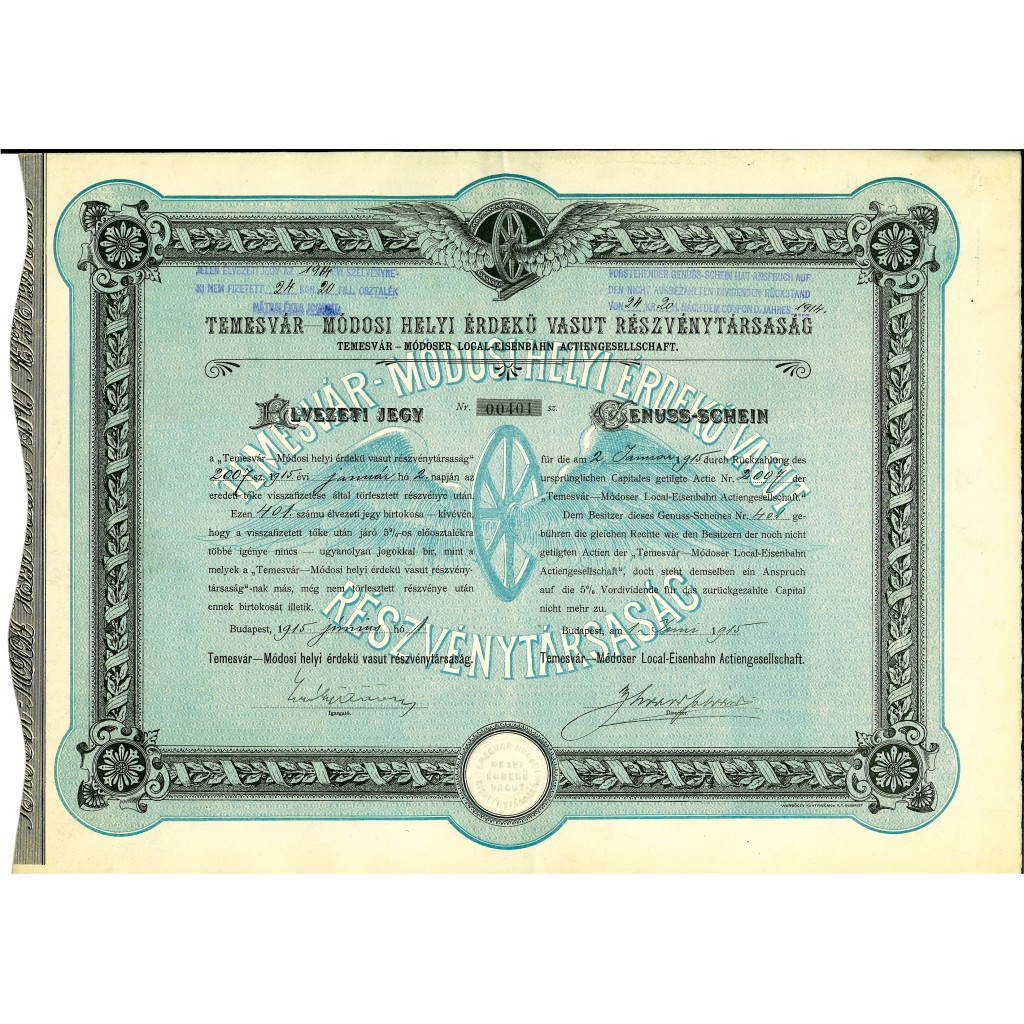
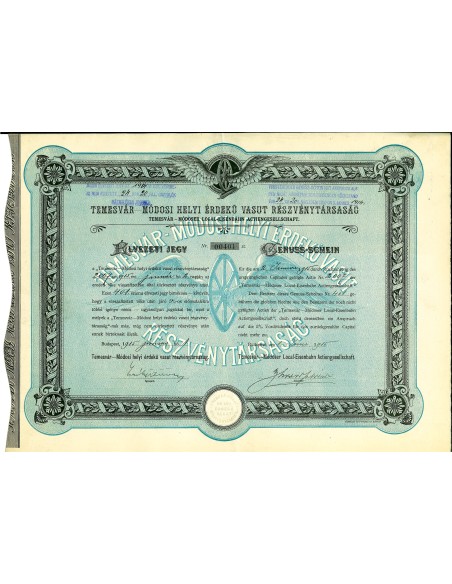
The bond visible in the image, dated 1915, is a Genuss-Schein, a type of bond that guaranteed the holder dividend rights and the return of the original capital. The signatures of company officials and the ornate design make this bond a highly interesting item for scripophily collectors.
Historical Data of the Company
| Company Historical Data | Information |
|---|---|
| Year of Establishment | 1869 |
| Headquarters | Temesvár (Timișoara), Austro-Hungarian Empire |
| Year of Stock Exchange Listing | 1875 |
| Year of Delisting from Stock Exchange | Around 1920 |
| Year of Dissolution | Around 1925 |
| Share Capital at Establishment | 10,000,000 florins |
| Share Capital at Dissolution | 8,000,000 florins |
| Annual Revenue (1915) | Not available |
Certificate Characteristics
| Characteristic | Description |
|---|---|
| Number of Certificates | N/A |
| Type of Certificate | Genuss-Schein (Bond) |
| Nominal Value | Not specified |
| Serial Number | 00401 |
| Date of Issue | January 20, 1915 |
| Signed by | Company officials (names present but unclear) |
| Condition of the Document | Very good preservation |
| Authenticity Status | Authentic |
| Ornamentation | Floral designs and geometric motifs typical of Austro-Hungarian style |
| Document Language | Hungarian and German |
Historical Context
This certificate was issued in 1915, during World War I, a critical period for the Austro-Hungarian Empire. Political and economic tensions were mounting, and infrastructure, including railways, played a crucial role in maintaining logistics for both military and civilian purposes. Despite the challenges, the Temesvár-Módosi Helyi Érdekű Vasút Részvénytársaságcontinued to operate, supporting the war effort with its transportation network.
After the war, with the dissolution of the Austro-Hungarian Empire and the creation of new national states, the region of Temesvár became part of Romania, and the railway company underwent restructuring, eventually ceasing operations in the post-war period.
Artistic and Typographical Details
The document features an elaborate design with graphic elements reflecting the aesthetics of the Austro-Hungarian Empire. The frame is decorated with floral motifs and symbols such as wings and railway wheels, clearly referencing the company’s railway operations. While the specific artist is unknown, it was likely created by a designer specializing in financial securities of the time.
The typography used is a combination of Gothic and serif fonts, typical of official documents from Central Europe during this period. The use of two languages, Hungarian and German, reflects the bilingual nature of the empire.
Provenance of the Certificate
This document has a fascinating ownership history. Originally issued to an investor of the time, it changed hands through several private collectors before being acquired in the 1970s by a renowned Austrian scripophily collector, who ensured its excellent preservation. It is currently part of a private collection and is available for historical bond collectors.
Evaluation and Rarity
Railway bonds from the Austro-Hungarian Empire have always been highly sought after in the world of scripophily, both for their historical significance and refined aesthetics. This particular bond, issued during World War I, holds additional historical value. Its rarity is high, especially considering its excellent condition. The valuation of this certificate can range between 300 and 700 euros, depending on condition and the collectors’ market.
The Importance of Scripophily Collecting
Collecting historical certificates like this allows one to delve into the economic and social history of an era. Beyond their financial aspect, these certificates are works of art that tell the story of the growth, innovation, and sometimes decline of great companies and empires. Scripophily offers collectors a unique window into the past, merging economy, art, and history.
These certificates, in addition to being a great investment for experienced collectors, can be used as decorative elements of great historical and artistic value. Protective framing is recommended to preserve them, while displaying them in offices or homes adds a touch of elegance and history.
These types of documents also make unique gifts for history and finance enthusiasts, or for those seeking a sophisticated and refined piece of décor. They are ideal as an author’s gift, historical decoration, or modern art expression.
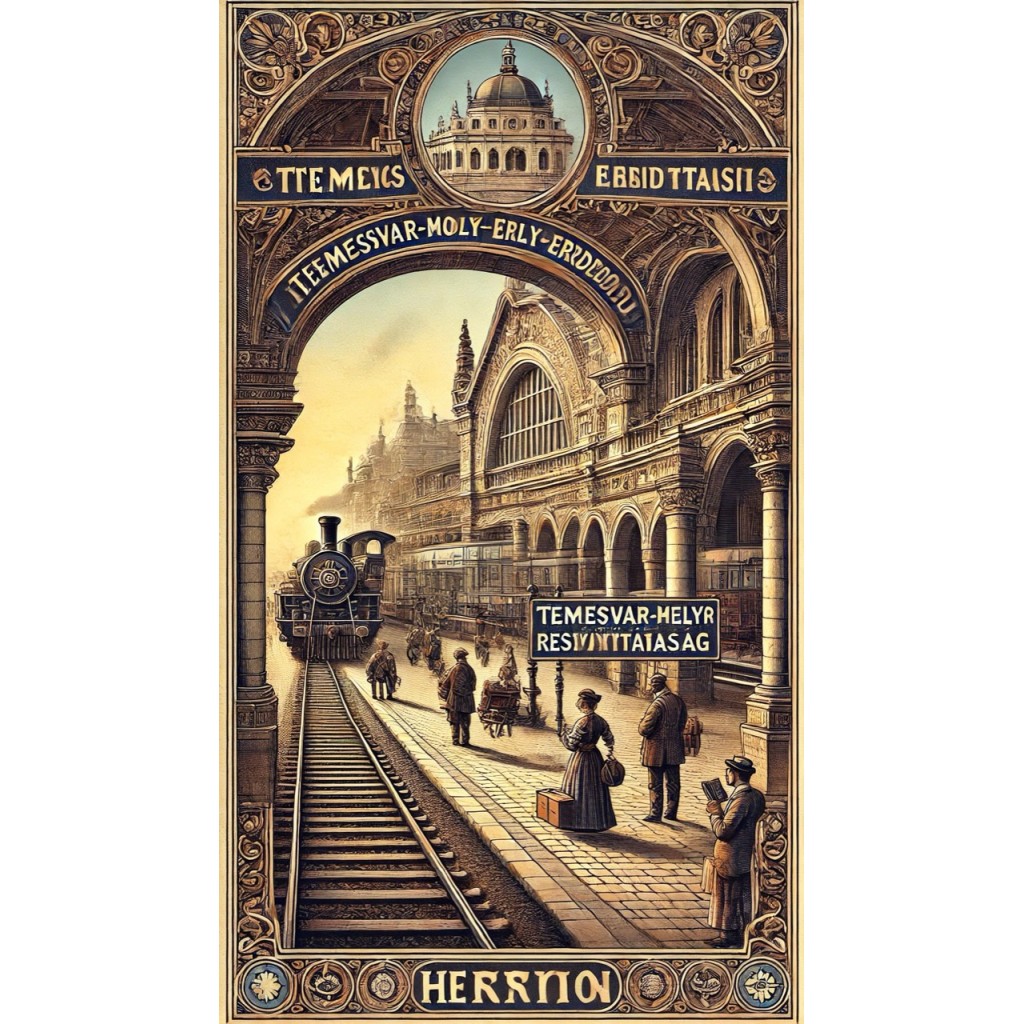
All historical documents for sale are considered collectible. They have no economic or financial value (no economic or financial value), and the images that are not of the historical document are representative of the company's object and the historical period. They are not provided but can be freely downloaded from the website and printed.