Shopping Cart
There are no more items in your cart
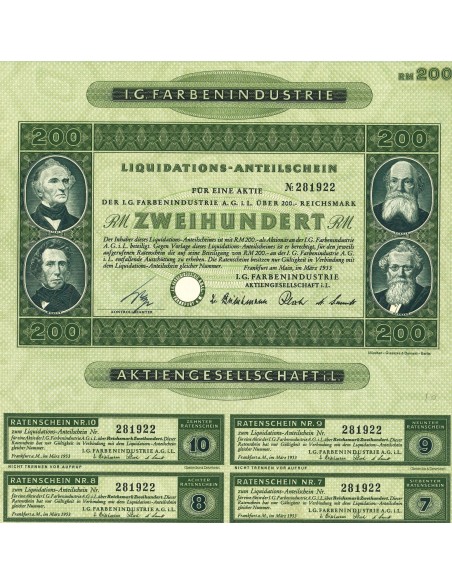
I.G. Farbenindustrie AG, commonly known as IG Farben, was one of the largest and most influential chemical companies in Germany and the world during the first half of the 20th century. Founded in 1925 through the merger of several German chemical companies, IG Farben quickly became an industrial giant with a wide range of chemical products, from dyes to pharmaceuticals, petrochemicals to plastics.
Company History
IG Farben was founded in 1925, with its headquarters in Frankfurt am Main, Germany. The company emerged from the merger of six major German chemical companies: BASF, Bayer, Hoechst, Agfa, Cassella, and Kalle. This conglomerate became the largest chemical producer in the world and played a crucial role in Germany's economy and science.
During World War II, IG Farben played a controversial role, being involved in economic and military activities related to the Nazi regime. This led to the company's dismantling during the Nuremberg Trials after the war and its subsequent division into several independent companies.
Historical Data of the Company
| Year of Foundation | Headquarters | Name at Delisting from Stock Exchange | Year of Listing on Stock Exchange | Year of Delisting from Stock Exchange | Year of Dissolution | Initial Capital | Final Capital | Annual Revenue |
|---|---|---|---|---|---|---|---|---|
| 1925 | Frankfurt am Main, Germany | IG Farbenindustrie AG | 1925 | 1952 | 1952 | 1 billion Reichsmark | Data not available | 2.8 billion Reichsmark (1943) |
Document Characteristics
| Characteristic | Description |
|---|---|
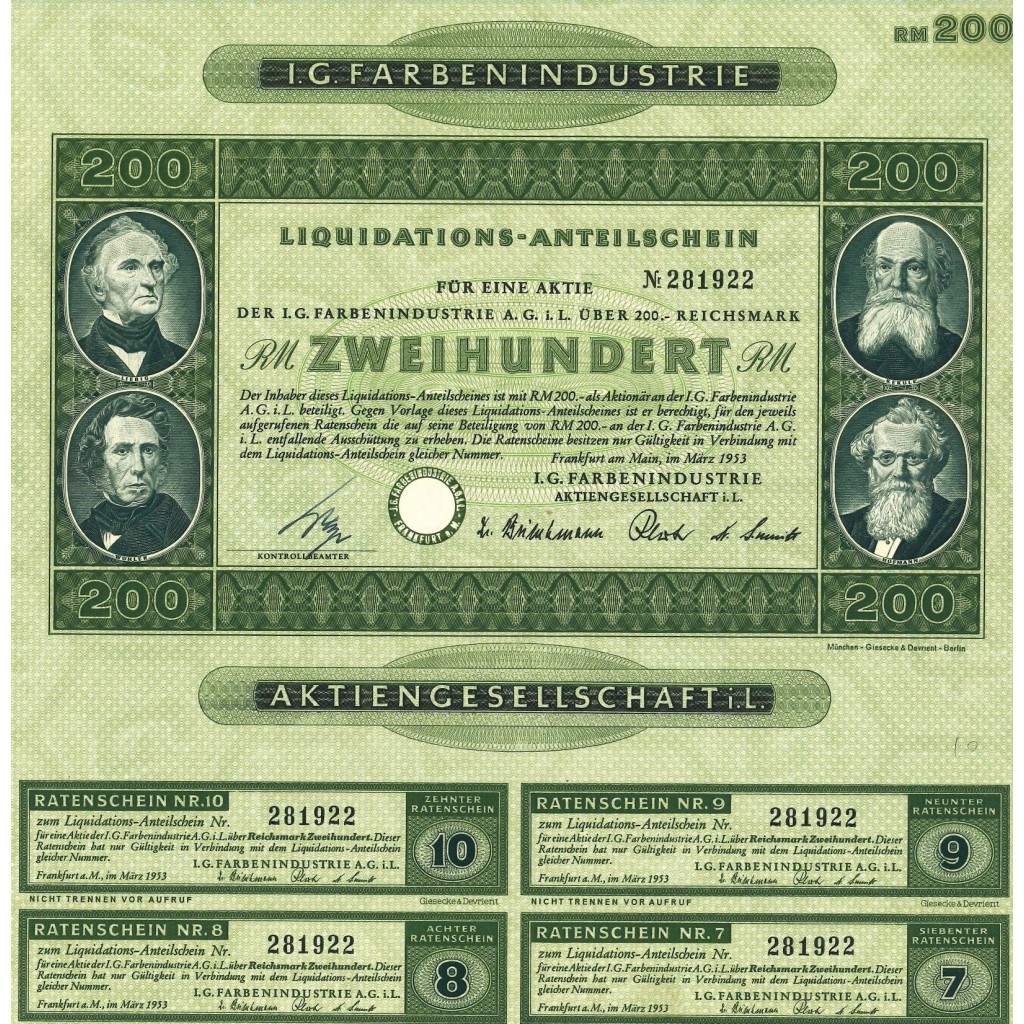
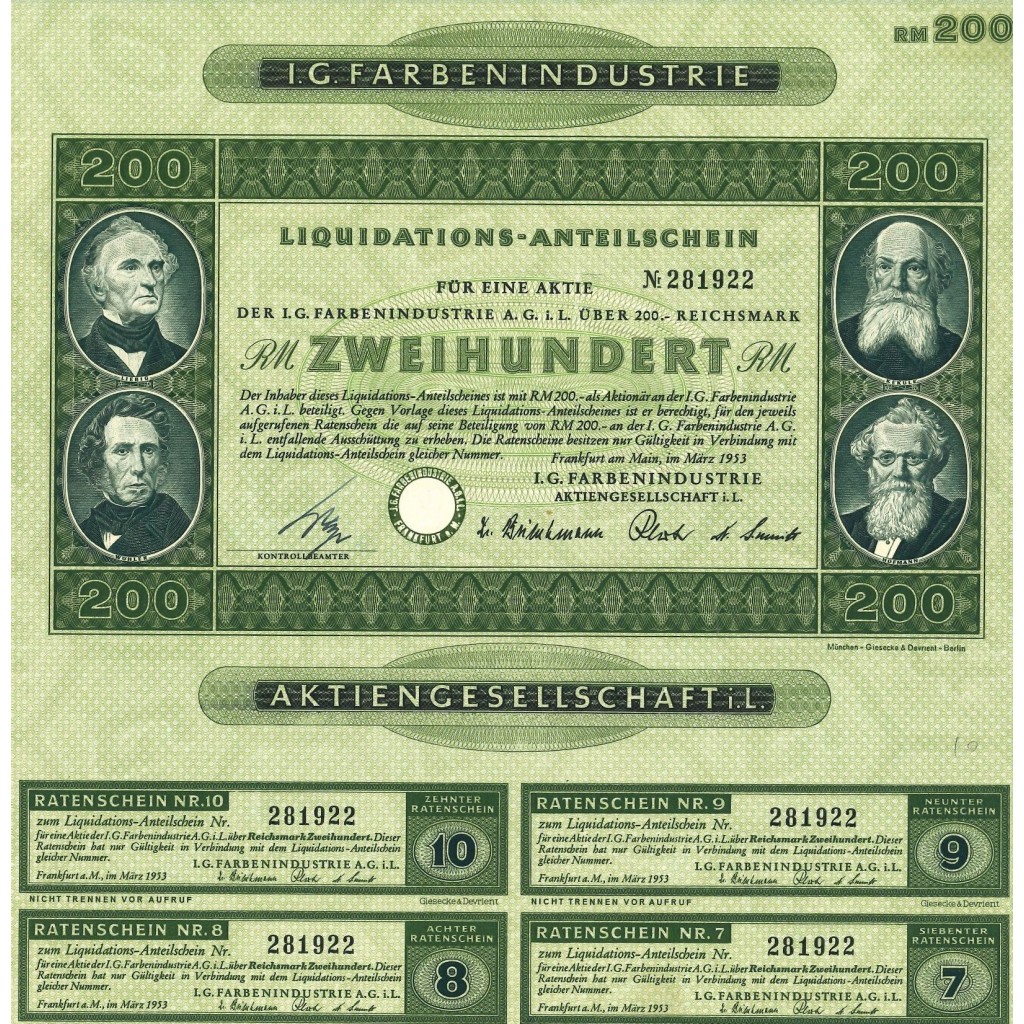
| Title | Liquidations-Anteilschein für eine Aktie |
| Nominal Value | 200 Reichsmark |
| Issue Date | May 1933 |
| Chairman Signature | L. Kohlmann |
| Managing Director Signature | H. von Schnitzler |
| Images | Portraits of historical figures, green layout with intricate details |
Importance for Scripophily Collectors
Scripophily, the collection of historical stocks and bonds, is a fascinating sector for enthusiasts of financial history and for those who appreciate the beauty and symbolic value of stock certificates. Owning a document like the one issued by IG Farben is not only an investment in a piece of corporate history but also an opportunity to possess an artifact that tells the story of industrial chemistry and the complex historical events of the 20th century.
All historical documents for sale are considered collectible. The documents have no economic or financial value (no economic or financial value), the second image is only representative of the object of the reference company.