
Shopping Cart
There are no more items in your cart

The structure boasted many firsts: it was considered by far the largest stadium in Italy and one of the largest in the world ever built, even larger than the contemporary stadiums in Athens and London. In addition to being the first stadium in Turin, it was also the first in Italy to be equipped with an electric lighting system and to be built in reinforced concrete.

The plant occupied a vast area between the current Corso Duca degli Abruzzi, Corso Einaudi, Corso Castelfidardo and Corso Montevecchio, where some residential buildings currently stand, the headquarters of the Polytechnic, that of the "G. Sommeiller" technical institute and of the high school scientific "Galileo Ferraris".
Until the nineteenth century one of the most popular sports activities was the elastic ball which, in Turin as in the major cities of Italy, was practiced in the various spheres. However, towards the end of the nineteenth century football became widespread and Turin was the first city in Italy where distinct sports federations were formed in this new sport imported from Great Britain. Its growing popularity necessitated the presence of adequate spaces and from 1872 the new parade ground, included among the current courses Galileo Ferraris, Einaudi, Castefidardo and Montevecchio, became a favorite place to practice it publicly.
This location existed until the early twentieth century and, together with the "Umberto I" velodrome, was the place where the competitive football of the Piedmontese capital was born.
The genesis of the project and the inauguration
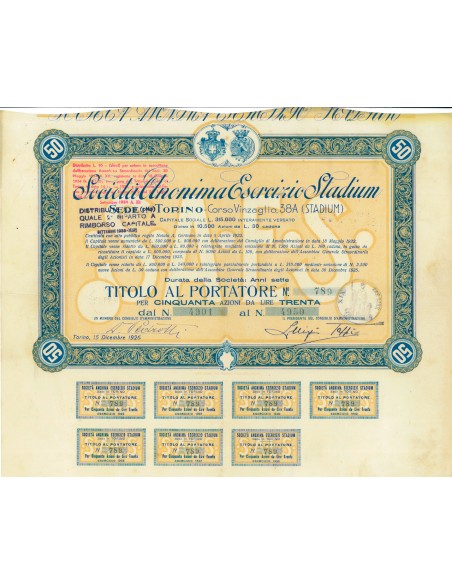
Built in conjunction with the 1911 Turin International Exhibition held at Valentino Park on the occasion of the fiftieth anniversary of the unification of Italy, the Stadium was built entirely with private funds merged into the S.A.E.S. - Società Anonima Esercizio Stadium chaired by the honorable Carlo Compans de Brichanteau de Challant. It stood on an area adjacent to the parade ground and represented the city's first multi-purpose vocational sports facility; the great emphasis with which the project was accepted and the speed with which it was achieved despite the vastness of the structure, earned him the affirmation of "great attraction of the 1911 exhibition".
The construction site was characterized by rapid times and in just ten months the works were completed. The plant was sumptuously inaugurated on April 29, 1911, hosting the evening of honor following the inauguration of the Turin International Exposition, with the representation of a gymnastic essay performed by six thousand students of the municipal schools of Turin, in the presence of the authorities and of King Vittorio Emanuele III.
Designed by architects Vittorio Eugenio Ballatore of Rosana and Carlo Ceppi, in collaboration with engineer Ludovico Gonella, it was built by the Porcheddu Building Company in an eclectic style, with a decorative apparatus inspired by Greek-Roman architecture and allegorical sculptures by Giovan Battista Alloati . The building was characterized by avant-garde solutions: it was one of the earliest examples of widespread use of reinforced concrete according to the "Systéme Hennebique", of which the enterprise of the engineer Giovanni Antonio Porcheddu was the first Italian licensee and passed into history also to be the first stadium in Italy to be equipped with electric lighting; another of his primacies was finally the overall extension of the structure, whose entire area comprised around 100 000 m².
_-_Esposizione_Torino_1911.jpg)
The elliptical structure had impressive dimensions: 361 meters long and 204 meters wide and an internal area of over 73 000 m² The main entrance was marked by two monumental obelisks and was placed on the long side overlooking Corso Vinzaglio but there there were eight other secondary accesses along the entire perimeter. The two hemicycles, divided into ten sectors, hosted a royal box placed on the long side opposite the entrance and tiers on which, every three steps, a row of wooden seats was fixed, for a total of 15 rows. Altogether it could accommodate over 40,000 seats and 30,000 standing and at the top of the stands there was also a covered walkway from which one could admire the panorama of the city and the surrounding Alpine arc.
The central arena, of about 47,000 m², was divided into two equal parts: the first half housed a regular soccer field and an adjacent training ground, the other half was instead equipped to set up an ice rink on ice and also included a swimming pool with a mobile springboard that could be completely emptied and covered. Around the arena there were three concentric tracks: one for athletic competitions, one for horse races and one, the most ex backhoe loader, for cycling races.
Under the bays of the stands there was a large number of rooms that housed the gymnasium used by the Reale Società Ginnastica Torino, several rooms intended for other sports such as fencing, artistic gymnastics, boxing and a series of other rooms: locker rooms, showers, infirmary, a cafeteria with restaurant, buffet rooms, stables, garage, warehouses, technical rooms and even a dormitory for athletes of sports teams with 5 000 beds.
Externally the structure was surrounded by a fenced-in flower bed that ran along the entire perimeter and, on the short side facing Corso Peschiera, there was a large green area that housed tennis courts and bowling greens.
