Shopping Cart
There are no more items in your cart
Title: "The 1869 Prize Loan of the City of Venice: A Historical Bond with Timeless Appeal"
Introduction The document we are examining is a bond issued in 1869 by the City of Venice, authorized by the Italian Government through a Royal Decree. This type of bond was linked to a prize loan, combining the features of a standard bond with the opportunity to win prizes through draws. Such bonds were very popular in the 19th century, as they attracted investors not only with a fixed interest rate but also with the prospect of additional gains through monetary prizes.
Historical Context In 1869, Italy was a relatively young country, having achieved unification only a few years earlier in 1861. Venice, one of the last major Italian cities to be annexed into the Kingdom of Italy in 1866, required funds to develop infrastructure and improve public services. To this end, the Municipality of Venice decided to issue a prize loan to raise capital. This type of loan not only helped finance public works but also incentivized citizens' interest through a system of prizes.
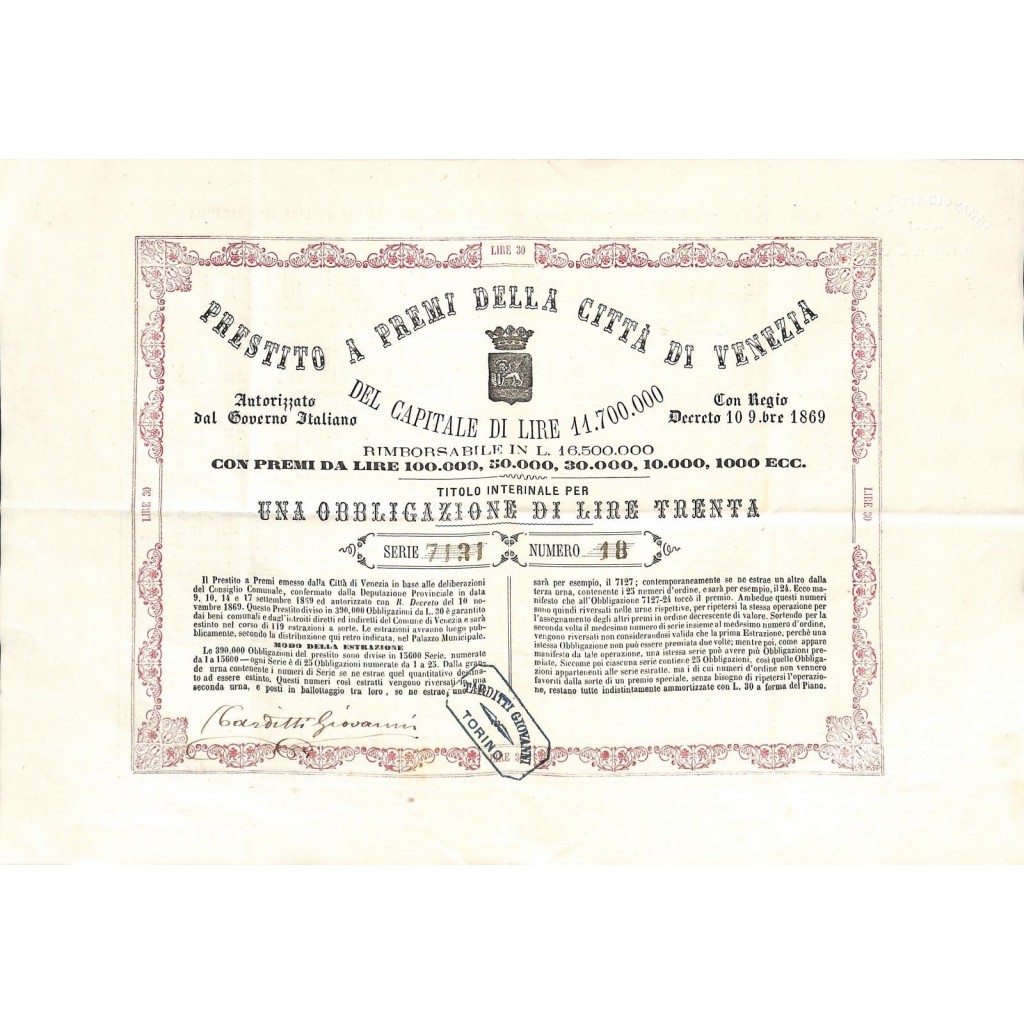
Document Analysis The bond we are analyzing has a nominal value of 30 lire and was issued as part of a total loan of 44,700,000 lire.
The front of the document is adorned with a decorative red border and elegant calligraphy highlighting key details such as the capital, prizes, and repayment terms. The text specifies that the bond was issued under a Royal Decree dated September 10, 1869, and that the capital would be repaid with prizes ranging from 100,000 lire to 1,000 lire.
Functioning of the Prize Loan This bond was part of a series of instruments that, in addition to providing a fixed return, offered the chance to win additional prizes through regular draws. These draws were held annually or semi-annually, providing bondholders with the opportunity to win substantial prizes without forfeiting their capital.
The extraction schedule printed on the reverse side of the document provides detailed information on the draw dates and prize allocation. Between 1869 and 1919, regular drawings were held, with a total of 119 drawings involving various series of bonds. Each drawing took place at the offices of the Municipal Treasury of Venice, under the supervision of local authorities.
The Role of Turin An interesting aspect of the document is the reference to the city of Turin. This suggests that part of the operations related to the loan, such as printing the bonds and organizing the draws, were carried out in collaboration with Turin-based companies specializing in the production of financial documents.
Significance for Collectors Bonds like this represent a fascinating chapter in Italian financial history and are highly sought after by scripophily collectors. The value of such documents lies not only in their financial content but also in their historical significance. They reflect a transitional phase for Venice, as the city integrated into the new Kingdom of Italy and sought to modernize its economic structures.
Examples in good condition, with original signatures and intact details, are particularly prized in the market. This document bears the autograph signature of Cardetti Giovanni, a prominent figure in Venetian financial management at the time, adding further historical and collectible value.
Conclusion This 1869 bond issued by the City of Venice is much more than just a financial document: it is a tangible testament to a period of significant transformation for both the city and Italy as a whole. Through the prize loan, Venice was able to raise the funds needed to support its growth and modernization while also providing citizens with an opportunity for profit and participation in public affairs.