
Shopping Cart
There are no more items in your cart

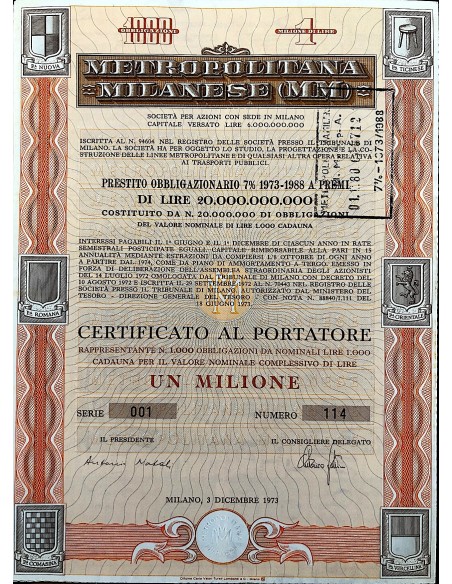
This certificate represents a bond issued by Metropolitana Milanese S.p.A. in 1973. The company, based in Milan, was established with a share capital of 1,500,000,000 lire. The bond is part of a 7% bearer bond loan for the period 1973-1988, with a total value of 20 billion lire divided into 20,000 bonds of 1 million lire each.
Characteristics of the Bond:
- Interest Rate: 7% per annum, payable in two semi-annual installments, on April 1 and October 1 of each year.
- Nominal Value: Each bond has a nominal value of 1 million lire.
- Validity Period: From 1973 to 1988.
- Issuance Date: December 3, 1973.
- Issuing Company: Metropolitana Milanese S.p.A.
- Serial Number: Each certificate is marked with a unique serial number. (Example: Series 001 Number 114)
Design of the Certificate:
- Colors: The certificate features a combination of predominantly brown and gray colors, with golden details.
- Graphic Elements: The document is enriched with elaborate frames and crests, symbols of the city of Milan and the issuing company.
- Stamps and Signatures: There are official stamps and signatures of the President and the Managing Director of the company.
History of the Company:
Metropolitana Milanese S.p.A. was established to design, build, and manage the metro lines of Milan. The company has played a fundamental role in the infrastructural development of the city, significantly contributing to the improvement of urban public transportation.
The Milan Metro (Italian: Metropolitana di Milano) is the rapid transit system serving Milan, Italy, operated by Azienda Trasporti Milanesi. The network consists of 4 lines, identified by different numbers and colours, with a total network length of 96.8 kilometres (60.1 mi), and a total of 106 stations, mostly underground.[1] It has a daily ridership of about 1.4 million on weekdays.
The first line, Line 1, opened in 1964; Line 2 opened 5 years later in 1969,[6] Line 3 in 1990, and Line 5 in 2013.[9] A fifth line, Line 4, is currently under construction. The Milan Metro is currently the largest system in Italy for length, number of stations and ridership.
The architectural project, by Franco Albini, Franca Helg and Bob Noorda, was awarded in 1964 with a Compasso
History
The first project for the network in 1952.
The first projects for a subway line in Milan were drawn up in 1914 and 1925, following the examples of underground transport networks in other European cities like London and Paris. Planning proceeded in 1938 for the construction of a system of 7 lines, but this too halted after the start of World War II and due to lack of funds.
On 3 July 1952 the city administration voted for a project of a metro system[11] and on 6 October 1955 a new company, Metropolitana Milanese, was created to manage the construction of the new infrastructure.[10] The project was funded with ₤ 500 million from the municipality and the rest from a loan. The construction site of the first line was opened in
The first section from Lotto to Sesto Marelli (21 stations) was opened on 1 November 1964, after 7 years of construction works. The track was 12.5 km (7.8 mi) long, and the mean distance between the stations was 590 m (1,940 ft).[12] In the same year, in April, works on the second line started. Passengers on the network grew constantly through the first years of service, passing from 37,092,315 in 1965 to 61,937,192 in 1969.
The green line from Caiazzo to Cascina Gobba (7 stations) opened five years later. During the 1960s and
The first section of the third line (yellow), with 5 stations, was opened on 3 May 1990 after almost 9 years of construction works. The line opened just before the World Cup. The other 9 stations on Line 3 opened to the southeast in 1991, and northwest to Maciachini Station in 2004.
In March 2005 the Line 2 Abbiategrasso station (
The first stage of
The metro replaced several interurban

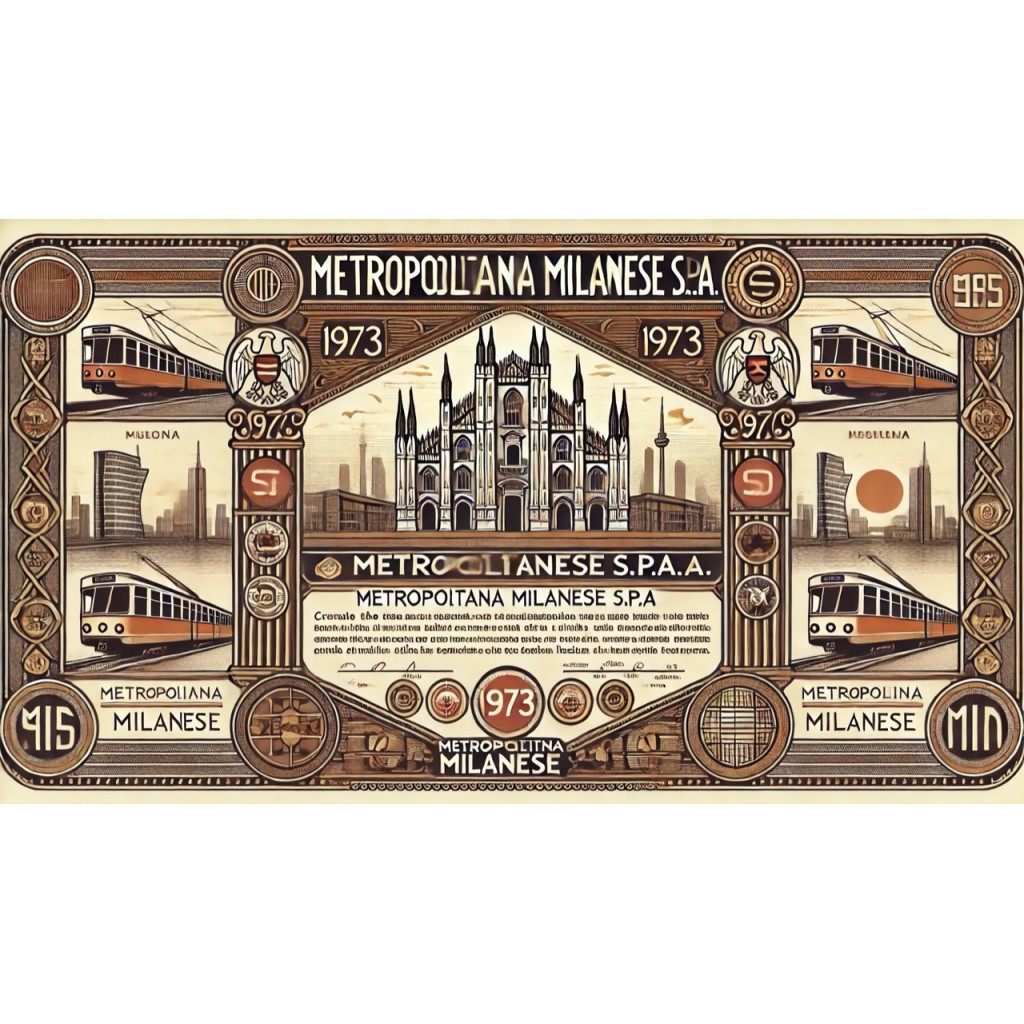
image representing the history of Metropolitana Milanese S.p.A.

